
In 2020, Dr. Corina Ciocan and her team at the University of Brighton made a startling discovery: dust from abandoned and sanded fiberglass boats contained poly diallyl phthalate (PDP), a resin material used widely in glass-reinforced plastic (GRP) boatbuilding. When juvenile mussels (Mytilus edulis) and water fleas (Daphnia magna) were exposed to this GRP dust, particles lodged in their tissues and appendages, triggering inflammation, impaired swimming, and mass sinking within hours (Ciocan et al., 2020). The implication was clear: GRP isn’t just a waste problem but also living contaminant that can enter the food chain.
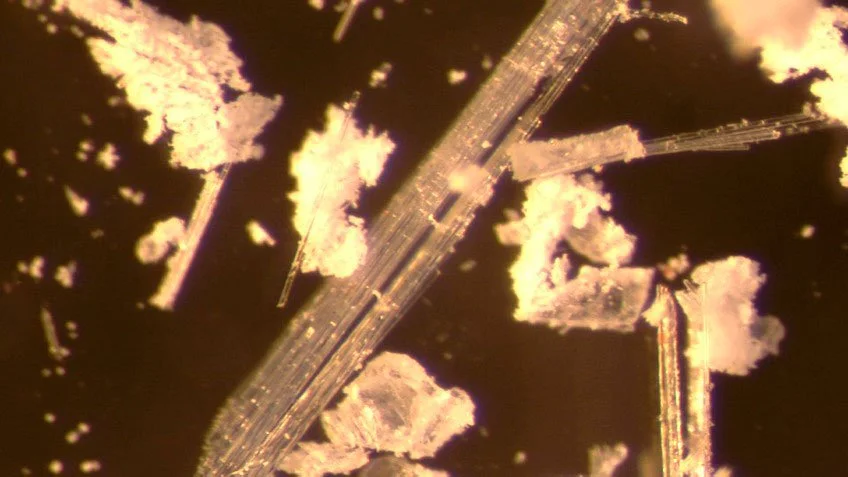
Resin and GRP particles found in samples collected by Dr. Corina Ciocan and her team in Chichester Harbour.
Fast forward to 2025, and the human health connection is becoming harder to ignore. A new global study in The Lancet estimates that exposure to di-2-ethylhexyl phthalate (DEHP)—one of the most widely used phthalates in plastics—was responsible for 356,238 cardiovascular deaths worldwide in 2018. That’s nearly 13.5% of all heart-related deaths among people aged 55–64. In total, DEHP exposure led to over 10 million years of life lost in just one year (Hyman et al., 2025).
These numbers tell us that phthalates are not an abstract toxicology problem—they are a global cardiovascular risk factor, comparable to smoking or air pollution. They disrupt metabolism, accelerate atherosclerosis, and increase oxidative stress, ultimately burdening the heart and blood vessels (Hyman et al., 2025).

Abandoned and derelict boats on the low tide in the Goyen River, Audierne, Brittany (France) rest besides oysters, mussels and cockles. Locals collect shellfish to eat from this very location. Photo: Angie Richard/Floating Stories Lab.

Mussels growing in the Goyen River, Audierne, Brittany (France), adjacent clusters of derelict and abandoned boats. Photo: Angie Richard/Floating Stories Lab.
And here’s the connection that brings this story home for coastal communities: phthalates leach not only from single-use plastics, but also from the hulls of GRP boats that dominate today’s marine landscape. Cutting, sanding, repairing, or abandoning these boats releases microplastics and glass fibers bound with phthalate resins into the water and air (Ciocan et al., 2020). Mussels and oysters near boatyards have already shown contamination with thousands of glass fibers per kilo of flesh in preliminary surveys. Those shellfish are part of our food web.
For boatbuilders, repair workers, and boat owners, the issue is both an ecological one and an occupational health one. Inhalation of fiberglass dusts from GRP processing has been shown to cause lung inflammation and obstructive syndromes in exposed workers (Abbate et al., 2006), with additional case reports linking long-term exposure to fibrosis and possible cancer risks (Takahashi et al., 1996; Riboldi et al., 1999).
At Floating Stories Lab, we believe that linking these dots is essential for re-imagining a fairer and safer marine culture. The evidence from Ciocan’s lab and the latest global burden analysis speaks to the same truth: plastics and their additives, including phthalates, are reshaping life and death in our oceans and in our bodies.
Through our Regenerative Tides citizen science initiative in Brittany, we are mapping abandoned fiberglass boats, training school students and teachers to detect microfiberglass in local waters, and co-creating stories that bring science into public view. By doing so, we aim to connect the health of marine ecosystems with the health of coastal communities—and advocate for a more transparent disposal systems, improvements in boatbuilding practices, and global accountability for the toxic legacies of plastic.
The impact on our aquatic ecosystems and organisms is not disconnected from what happens in a humans. The science is telling us that the tide must turn.
