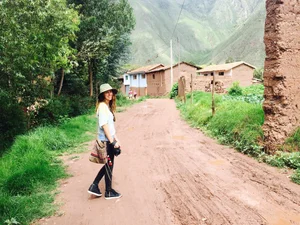
There is a mystique that seems synonymous with travel stories about Colombia. Fear, darkness and Narcos fanfare too often clouds this beautiful country, but beneath her shadowy past lies a fascinating land whose people are deeply connected with Pacha Mama, Mother Nature; raw beauty, abundant flora and fauna, contrasting landscapes and coconuts.

©Angie Richard
Colombia, along with many other countries around the world, always held a special place in my heart. With my burning desire to explore the many diverse offerings of our planet, I decided to sell up all that we owned and purchased one-way tickets for Colombia – a decision that was met with mixed response from my family and friends. I felt that my sons, aged seven and five, could do with some life education. Together, we traversed half the globe on five flights to begin our epic journey. The long-haul effort to reach northern South America is enough to put off any travelling family, let alone a single mother with two energetic boys, but there’s a saying around action sports communities that says: “You have to risk it for the biscuit.” The vegan cookies and crisp mountain air of our friends’ luxurious villa in La Mesa de Los Santos in the outskirts of Bucaramanga, one of Colombia’s safer and spectacular mountainous cities, sure did make the jet lag well worth the struggle.
La Mesa de Los Santos
Our first Colombian adventure found us in La Mesa de Los Santos - The Table of the Saints. A rural area used for agricultural farming, La Mesa is an hour’s drive from Santander’s capital, Bucaramanga, making it a popular weekend retreat destination for wealthy city dwellers.
Our local friends took us to their private villa, an elegantly modern two-story home offering uninterrupted views over the vast and dramatic Chicamocha Canyon. Standing on the edge of rocky ridges and looking out over the seemingly infinite canyon certainly halts all sense of time and space. With every day that I spent in La Mesa, I felt intrinsically connected to Mother Nature’s divine supremeness.
Alarm clocks were replaced each morning with the sun’s illuminating rays spearing through low-hanging clouds that would, at times, engulf the entire villa; waking up in the clouds is a rare and thus immensely spiritual way to begin your days.
We visited local organic farms and stocked up on local produce to take back to the city. Avocados as big as a small child, moringa, corn, bananas, cucumbers, and a great variety of leafy greens were just some of the gems on offer. The kids were in their element getting up close and personal with the farm’s animal families; we are a plant powered family and since all switching to a vegan diet almost a year ago, the boys’ compassion for animals has grown profoundly.

©Angie Richard
The highlight of La Mesa was a beautiful visit to a dramatic cliff top hostel called Refugio la Roca, The Rock Shelter. The concept was designed around the natural habitat, and the hostel is a spectacular representation of sustainable tourism. Popular with climbers due to its natural rockwall-climbing park, the hostel was surprisingly busy, although our peace was well maintained. I’ve had an affinity with mountains since my early childhood years when I’d go on treks with my father. I’d developed a relationship with the earth’s core that I hadn’t quite come to understand, nor appreciate, until recent years. I’m particularly drawn to raw, barren, and rocky landscapes with flora that’s able to endure harsh conditions, a metaphor, perhaps, for my own personal life experience.
Our room was a cosy rammed earth hut, built into the cliff face and hugged most mornings by low-settling clouds. A rope was provided to traverse down to the mini bar and meditation area bringing the rock-climbing theme to play inside our room.
Glass windows wrapped around the side and base of our bed which offered sprawling views of the canyon. Each morning, we were greeted with a sunrise incomparable to any that I’ve ever seen in my life. After taking some time to soak up the morning rays, I popped atop our hut, where the roof doubled as an infinity yoga platform, and practiced asanas – quite literally on the edge of the world.
Tayrona National Park

©Angie Richard
The Sierra Nevada de Santa Marta is one of the world’s highest coastal mountain ranges. This isolated mountain range is separated from the Andes chain that runs within Colombia and reaches an altitude of 5,700 metres, despite its location just 42 kilometres from the Caribbean coast. Her foothills sink into the Caribbean Sea, forming bays and coves of an exceptional beauty and rich diversity that feature as part of the protected area known as Parque Nacional Natural Tayrona, or Tayrona National Natural Park.
Sprawling some 30 square kilometres of maritime area in the Caribbean Sea, and approximately 150 square kilometres of land, the Tayrona Park is the second most visited national park in Colombia. Established in 1964, the park, with its sandy white beaches fringed by rocky atolls, mangroves and forests, was created in order to preserve and share its unique biodiversity and maintain the culture of its indigenous inhabitants.
While we only spent two days in the park, you could easily get blissfully lost in there for a week, or longer. Tayrona offers an immense variety of flora and fauna, a result of two ecosystems that produce a variety of climates and geography ranging from arid sea level to 900 metres above sea level, producing vegetation as varied as tropical dry forest to coral reefs.
Wildlife is abundant within the park, including red howler and titi monkeys, red woodpeckers, iguanas, a variety of lizards, snakes, tropical marine life and more than 400 species of birds. We were treated to our first glimpse of a crocodile floating stealthily in a lagoon fringing the beach shortly after we dismounted from our rides, affirming pre-entry warnings about not swimming in any rivers within the park.
We rose early the next morning, scoping out a private rock face to perch on for ocean observations and a few yoga poses. With the sun warming our bodies swiftly, we decided to skip breakfast, ditch the crowds and head inland in search of an archaeological site we’d heard was a short trek away. What started as a stroll soon turned into quite a radical trekking adventure. After multiple hours, we finally reached the Pueblito Chairama Ruins, where now only a small family lives atop ancient historical grounds deep within Tayrona Park.
We had been out of water for hours when we suddenly stumbled upon a hostel in a mandarin plantation. A young native girl from the plantation sold us freshly-squeezed ice-cold mandarin juice – a gift from the heavens which saved us from the cusp of dehydration. After some 10 hours trekking, we finally popped out of the park and onto the main road, and as we rode a local bus back to our waiting car the kids proclaimed how much they loved travelling by foot as they were able to ‘see everything so close’; touché.

©Angie Richard
Minca
Driving out of Tayrona was a weird feeling; we were grateful to rest our swollen feet but felt an urge to remain entrenched outdoors. Following the flow of a local connection, we made our way to a family-owned permaculture and yoga retreat called Sol de Minca. Perched high in the jungle with expansive views over dense verdant mountains, the buzzing city of Santa Marta flickered aggressively in stark contrast by the coast in the distance. That night, we enjoyed a delicious meal of vegan tacos, made with love by Viviana and her family, as we exchanged like-minded discourse around a campfire. Retiring to our tent, we added to our mental star-gazing bank of the sparkling night sky gems. The next morning, we woke early and joined a small group of locals for Viviana’s morning yoga session on the main balcony space before sitting down to a full vegan spread of breakfast delights.
Viviana’s family home was a labour of love; the family were all involved in educating themselves in bio-construction and ecology, with close consultancy of local indigenous elders to ensure the sacred spirit of the land was left unharmed and respected. The result is a wondrous natural healing centre that we simply couldn’t leave after just one night and extended our stay a few days.
On our last day, Viviana shared with us her yoga-retreat-in-progress, a wooden structure hidden on the other side of the property. A rootsy project based on simplicity, spirituality and deep connection with self, Viviana hopes to open the retreat later this year and is particularly passionate about hosting programs for women who are victims of abuse – a subject close to my heart following my own 10-year marriage rife with domestic violence.
Like too many women, Mother Earth has been used and abused in this part of the world, and recently the four native tribes of the Sierra Nevada de Santa Marta region came together to work with native filmmakers to record messages speaking out against the destruction of Pacha Mama particularly at the hands of the coal mining industry, over development, and abuse of the coca plant.
It is the hope of Viviana and her family that by purchasing native land and working together with local tribes, they can contribute in a positive and sustainable way and even return some of the area’s natural aspects back to their original, prosperous states. No doubt the healing of abused women is intricately connected with the fate of Pacha Mama moving forward, here in Colombia and all over the world.
Sapzurro
Next, we decided to join our extended Colombian family on a wild journey out to the most remote jungle region of the country’s coast, a tiny slice of Caribbean paradise known as Sapzurro.
We started our adventure from the mainland coastal village Necocli, hauling up for the night in a refreshing local hotel owned by our adopted Colombian father Fercho Silva, the Hotel Palma Real. The next morning, we were bouncing in a jet boat over the Caribbean Sea, taking a detour through lush mangroves before embarking across to Sapzurro, into ‘La Frontera’, literally ‘the border’, with Panama.
After an arduous journey, relief was quickly found with fresh coconuts harvested by our Caribbean caretaker, and the afternoon was spent lazing around in hammocks and frolicking in the tepid sea.
The pace of erosion that the village has seen in recent years surprised me; concrete blocks from old piers had fallen into the sea in many parts of the island and had even begun to form mini artificial reefs with small waves peeling into the shore.

©Angie Richard
The small fronting bay is a haven for visiting yachts, and each evening as the sun set, the few local businesses would pump their Caribbean beats and the
New Year’s vibe filled our beach house until the night hours. We took a visit to the palm-fringed Panama coast, a short yet steep walk up a flight of concrete steps to a high-point lookout military post where passports were checked, and entry granted to the ‘other side’. Snorkelling and beer drinking seemed to be the primary attractions of the Panama side, along with a duty-free store selling cheap alcohol for American dollars. We spent a few fun hours jetty jumping off the pier into the turquoise water, before returning by another brutal boat crossing back to Sapzurro.
Our time in Colombia came to an all-too-soon end upon the expiry of our three-month visas. We packed so much more into our holiday than can be shared on these pages. As we swayed our way back to the airport to set out for our next destination, Japan, I knew in my heart I was not done with Colombia and cannot wait to return some day.
If Colombia has been on your radar but you have been holding out due to fear, I’ll leave you with the wise words of Mark Twain: “Twenty years from now you will be more disappointed by the things you didn’t do than by the ones you did do. So throw off the bowlines, sail away from the safe harbour. Catch the trade winds in your sails. Explore. Dream. Discover.”
Further Resources
Refugio la Roca, Santander, Colombia. An ecological reserve popular with respectful local rock climbers and travelers alike, with simple-yet-inspiring accommodation built around the local ecosystem with minimal disturbance.
Sol de Minca, Santa Marta, Colombia. A family-owned permaculture, bio-construction and yoga retreat in lush, regenerated lands surrounding Santa Marta.
Tayrona National Park, Santa Marta, Colombia. Located at the foothills of the Sierra Nevada de Santa Marta, the highest coastal mountain in the world, along Colombia’s Caribbean Sea coast, this national park is a Colombian treasure. Walking, horse riding, camping (tents or hammocks) and archeological ruins are among the highlights. Each year, the park closes for roughly a month for its indigenous custodians to conduct their sacred ceremonies.
*Originally published in Australian Natural Health Magazine in 2016. Download the original (PDF).