
Originally published in FSL’s Substack Newsletter: https://voyagevirage.substack.com/p/new-milestones
Hi folks,
It’s pre-dawn on Monday morning and I am honestly thrilled to sit down and write this newsletter over a cup of hot ginger and lemon tea. We have new milestones to share:
Thanks to local help we got the starboard hull backbone and bulkheads up on Saturday, and celebrated by hosting a small, local ‘open boatyard’ gathering on Sunday afternoon.
We have published our first major report on the current state of the end-of-life boat crisis.
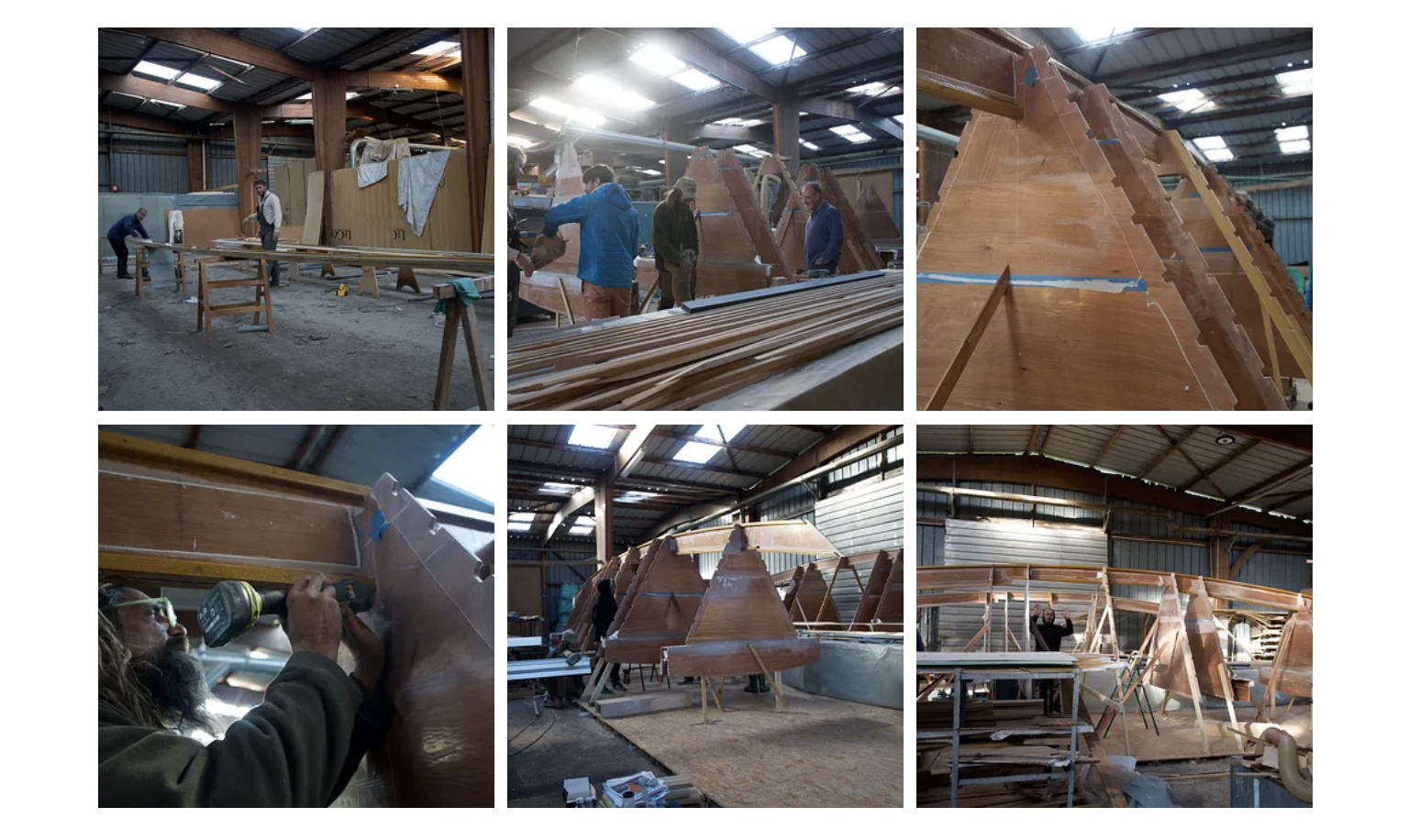
Our team of volunteers gathered on a Saturday morning to help raise the starboard hull.
We gathered a small crew of local help early on Saturday morning and dove straight in to erecting the starboard hull backbone. Remy had already set up the bulkheads the previous weekend so it was just a matter of lifting the heavy backbone and slotting it in. Always simple in theory, but as we’re learning with boat building, nothing every goes entirely to plan.
The trouble we experienced with the port hull, where two bulkheads were ultimately cut too high, would not bother us with the second hull as Remy had already repaired these on both sides (see our newly released video below), but, we had forgotten about a couple of other bulkheads that needed a little extension in their slots to fit snug. Nothing major, just a quick snip with Robert’s multi tool and then the backbone sank in to her new home.
To celebrate this milestone of having both hulls now looking somewhat like a 12-metre catamaran, we invited some of our local friends and volunteers over for a drink on Sunday afternoon. It was lovely to share the build so far and might just be the motivation we needed to settle in to the long list of build projects coming up over the winter months ahead of finishing the hulls and turning them by Spring/Summer to start working on the interior.
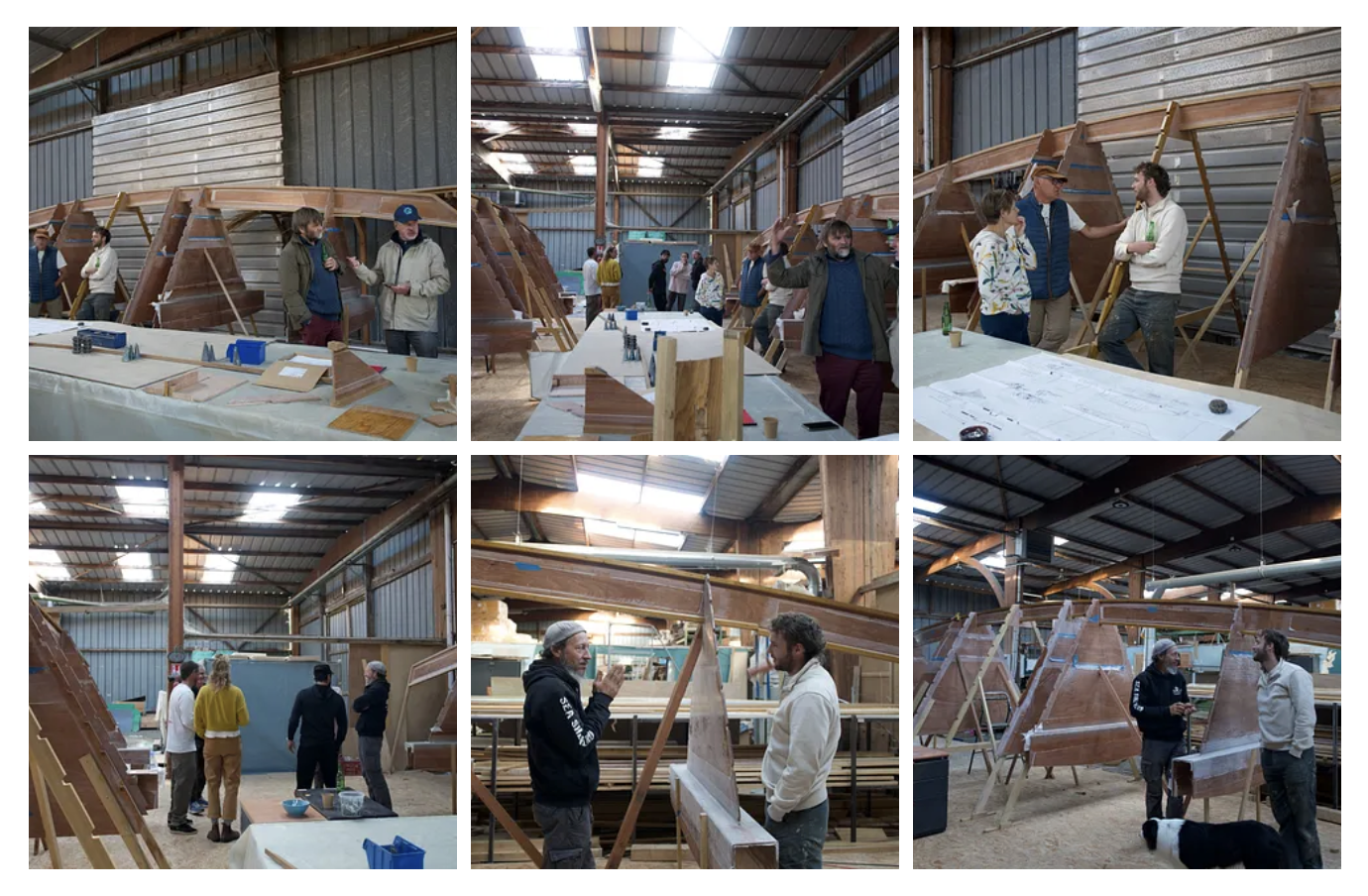
Gathering our neighbors and local volunteers to raise a glass in celebration of having both hulls now erected.
We are furiously fundraising now to support the next phase of the build. Please consider becoming a member directly via our website/upgrading your Substack subscription. You can also give a one-time donation to help fund materials, tools, and coffee.
Old boats, new plans
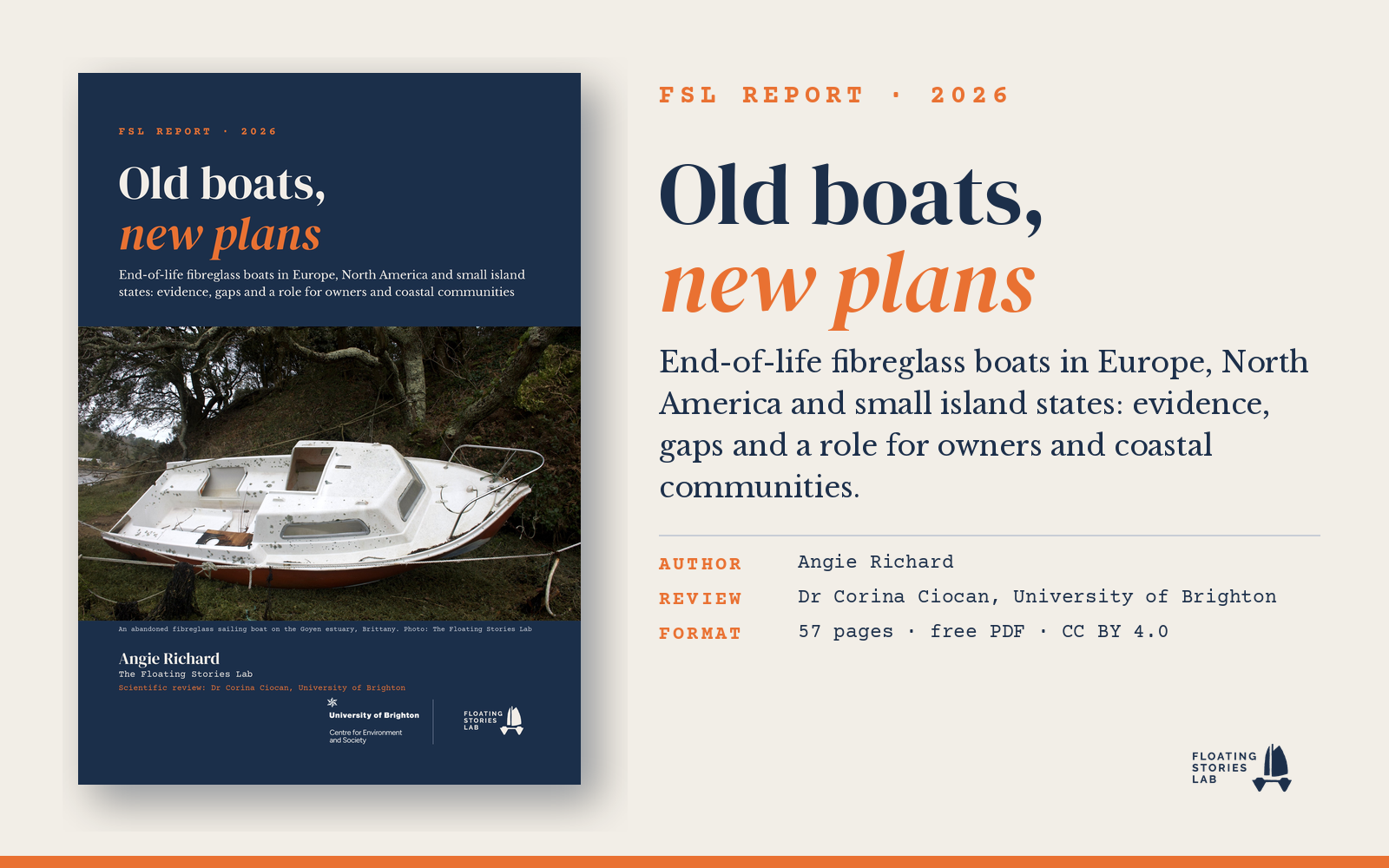
At low tide on the Goyen Estuary, minutes down the road from FSL’s boat yard, old boats rot in the mud while locals collect shellfish, seals bask in the sun, and herons perch above oyster leases.
This scene paints the picture for “Old boats, new plans”, our new report on end-of-life fibreglass boats in association with the University of Brighton's Centre for Environment and Society. It’s freshly published and free to download.
The boats built in the boom years of the 1970s to 1990s are reaching the end of their lives, and no country yet deals with them well:
→ The EU has about six million recreational boats, 95% of them fibreglass. An estimated 60,000 to 120,000 reach the end of their lives each year.
→ Every boat has a last owner. When a boat is worth less than the cost of disposal, the bill lands on whoever holds it last, and then on the public. In the US, removal often costs more than US$24,000 a boat, and Cornwall expects to spend £165,000 clearing wrecks from Truro and Penryn waters.
→ Fibreglass is reaching shellfish. Researchers at the University of Brighton have found up to 11,220 glass fragments per kilogram in wild oysters in Chichester Harbour.
→ Of the 90 boats on our own citizen-science map, half are fully or partly submerged and a third lie beside oyster reefs.
→ Technology is a last resort, not a plan. A 2025 review puts refusing, rethinking ownership (such as sharing) and reducing at the top of the waste hierarchy, and places today’s recycling routes for hulls among the options to phase out.
→ Even France’s producer-pays scheme can’t keep up: almost four new boats were placed on the market for every one dismantled between 2019 and 2024.
Levies, registration and recycling are regularly proposed as solutions, but they leave gaps: knowing where the boats are, paying for the “last mile” of transport and legal steps, establishing ownership, counting impacts in the water, involving the people who live beside the wrecks, and an economy that depends on selling new boats, in which sharing, repair and keeping boats in use earn little.
Thank you to Corina ciocan for her scientific review, and to Practical Sailor and Roxanne Darrow (an abridged version of the report is coming soon in the magazine). Thank you also to every citizen scientist, student and volunteer who has walked shorelines or trudged through mud to map a bad boat.
The report is now being submitted to repositories and shared with industry, universities, government, community members, and wider ocean and marine stakeholders.
United Nations Ocean Symposium
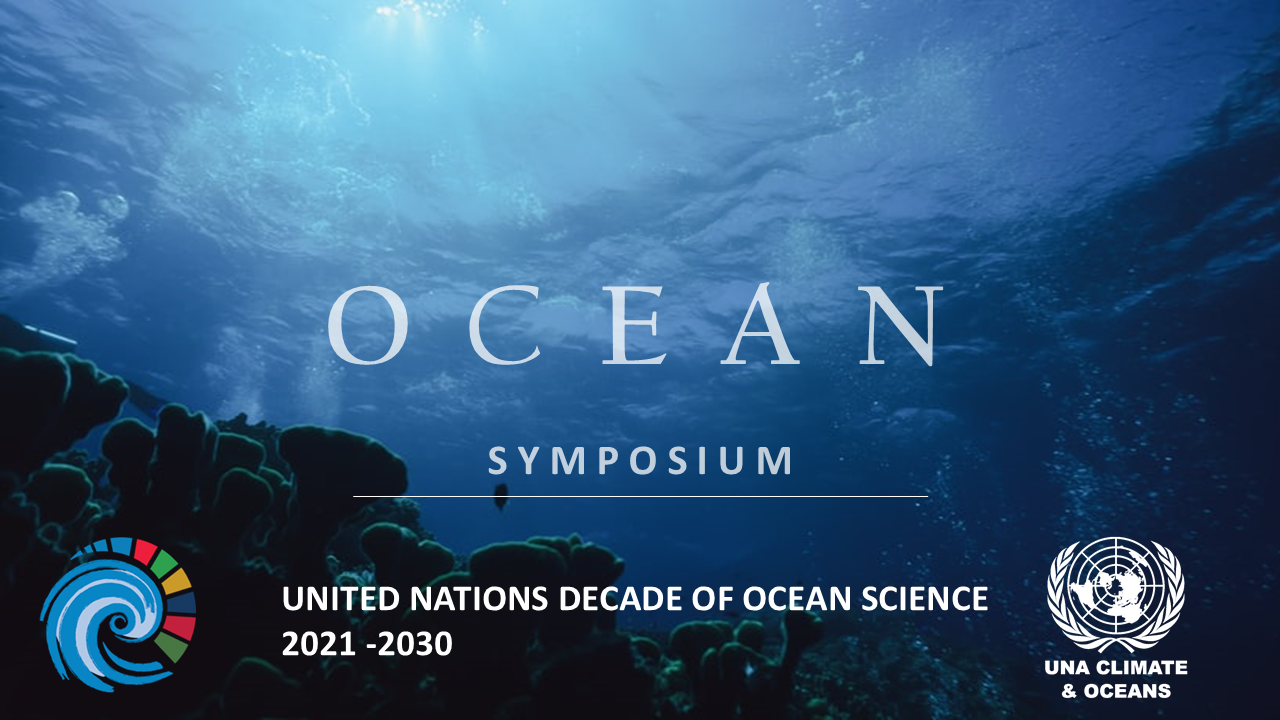
Event date: Saturday, November 14 • 10 AM - 4 PM. Register HERE.
Our roving art x science exhibition ‘The Table of Curiosity’ voyages to Bex Hill in England next month to feature at the UN Ocean Symposium and Marine Exhibition. Angie will join Dr. Corina Ciocan in presenting our collaborative work and findings from FSL’s ongoing citizen science initiative, Regenerative Tides: Sailing for Solutions (ReTISS), which earlier this year received UN Ocean Decade Action status.
High level speakers, marine artists and the wider marine community with gather for the day around the theme:
“Reimagine: Beyond the World We Know, a New Relationship with our Ocean”
Join us and connect with fellow ocean enthusiasts and experts as we discuss conservation, marine life, and the importance of protecting our oceans for future generations. There will be expert Speakers, a showcase of short underwater inspirational films as well as exhibitions and stalls. Sea, River Pollution and Citizen Science will be high on the agenda during the day. Marine Technology will also be a central part of this event.
Event Details
Where? St. Peter’s Parish Community CentreBexhill, England
When? Saturday, November 14 • 10 AM - 4 PM
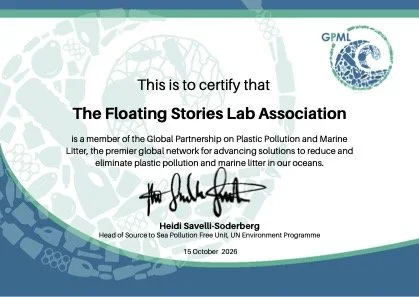
We are also proud to share that the Floating Stories Lab Association is now an official member of the Global Partnership on Plastic Pollution and Marine Litter, a multi-stakeholder partnership that brings together all actors working to prevent plastic pollution and marine litter. By providing a unique global platform to share knowledge and experience, partners collaborate to create and advance solutions to this pressing global issue.
Finally, our new snail mail letter and postcard set ‘SLOW Footprints Snapshot’ ships at the end of October to members in our 50€ and 150€ tiers. Join today and keep an eye on the post!

Thank you, as always, for being here. The Floating Stories Lab is dedicated to creating ocean experiences, science and stories more accessible, with a goal of collaborating together to create regenerative futures for all. As the saying goes, hope is a verb with the sleeves rolled up. We truly could not do this work without your support — thank you!
Angie & Remy
