
Date of sail: October 28, 2022
Sailors: Angie, Remy
Skipper: Dominique
Vessel: Aracati, 9.14m Beneteau First 310
Weather Conditions
Sunshine level: cloudy 85% cloud cover
Rain forecast: none
Temperature: 24°C
Wind speed and direction: 5 – 12 knots, cross/onshore SSW -207°
Height and Swell Direction: 1.4m, 14s period, E 87°
Visibility at sea: Good, more than 5nm
Tides
Standard Port Pointe de Grave Boucau
Low Tide: 12:37pm
High Tide: 19:13pm
Tide Coefficient: 74
Departure: Port d’Anglet, 10:30am
Arrival: Port d’Anglet 16:00pm
Total time at sea: 5hours 30minutes
Before departure knowledge
We learned how to release the two bow lines that would be left on the dock, and how to release the stern line (or backspring), as well as how to attach them to the dock and boat cleats again upon return. We were also reminded to bring the fenders inside the lifelines once we had got into the channel but only to put them away in the lockers once we were clear of the channel and out to sea. This is a safety precaution in case we ran into any incidents where we’d need to use the fenders swiftly.
The voyage
We departed from the Port d’Anglet under motor, pointed the bow into the wind and hoisted the mainsail, then motor-sailed through the turbulent channel that marks the exit/entrance of busy channel where the Riviere L’Adour meets the Atlantic Ocean. The current and wind were at odds and combined with the swell rolling into the channel our instructor Dominique had to increase our engine speed to safely navigate us out into the open ocean.
Having previously sailed on a slightly bigger vessel with our previous private instructor Damien, this was our first time on Aracati and our debut navigating with a tiller (our previous learning vessel had a wheel). It took a little bit of time to get used to the different sensation of the tiller, which ultimately feels the movements much more sensitively and is far more responsive than a wheel.
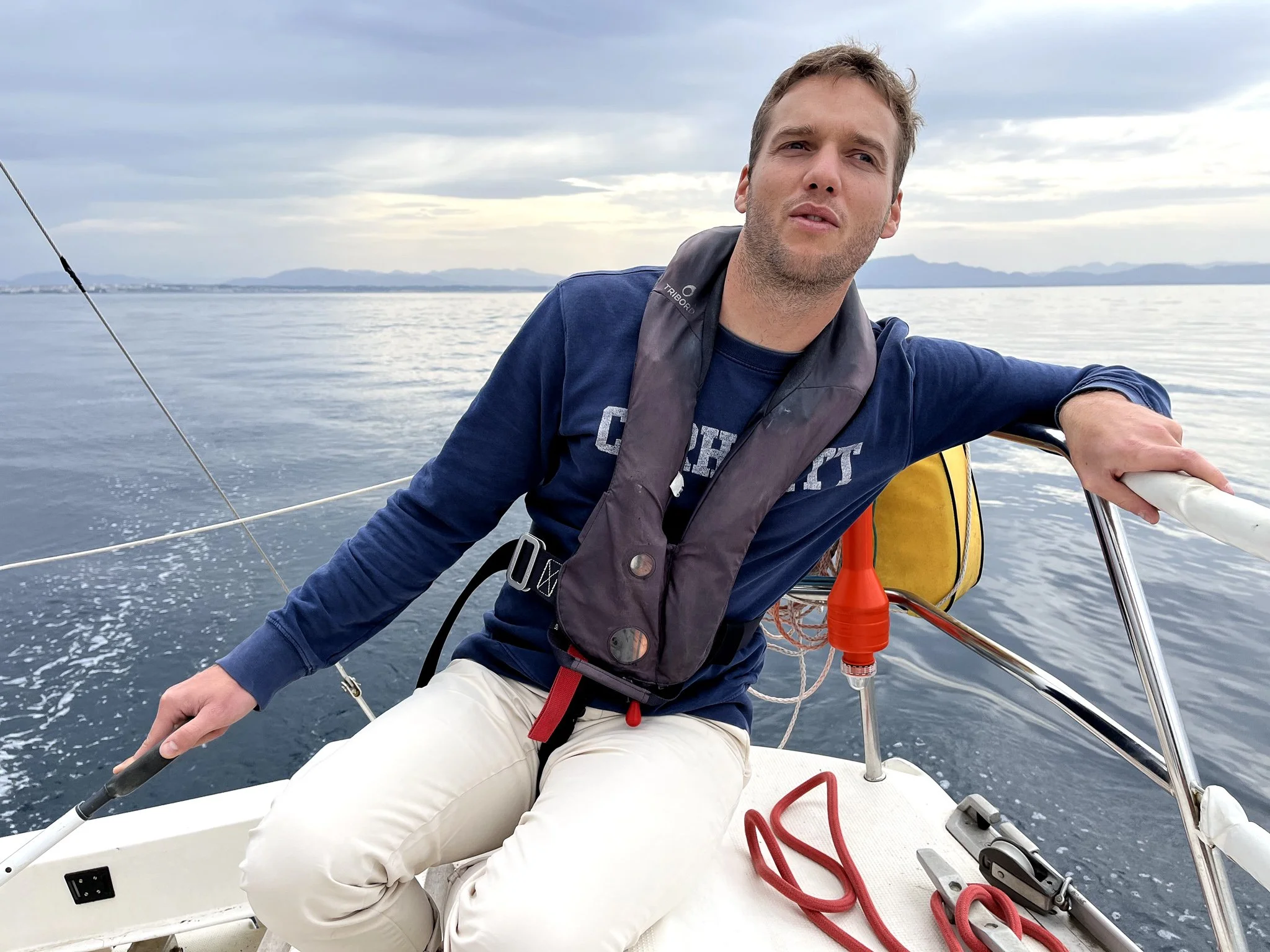
Once clear of the channel, we attached the jibsheet to the winch and rolled out the genoa. The boat picked up momentum as the sails filled with wind and though we weren’t sure of our exact speed over ground due to a faulty speedometer, Dominique suggested we were sailing at a nice pace of our 4 knots. This speed felt lovely.
Dominique began teaching us – in French – how to trim the sails and I’m sure we picked up another knot of speed. We steered toward a yellow cardinal mark and began to practice taking a reef, tacking, and gybing. We particularly enjoyed learning Dominique’s technique for gybing, which included releasing the mainsheet to about 10% from the center, gently moving the boat to a downwind position, easing the genoa to be wing-on-wing with the mainsail, then carefully moving your body with the tiller into the middle of the boat as we gybed, standing with the tiller in between our legs whilst holding the mainsheet, then completing the gybe. It felt much gentler to methods we had practiced in the past.
The wind was inconsistent and at times we had to search for a breeze or be patient, but with Biarritz behind us and, when the wind blew, the calm conditions made for a comfortable training. We ate our picnic lunch somewhere out at sea off the coast of Biarritz. It felt lovely to be away from the noise and pace of land life, away from traffic and buildings, bobbing along gently out in the Atlantic Ocean.
After lunch, during some gybing training, Remy spotted some dolphins jumping to the north – direction Tarnos – and we sailed closer to check them out. Within no time, the dolphins came directly towards us, and it was then that we realized this was a huge pod of at least 15-20 Common Dolphins. I rushed to the bow, delighted to see some of the dolphins playing around the boat swimming along with us. This is a moment I have dreamed of, and it was beyond my imagination. Suddenly, the entire pod were swimming, jumping and tail splashing us playfully around the bow, I was quite soaked with water. I could not believe the size of the dolphins, more than two meters and looking rather well fed. Their white bellies glowed under the clear, glassy water. At one point, I began to whistle to the pod and one of the dolphins poked its head completely out of the water and looked me straight in the eye. Wow, what a moment!

The dolphins stayed with us for almost half an hour before swimming off to the south just as the wind died. We rolled in the genoa, turned on the engine, and putted our way back towards the channel, aiming for the first set of leading lights at 090° on our port side and then once we’d entered the channel, navigating towards the starboard side leading lights at 111.5°. Dominique advised that when the traffic tower (positioned on the starboard side of the channel entrance) flashes red, vessels cannot enter or exit the channel as it means there is a cargo ship approaching to enter or exit. As it happens, we just reached the marina as a cargo ship was releasing its dock lines and preparing to be towed out of the channel.
Prior to approaching the channel, Remy and prepared the fenders, tying clove hitches to attach them to the lifelines. Once we had safely entered the channel, we pointed the boat into the wind and pulled down the mainsail. This was quite easy with the lazy bag on the boom and I made a note that we will definitely want to fit a lazy bag on our boat in the future.
We re-entered the marina and Dominique steered us into our narrow marina berth. Remy worked the lines, attaching the stern line/back spring to the dock cleat and then the bow lines. I held the other end of the backspring until Dominique was satisfied we were in the berth nicely and then I tied off the line to the stern cleat on Aracati, as Remy secured the bow lines.
Glossary
Bow line
The rope used to attach the bow (front) of the boat to a dock.
Stern / back spring line
The rope used to attach the stern (back) of the boat to a dock.
Cleat
A T-shaped piece of metal or wood on a boat or dock to which ropes are attached.
Bow
The front of a vessel.
Stern
The back of a vessel.
Tiller
A tiller is a steering stick commonly used in maritime vessels, particularly smaller sailboats, where it is attached to an outboard motor (found on dinghies), rudder post or stock to give the navigator (helmsman) leverage to steer the vessel.
Mainsail
The mainsail is the sail rigged on the main mast of a sailboat. The sail’s foot is attached to a boom.
Genoa
A genoa is a type of large jib sail or staysail that extends past the mast. It is used on single-masted sloops and twin-masted boats such as yawls and ketches.
Cardinal Mark
A cardinal mark is a sea marker used in maritime pilotage to indicate the position of a hazard and the direction of safe water.
Mainsheet
A sheet (rope) used for controlling and trimming the mainsail of a sailboat.
Jibsheet
The sheets (rope) used for controlling and trimming the jib of the sailboat.
Taking a Reef
When there is too much wind, it is important to ‘take a reef’ (reduce the sail area). When is it time to reef? A common saying is that if you’re thinking of taking a reef then it’s time to take a reef! If your boat is heeling (tipping to one side or the other) more than 30°, or when your lee deck (deck on the opposite side of the wind) is consistently awash with ocean splash, or when steering becomes difficult with the boat constantly trying to round itself up to the wind, or when the boat is pounding too hard, it’s usually the best time to consider reefing the sails.
Tack
Tacking turns the boat 90° through the wind. You are on a starboard tack when the wind is from your starboard side. You are on a port tack when the wind is from your port side. When it’s time to tack, the skipper or helmsman says, ‘Ready to tack!’ and begins to turn the boat 5-10° to build up momentum for the turn. The crew ensures the jibsheets are clear and not tangled, and as tack begins they release the jibsheet and as it starts to luff they move to the opposite side of the boat and pull on the other sheet attached to the winch. After the bow passes through the wind, the sails may luff until the boat settles into the new tack and the wind fills the sails again. As the jib begins to fill with wind, the crew can trim the sails. The main tacks by itself and doesn’t need adjusting, but you may need to be careful if it swings across during the tack.
Gybe
A gybe is when the boat turns with the wind on its stern, so behind you. It is a way of changing tacks whilst sailing downwind. A gybe can be much more instantaneous than a tack, and to make it a smooth transition the skipper and crew must be careful and aware. A gybe that goes unchecked can put strain on the rigging, can make a weapon of the boom and mainsheet, and can cause a loss of control. A controlled gybe requires a timing, planning and careful sheet handling, and when sailing with a crew, good communication. The helmsman should call ‘Ready to Gybe!’ before sheeting in the main whilst holding course and then turning the helm slowly to bring the stern of the boat through the wind. Dominique taught us a method of loosening the mainsheet to 10% from center, bringing the jib across to have the boat sailing downwind wing-on-wing (where the jib and mainsail are on opposite sides) then gradually turning the boat with the boom swinging gently last, letting out the mainsheet completely to complete the turn.
Leading Lights
Leading lights are a pair (or more) of light beacons used in navigation to indicate a safe passage for vessels entering a shallow or dangerous channel; they may also be used for position fixing. At night, the lights are a form of leading line that can be used for safe navigation.
Fender
A fender is a bumper used to absorb the kinetic energy of a boat or vessel berthing against a jetty, dock wall or another vessel adjacent to it in a marina berth.
Clove Hitch
The clove hitch is a type of knot. Along with the bowline and the sheet bend, it is often considered one of the most important knots. A clove hitch is two successive half-hitches around an object.
Starboard
The right side of a vessel.
Port
The left side of a vessel.
