If there was one seminal book that reached my hands during the first French lockdown, it was Sand Talk, by Tyson Yunkaporta. It came urgently recommended to me by a mentor, co-collaborator, producer and friend called Anne, and so I ordered it hastily and got stuck in whilst spending my work-free days lying around the practice permaculture garden Remy and I had constructed on my in-laws’ property. Spreading a blanket atop the wildflowers and grasses that had sprung up since we’d begun gently tending the land, I soaked up every page of Sand Talk, and when I was done, I re-read it immediately, this time with sticky notes.
As Tsyon explains himself, the book is an examination of global systems from an indigenous perspective, his contribution to a discussion we desperately need to have. He begins by contemplating the intelligence of echidnas, and paying respects for The Elders and traditional custodians ‘of all the places where this book is written and read.’
All humans evolved within complex, land-based cultures over deep time to develop a brain with the capacity for over 100 trillion neural connections, of which we now only use a tiny fraction. Most of us have been displaced from those cultures of origin, a global diaspora of refugees severed not only from the land, but from the sheer genius that comes from belonging in symbiotic relation to it. In Aboriginal Australia, our Elders tell us stories, ancient narratives to show us that ‘if you don’t move with the land, the land will move you.’ There is nothing permanent about settlements and the civilisations that spawn them.
Perhaps we need to revisit the brilliant thought paths of our Paleolithic Ancestors and recover enough cognitive function to correct the impossible messes civilisation has created, before the echidnas decide to sack us and take over as the custodial species of this planet.
As time seemingly stands still for those of us in lockdown, watching an unprecedented (at least for our generation) pandemic unfold and questioning if we want to return to ‘normal’ once the storm passes, Sand Talk’s pages deeply disrupt my conditioned learning.
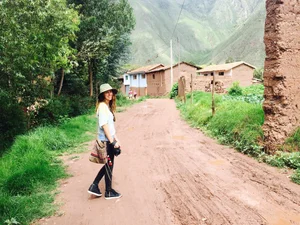
We don’t have a word for non-linear in our languages because nobody would consider travelling, thinking or talking in a straight line in the first place. The winding path is just how a path is…
Our man tried going in a straight line many thousands of years ago and was called ‘wamba’ (crazy) and punished by being thrown up into the sky. This is a very old story, one of many stories that tell us how we must travel and think in free-ranging patterns, warning us against charging ahead in crazy ways.
Throughout my adult life, I’ve felt like the odd-fit in a society dead-set on linear paths. Settling down and domesticating has never felt natural, instead, I’ve sought out voyages that enable interconnected, lived experiences with humans and nature to inform my knowledge and thus my contribution back to society. What I’ve tried to offer in return is the sharing of stories. Sand Talk explores the importance of these kinship relationships and harnessing the power of story, or ‘yarning’.
Yarning is more than just a story or conversation in Aboriginal culture – it is a structured cultural activity that is recognised even in research circles as a valid and rigorous methodology for knowledge production, inquiry and transmission. It is a ritual that incorporates elements such as story, humour, gesture and mimicry for consensus-building, meaning-making, and innovation. It references places and relationships and is highly contextualised in the local worldviews of those yarning.
It has protocols of active listening, mutual respect and building on what others have said rather than openly contradicting them or debating their ideas. There is no firm protocol of only one person speaking at a time, although the mutual respect protocol ensures that interjections are in support of what a speaker is saying, enriching what is being said. There is no ‘talking stick’ protocol. (The talking stick idea was appropriated by the West from Native American culture.)
Yarns and yarning can be more than tools to enhance memory and engagement. They can be a disruptive innovation that is empowering and liberating when transferred to contemporary media.
As I meandered through Sand Talk, the book a non-linear, winding-path journey in itself, I tried to approach the themes Tyson yarns us through - such as the climate crisis, education, diet, relationships and society, history, gender and gender roles, economy, violence, racism, values – by adopting the systems-thinking approach his book conveys. Upon completion of my second reading, I am left with a warm belly full of hope. Perhaps my lifelong discomfort with the dominant society I had been born into was the result of unsettled, ancestral knowledge buried deep within trying to escape? Certainly, the violent suppression of Indigenous knowledge systems has enabled the speeding towards the cliff’s edge for all of humanity. Sand Talk gives us a framework to ‘remember forward’ Indigenous ways of thinking, and, just perhaps, ‘save the world.’
English Title: Sand Talk: How Indigenous Thinking Can Save The World
Author: Tyson Yunkaporta
Page Count: 288 Pages
Published: 2019
Publisher: text publishing
From the publisher
This remarkable book is about everything from echidnas to evolution, cosmology to cooking, sex and science and spirits to Schrödinger’s cat.
Tyson Yunkaporta looks at global systems from an Indigenous perspective. He asks how contemporary life diverges from the pattern of creation. How does this affect us? How can we do things differently?
Sand Talk provides a template for living. It’s about how lines and symbols and shapes can help us make sense of the world. It’s about how we learn and how we remember. It’s about talking to everybody and listening carefully. It’s about finding different ways to look at things.
Most of all it’s about Indigenous thinking, and how it can save the world.
Praise for Tyson Yunkaporta and SAnd Talk
*Winner, Small Publishers' Adult Book of the Year, Australian Book Industry Awards, 2020
*Winner, The Ansari Institute's Randa and Sherif Nasr Book Prize on Religion & the World, United States, 2022
*Shortlisted, Matt Richell Award for New Writer of the Year, Australian Book Industry Awards, 2020
*Shortlisted, Non-fiction, Indie Book Awards, 2020
*Longlisted, Booktopia Favourite Australian Book, 2020
*Longlisted, Bookseller's Choice for Adult Nonfiction, Australian Booksellers Association, 2020
*Longlisted, Non-fiction, Indie Book Awards, Leading Edge, 2020
‘An extraordinary invitation into the world of the Dreaming… Unheralded.’ - Melissa Lucashenko
‘It was certainty that drove a bulldozer through the oldest and deepest philosophic statement on earth at Burrup Peninsula. Sand Talk offers no certainties and Tyson Yunkaporta is not a bulldozer driver. This is a book of cultural and philosophic intrigue. Read it.’ - Bruce Pascoe
‘Radical ideas, bursting with reason.’ - Tara June Winch
‘After two hundred years, Indigenous thinkers are claiming the right to interpret Aboriginal Australia. It is a revolutionary change: here, in this compelling book, are its first fruits.’ - Nicolas Rothwell
‘An exhilarating meditation on different ways of knowing and being. Sand Talk is playful, profound and fiercely original.’ - Billy Griffiths
‘A familiar Indigenous sense of humour and generosity of sharing knowledge makes this book enjoyable to read…Like Dark Emu, Yunkaporta’s book will have people talking.’ - Books+Publishing (starred review)
‘Tyson Yunkaporta’s Sand Talk is an extraordinary reading experience. It’s both philosophical and practical, and underpinned by a compassionate yet realistic humanity.’ - Readings
‘Asks the reader to emotionally connect to with not only the text, but connect to the author through the text.’ - Geelong Advertiser
‘Clever, funny, thought provoking, sensible and generous all at the same time. A must read!’ - Sydney Morning Herald
‘Readable, digestible and quite frankly exciting.’ - Fifth Estate
‘Thought-provoking.’ - New York Times
‘Sand Talk is an important book. Tyson Yunkaporta an important and original thinker and writer. The book unpacks for us something originally genius about Indigenous thought, which has for too long been dismissed as archaic folk knowledge from old oral cultures of interest only to academics and fetishists. This book shows how vital and alive and essential Indigenous ways of being and thinking are. Yunkaporta is so smart, funny, and accessible. Everyone needs to read this.’ - Tommy Orange, bestselling author of There There
‘Challenges us to think differently – and change the world… It is a timely and insightful read.’ - Di Morrissey
‘Perhaps the most unusual science book of the year…It’s a dramatically new (to some) and absorbing way of engaging with the world, and stops just short of exasperation with self-important “western science”.’ - Guardian
‘A bold voice among a growing field of Australian Indigenous writing that challenged a lot of my assumptions.’ - Dr Larry Marshall
About the Author
Tyson Yunkaporta is an Aboriginal scholar, founder of the Indigenous Knowledge Systems Lab at Deakin University in Melbourne, and author of Sand Talk. His work focuses on applying Indigenous methods of inquiry to resolve complex issues and explore global crises.
Tyson is also the host of The Other Others podcast:
Through the Deakin University Indigenous Knowledge Systems Lab, we have unlikely, borderline seditious and kind of inappropriate yarns with surprising people about how an Indigenous complexity science lens can be applied to solving the world's most wicked problems. There's gold at the margins, but almost no trigger warnings, so enter at your peril.
Reviews
The Guardian - Best science books of 2020
New York Times (Interview) - Beer with Bella: Tyson Yunkaporta
Antithesis Journal (Interview) - Antithesis author spotlight: Tyson Yunkaporta
Get your copy! Purchase Sand Talk from the Voyage Virage Book Store Powered by Bookshop.org, supporting independent booksellers.