

The Pacific Ocean, with its vast ‘sea of islands’ scattered across its expanse, has long been a region of profound knowledge and cultural achievement for the people of Polynesia. For Oceanic scholars and communities, there has been great respect and admiration for the ingenuity and skill of Polynesian navigator, long before the arrival of outsiders. Yet, as is often the case, Western narratives sought to cast doubt on these capabilities, framing them as improbable feats in need of external validation.
In Sea People: The Puzzle of Polynesia, Christina Thompson attempts to bridge the gap between these two perspectives, tracing the history of Western encounters with Polynesia alongside the enduring power of indigenous oral traditions. Her narrative intertwines Western scientific inquiry with Polynesian cosmology, reflecting a clear admiration for the culture she writes about.
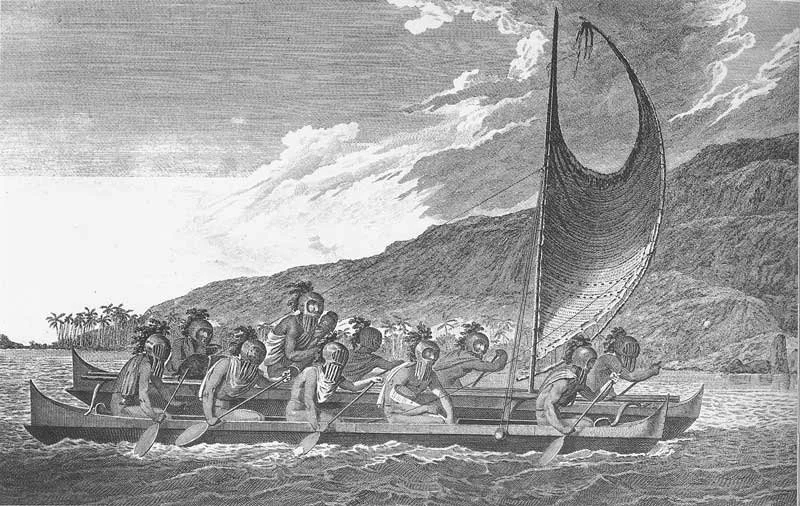
Early Polynesian navigators sailing multi-hulled canoe, c. 1781. Source: Wikipedia.
Rediscovering Polynesia
Thompson's approach in Sea People is a well crafted blend of narrative history, personal reflection, and cultural anthropology, thoroughly researched and exquisitely written. The book opens with Thompson’s compelling assertion that “the story of the Polynesian settlement of the Pacific is not so much a story about what happened as a story about how we know.” It is this framing that underpins her exploration, shifting the focus from merely recounting historical events to examining the processes, biases, and methodologies that have shaped our understanding of them. Against this backdrop, she revisits the age-old Western contemplation: “How did they get here?” A question grounded not in skepticism but in awe, as Thompson seeks to unravel how Polynesians—without compasses, maps, or modern technology—navigated vast ocean distances to settle across a third of the Earth’s surface, while also scrutinizing how that story has been pieced together by both indigenous knowledge and Western inquiry.

This Tahitian scene is one of a number of drawings by Tupaia. Credit: British Library, Sourced from https://coastbeat.com.au/art-entertainment/captain-cooks-right-hand-man-polynesian-navigator-tupaia
Thompson meticulously traces Western attempts to unravel the mystery, from Captain James Cook’s early interactions with Polynesian navigators such as Tupaia, to the advent of modern linguistic and archaeological studies. She gives equal attention to the voices of Polynesian oral traditions, carefully weaving them into a larger landscape of cultural rediscovery. This interplay of perspectives is the book’s central strength, showcasing not only the immense skills of Polynesian navigators but also the cultural bias of early Western explorers who failed to see these skills as legitimate science.
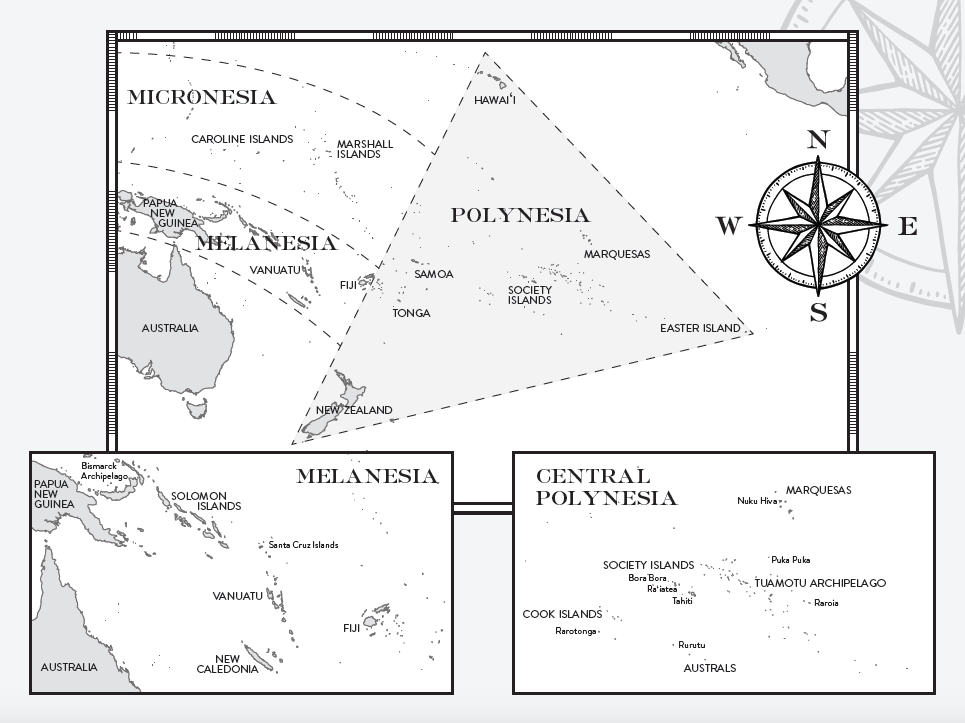
Thompson introduces readers to the Lapita people, ancestors of modern Polynesians, whose ceramic fragments and archaeological remains are scattered across the Pacific, providing crucial evidence of their migrations. Emerging around 1600 BCE, the Lapita were master navigators, credited with the initial wave of settlement across the Pacific islands. Their distinctive pottery, marked by intricate geometric patterns, has been found thousands of miles apart, a testament to their extraordinary voyaging capabilities. The Lapita not only carried the tools and materials needed for survival but also the seeds of a thriving cultural legacy, including the knowledge systems that would evolve into Polynesian wayfinding. This group represents the critical link between Southeast Asia and Polynesia, embodying the ingenuity and adaptability that defined Pacific migration.
(Our friend Hanneke Boon, head of Wharram Designs, led the the first sailing expedition that successfully followed a possible migration route of the ancient Polynesians out of SE Asia, The Lapita Voyage, in 2008-2009).
The Art and Science of Experimental Boat Archaeology

Pius Mau Piailug, master navigator from Satawal, Yap State, Micronesia navigated Hōkūle‘a on her first voyage to Tahiti in 1976; subsequently, he taught Hawaiians and other Polynesians to the arts of navigating without instruments.
One of the most compelling sections of Sea People for me is the exploration of the practice of experimental boat archaeology, a discipline that goes beyond theory to recreate and test ancient maritime technologies. Thompson delves into the work of folks like Ben Finney, who, along with Nainoa Thompson (no relation to the author), was instrumental in reviving Polynesian navigation through the voyages of the Hōkūleʻa.
The Hōkūleʻa, a replica of a traditional Polynesian voyaging canoe, became a powerful symbol of cultural pride and scientific revelation. Its successful journeys proved what many Pacific Islanders had always known: that their ancestors were not passive drifters but master navigators capable of intentional, long-distance voyages guided by a deep understanding of the stars, ocean currents, wind patterns, and ecological cues. Yet, these achievements were not without sacrifice.

“Eddie Aikau wanted to go for help. An expert waterman, he had saved the lives of many swimmers in trouble in the powerful surf of Waimea Bay on the north shore of O‘ahu. Nainoa paddled out with him a short distance to test the surfboard and waves. Eddie would go alone. The crew, clinging to the overturned hulls, watch[ed] in silence as he rode the waves into a fate not unknown to many of the people of old who sailed toward distant lands.” - Will Kyselka, in An Ocean in Mind, Source: https://archive.hokulea.com/holokai/1978/voyage_cancelled.html
The Hōkūleʻa's revival also bore moments of tragedy, such as the loss of legendary surfer Eddie Aikau, who went missing while heroically paddling for help after the vessel capsized shortly after leaving Hawaii during one of its early voyages in 1978. His story underscores the profound dedication and risks involved in reclaiming this heritage, as well as the enduring spirit of those who continue to honor the legacy of Polynesian wayfinding.
“…the voyages of Hōkūleʻa did not - indeed, could not - prove anything about what had actually happened in the distant past. What they did prove was the robustness of non-instrumental navigation as a method and the feasibility of voyaging in general. They demonstrated - conclusively - that a trained and capable navigator, using nothing but the stars, winds, and swells, could hold a course, calculate the distance traveled, hit a small target with sufficient accuracy, and incorporate all the necessary information into a mental construct that was both flexible enough to allow for adaptation and systemic enough to be passed on.”

The Building of the Hokule‘a - 1973-75, Credit: Polynesian Voyaging Society
Thompson’s discussion of this revival highlights the intersection of Western scientific methods and indigenous knowledge systems. She captures the excitement of these voyages, where traditional navigation techniques were not only tested but vindicated on the open sea.
The Knowledge Encoded in Stories
Throughout the book, Thompson emphasizes the significance of Polynesian oral traditions, which served as repositories of navigational knowledge, ecological wisdom, and cultural identity. These stories, often dismissed or misunderstood by early Western observers, were - still are - far more than myths; they are practical tools for survival and exploration.
Thompson recounts how Polynesian navigators memorized star charts, studied wave patterns, and learned to read the behavior of birds and marine life, embedding this information in songs, chants, and genealogies. This encoded knowledge was passed down through generations, a living testament to the ingenuity of Polynesian societies.
Should we be surprised that the latest science brings us closer to the oral history of the Polynesians? It has been about a hundred years since these chants and tales were last taken as seriously by Europeans as they were by Polynesians themselves. For most of the twentieth century, they were largely dismissed by scholars, who werre inclined to view Polynesian traditions as “mythical fictions composed for just about any purpose other than memorializing actual events.” There were seen as literature or religion or political tracts, metaphors or symbols or allegories, but never simply documentary accounts.
In part, this was the consequence of a general pivot toward science in the twentieth century: a semi-repudiation of the nineteenth century’s romantic tendencies and a gravitation to the provable and quantifiable, toward numbers and calculations. But it also had something to do with the way traditions - and the world they represented - were receding in time. Nineteenth-century Europeans, for all their foibles, had been close to this material and to the people who created it. But after about the 1930s, once can feel this knowledge, this intimacy, slipping away. The hard turn toward skepticism - regarding both the usefulness of traditions and the voyaging capacity of the Polynesians themselves - that we see in the 1950s and 60s is a measure of drift.
While Thompson occasionally lapses into a Western framing of these traditions as “evidence,” her overall portrayal is one of respect and admiration. She convincingly argues that these oral traditions are as rigorous and valuable as any written record, a point that resonates deeply in contemporary efforts to decolonize historical narratives.
History, in the post-Enlightenment European tradition, is made up of elements that are theoretically available to anyone to do with as they see fit. But this idea conflicts with what one might call a “traditional” Polynesian perspective about things that happened in the past. According to the Polynesian view, history is not an assortment of data points to be cherry-picked at will but something much closer to a kind of intellectual property. Polynesian histories may be fluid, but not everyone is equally entitled to make sure of them.
A Passing Critique
Though the book’s scope is impressive, Thompson’s omission of certain modern contributors to Polynesian canoe research is worth noting. Figures like James Wharram and Hanneke Boon, whose designs were deeply inspired by Polynesian double-hulled canoes, represent a continuation of the experimental archaeology she praises. That said, The Sea People remains a thorough and engaging exploration of Polynesia’s maritime heritage.

Double Canoe drawing, James Wharram Designs.
The Lessons of the Pacific
In her closing chapter, Thompson underscores the importance of merging Western science with indigenous knowledge systems. This is perhaps the most important takeaway from Sea People: that no single perspective can fully capture the complexity of human achievement. Polynesian navigation, as Thompson so effectively demonstrates, was not just a technical feat but a cultural one—a testament to the power of human ingenuity and the interconnectedness of knowledge.
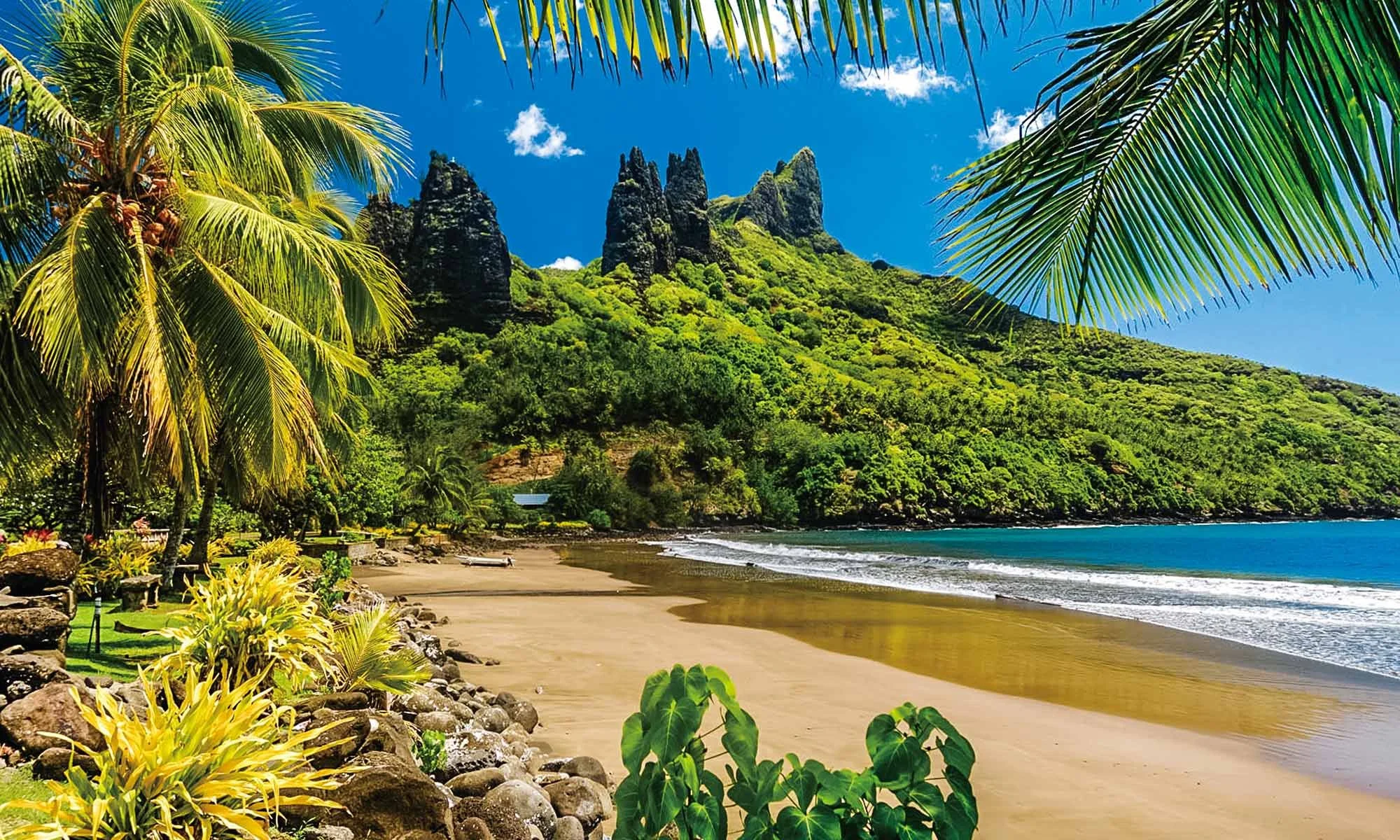
The Marquesas Islands. Source: Tahiti.com
To the extend that this history has been disentangled, however, it has been thanks to the input of radically different kinds. At one end of the spectrum are the mathematical models: the computer simulations, chemical anayses, statistical inferences - science with all its promise of objectivity and its periodic lapses of error. At the other, the stories and songs passed from memory to memory: the layered, subtled, difficult oral traditions, endlessly open to interpretation but unique in their capacity to speak to us, more or less directly, out of a pre-contract Polynesian past.
These two angles of inquiry are in many ways opposed, and for much of the past two centuries the debate has oscillated between them, as first one and then the other was held up as the avenue of truth. In fact, both have been crucial to the unfolding of a credible history of Polynesian migrations, as have the bold experiments in voyaging that bookend this story: the sixteenth-, seventeenth-, and eighteenth-century explorers whose accounts give us a glimpse of Polynesia as it was, and the twentieth-century experimental voyagers who set out to rediscover what the very first explorers of the great ocean must have known.
For readers, this book, whilst a voyage through history, challenges us to reconsider how we value and validate different ways of knowing. As modern double canoe voyagers make their way around Polynesian and beyond, Sea People serves as a reminder of how stories of the past can shape how we navigate the future.
Polynesian Appreciation
Sea People is an evocative and thought-provoking exploration of Polynesia’s voyaging legacy. Christina Thompson’s ability to weave together history, science, and storytelling makes for a captivating read, one that honors the skill and resilience of the Pacific’s sea people.
While the book could have benefitted from a broader inclusion of modern voices and innovations, its strengths outweigh its shortcomings. Thompson reminds us of the boundless creativity of Polynesian navigators and the importance of viewing history through a lens that respects and uplifts indigenous knowledge. As readers close the book, they are left with a deep appreciation for the enduring legacy of Polynesia’s voyaging ancestors—and a sense of wonder at the oceans that connect us all.
Related reading
Quotes from Epeli Hau'ofa's influential essay Our Sea of Islands
Indigenous Pacific Islander Eco-Literatures, University of Hawaii Press.
Lessons from the Stone Age Sailors, James Wharram
People of the Sea, James Wharram with Hanneke Boon.
Study: Artifact geochemistry demonstrates long-distance voyaging in the Polynesian Outliers
