
Hi folks,
Our work site flooring project is complete and we are beyond thrilled. Thanks to a motivating kick off working bee led by local advisor Pascal and our team of volunteers, I (Angie) chipped away at the floor build for the past week, putting down the tools well before beer o’clock on Friday afternoon. Prior to last week, I’d never used a jigsaw and had only ever drilled a screw or two in my life; it was a welcome change from the screen to lean how to use the power tools and come home with satisfactory fatigue after each day’s work session.
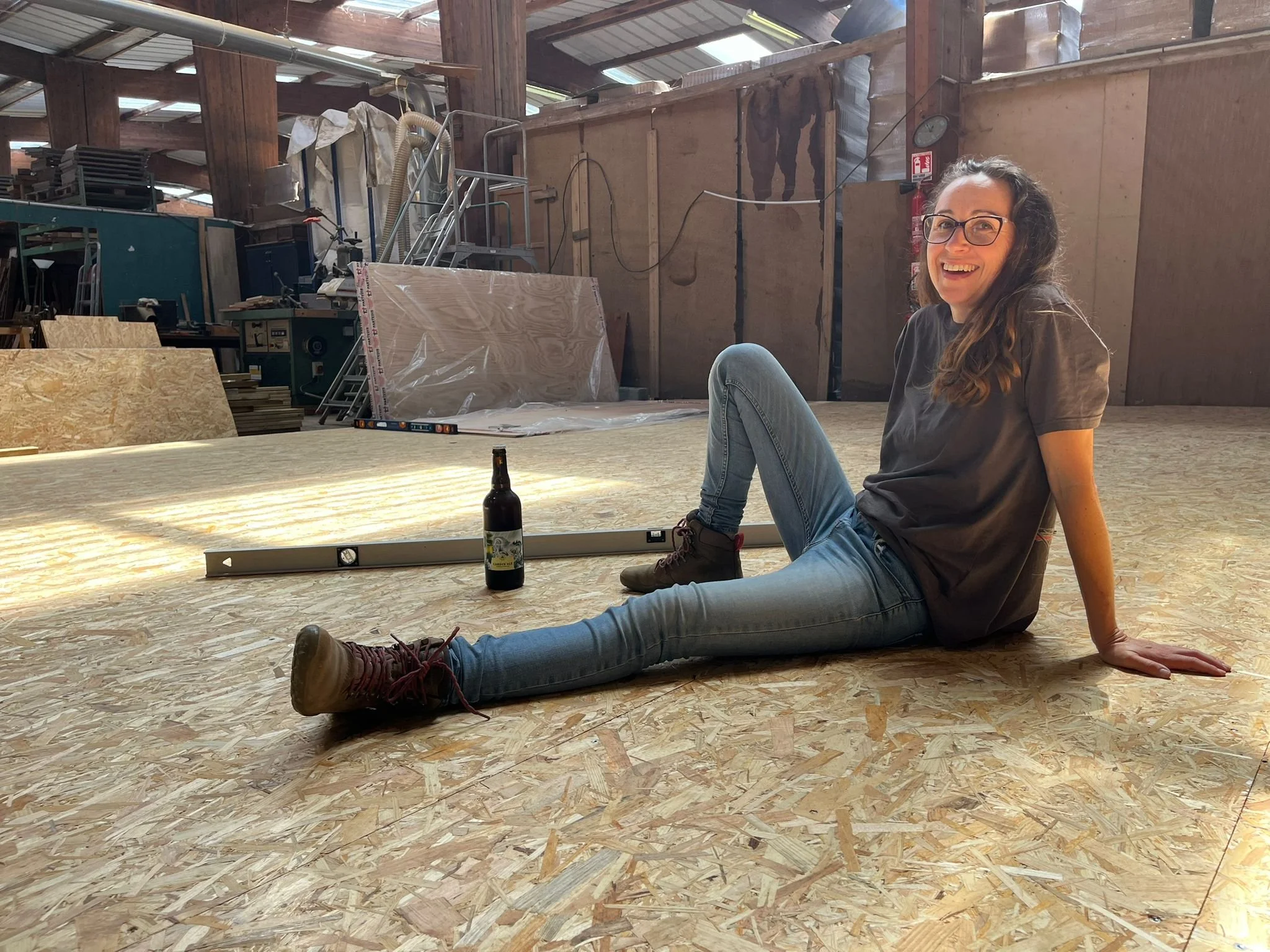
A very happy builder with a cold local brew to enjoy thanks to our friends at L'Amer d'Iroise.
We opted for a minimalist, inexpensive flooring with the objective of having a level, clean and dry base atop which to spend the next two years building FSL’s 41ft Polynesian-inspired Wharram Designs wooden catamaran.
To ensure the flooring can be disassembled and materials re-sold after its use, we used plaster to secure the pine planking to the rough floor though I often cursed the plaster, finding it challenging to get the right consistency and have all planks firmly secured once I began nailing the flooring boards. We had about 30 plastic pedestals we’d acquired secondhand that I encourage others to consider if building a similar floor — much faster and easier to work (and tidier) with than plaster!
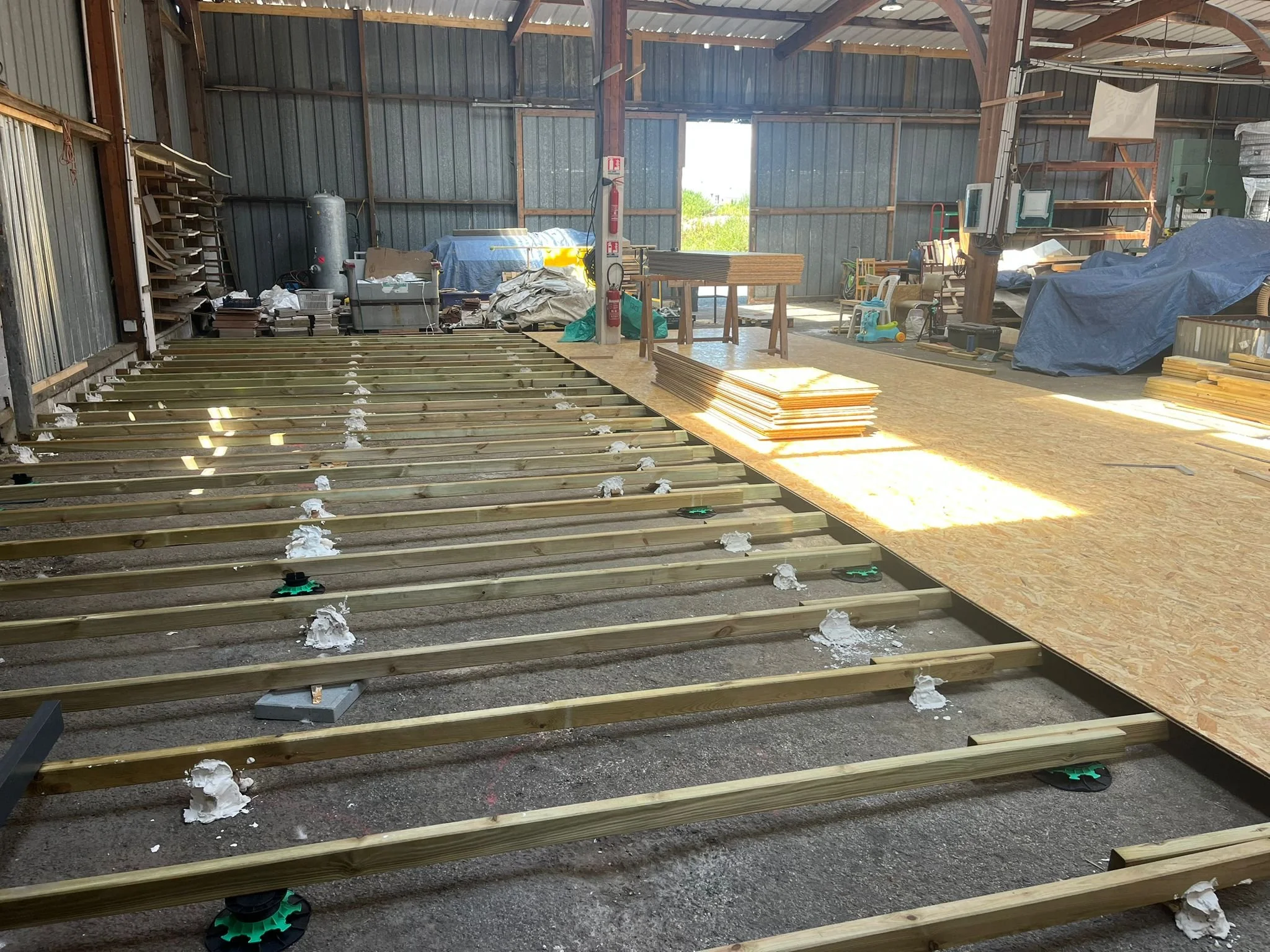
Plastic pedestals were much easier to work with than plaster.
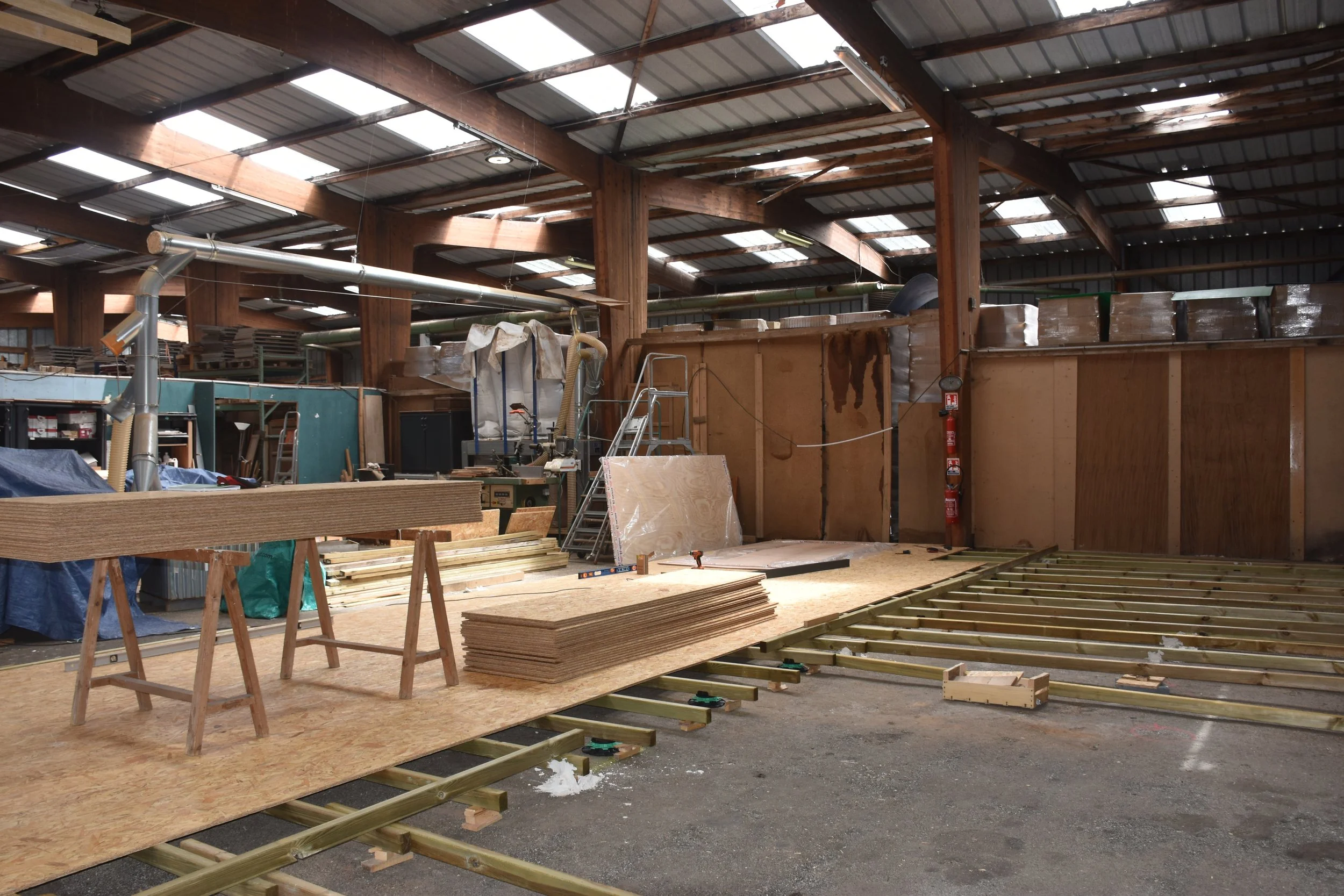
I had to remove the stack of floor boards that we had mistakenly allowed the supplier to deliver in the center of the work space. Tough lesson to learn as they were heavy and I had to move half of them by myself. I have plenty of bruises to show for it.
We learned a lesson in not ordering a 10 per cent surplus in timber; roughly 6 to 8 of the 54 pine planks were imperfect, with serious curvature or bends in the timber. Using off cut spacer wood I was able to add additional supports in the framing and keep the whole structure level. Another tough lesson was having the supplier drop off the floor boards in the center of our work space; we had to build the frame around this stack and lay the boards on the first side before I could physically move the second half of the pile to the finished side (see photo above).
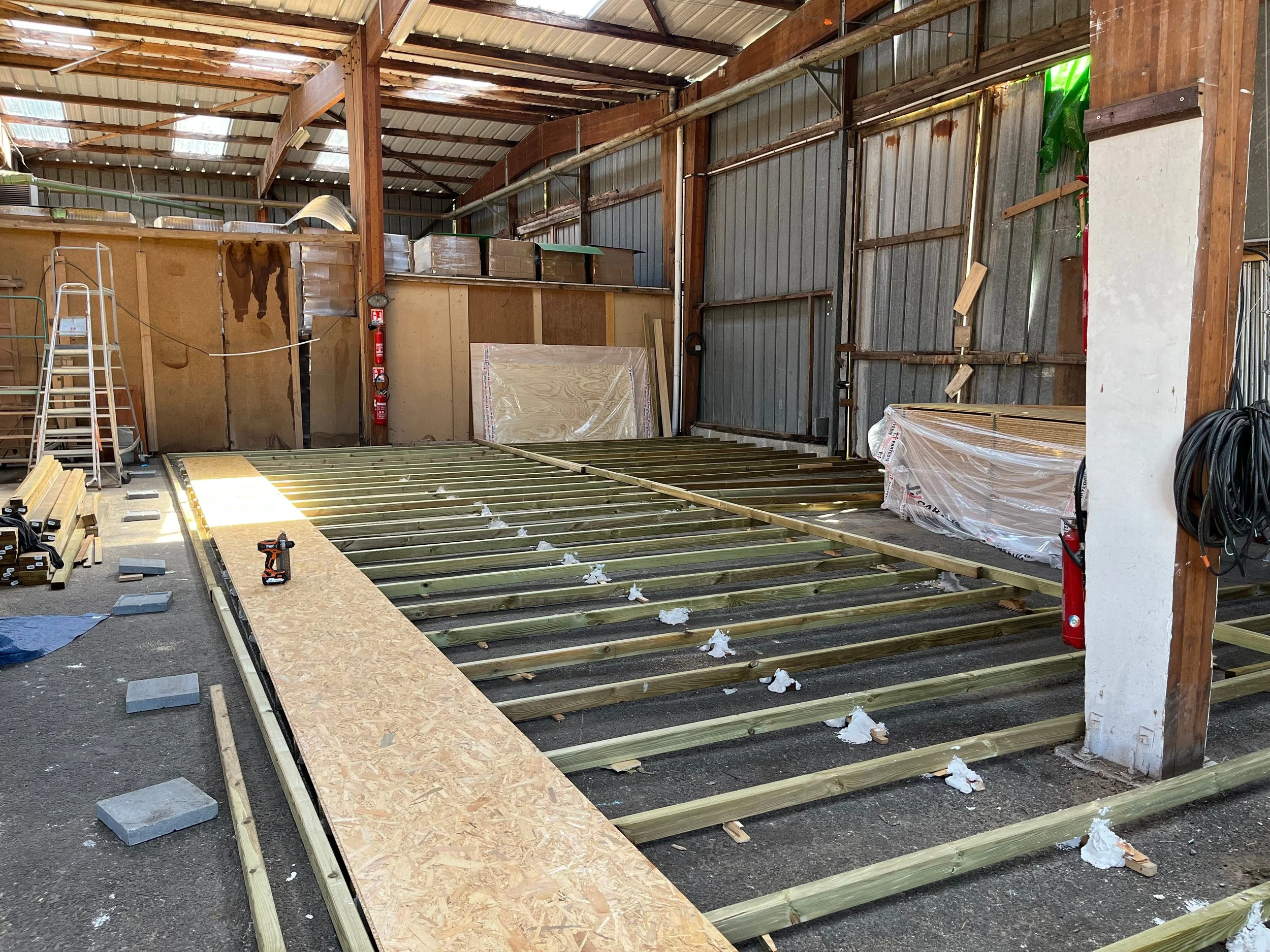
Off-cut pieces of wood were added to the framing to add support and level the beams.
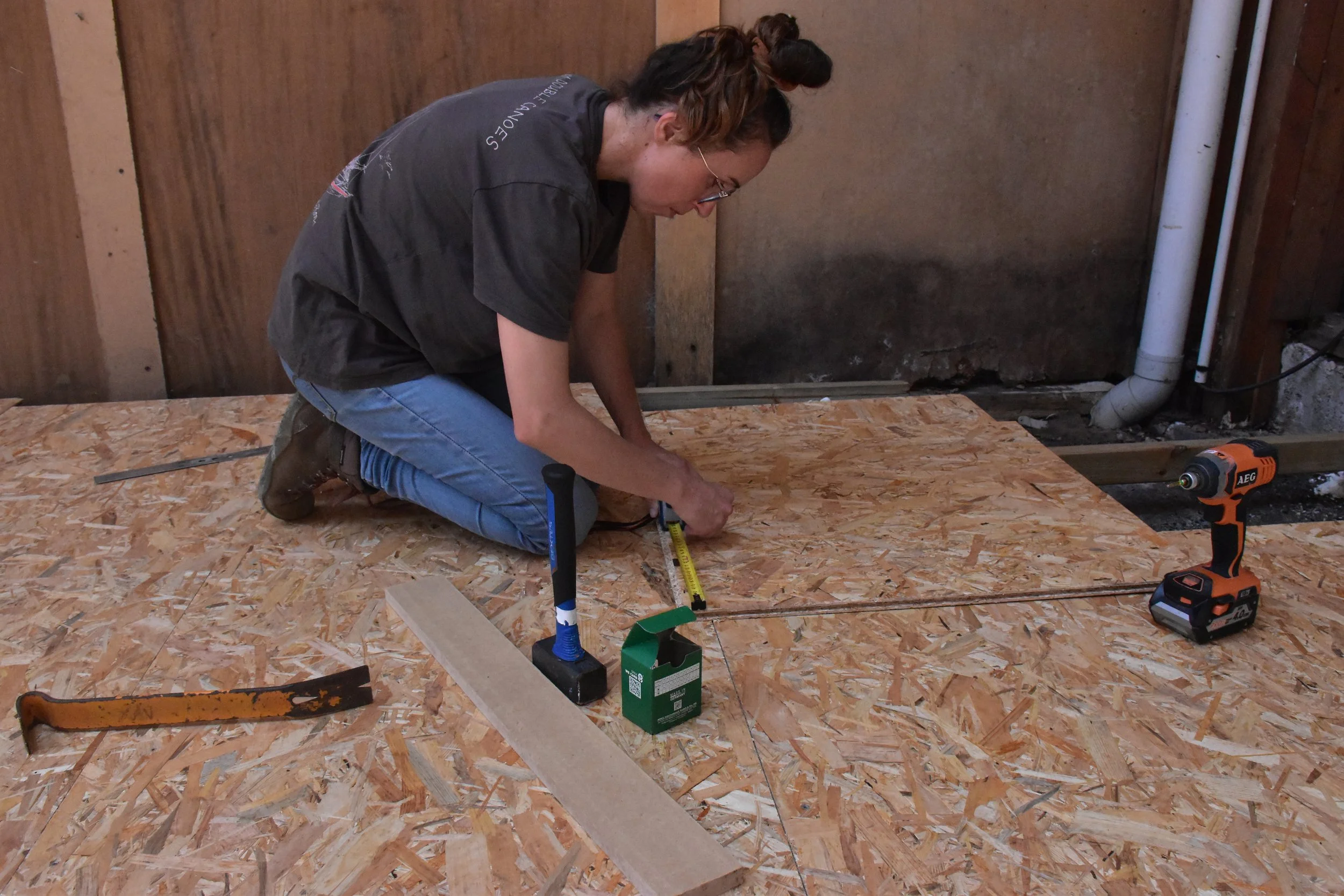
The final section was the toughest, leaving space for water piping and tackling curved beams.
As is generally the case (so I am told), the last part was the toughest. I had to cut the floor boards to leave enough space for water piping whilst trying to keep curved beams as level as possible (above photo). I also ran out of screws twice over the last two days, having to run back and forth to the hardware store. Pascal had advised we needed 1000 screws and we did actually order those originally, but the wholesale supplier gave me only 500 and I was already halfway home from Quimper with a baby before I realized. This was a another lesson — buying the screws at the local hardware store cost double for half the quantity.
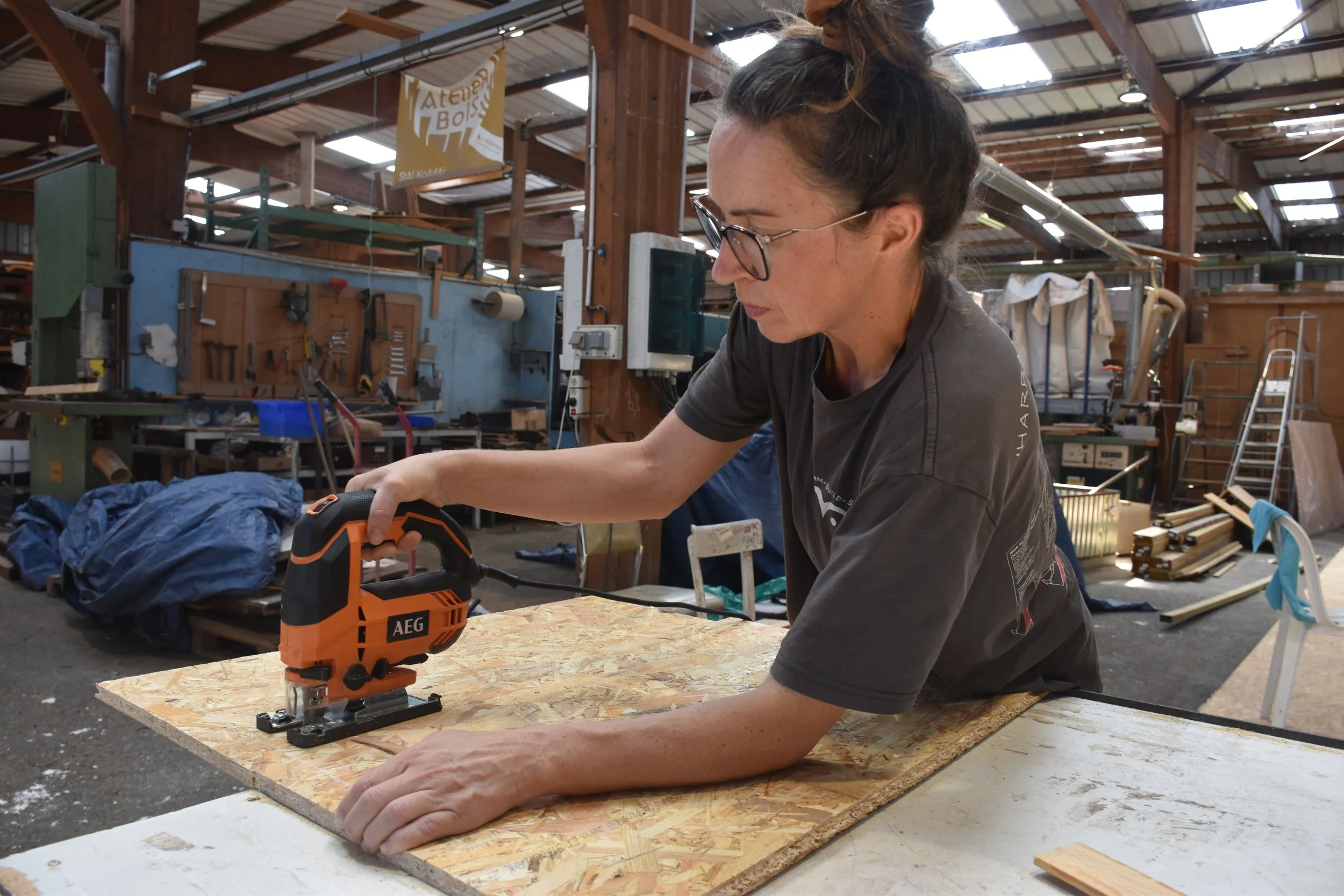
Getting used to the power tools.
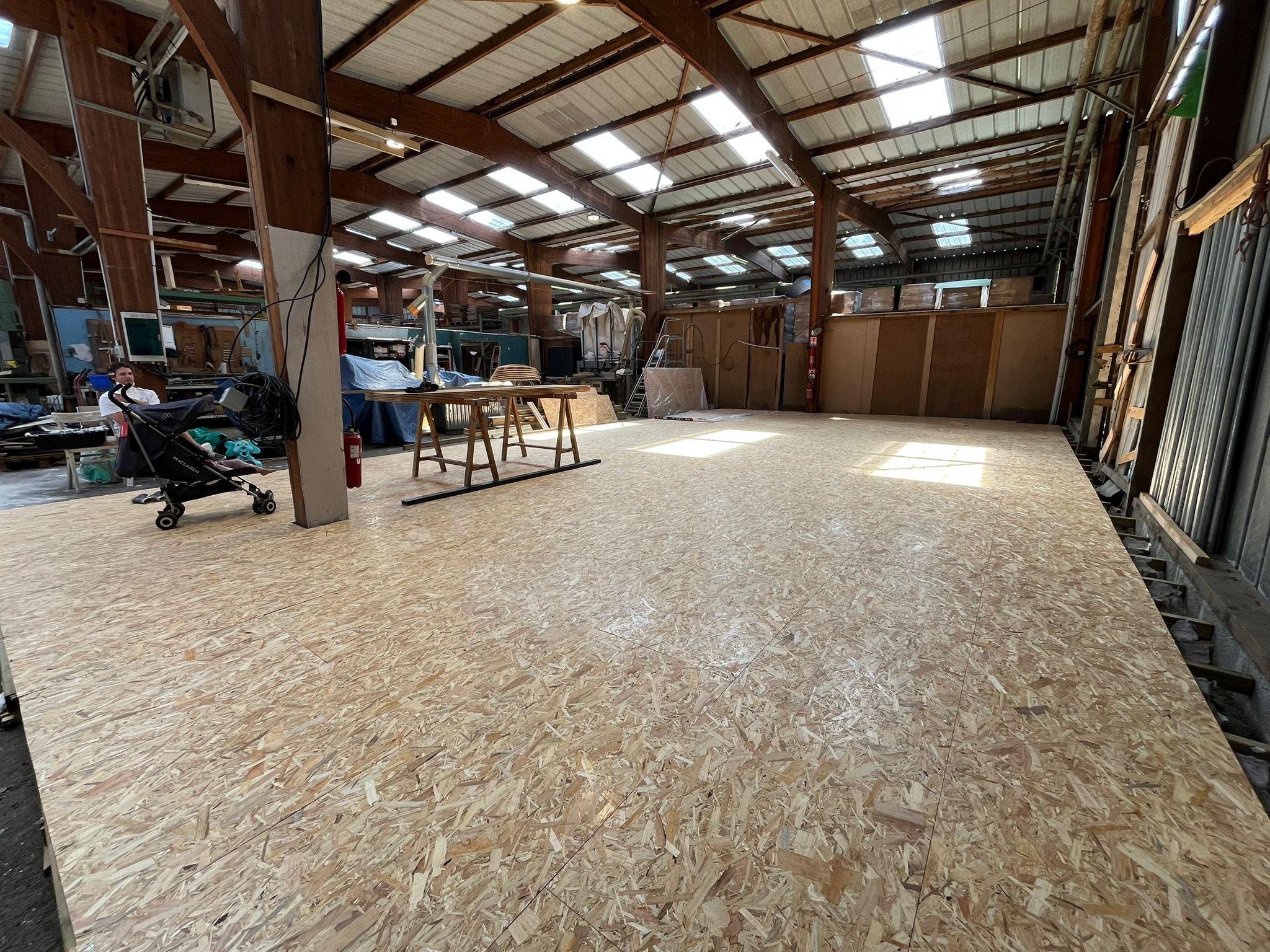
We are very happy with the finished flooring.
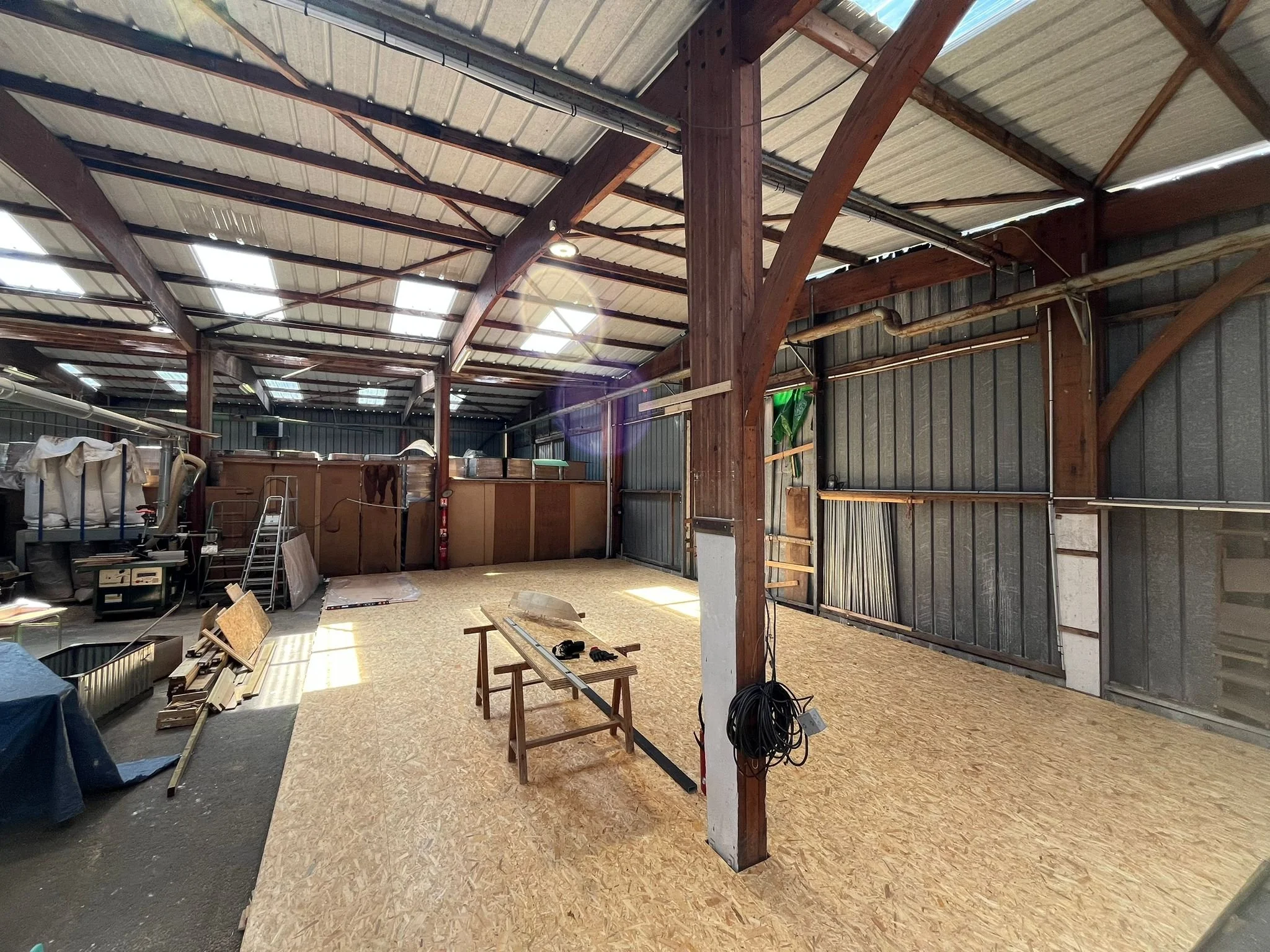
One hull will be built on each side of the flooring, connected in the center with a decking and lashed beams. The center deck and beams will need to be disasembled in order to get each of the hulls out of the boat yard and loaded onto a trailer and delivered to the Goyen River in Plouhinec, where we will reassemble and finally, launch into the water.
Though building a full scale work site flooring is not a requirement for building a Wharram Designs catamaran, we decided to go ahead anyway and are very happy with our decision. The total floor build project was completed over a period of 8 days (not full time) and 29.5 hours.
We are now ready to draw the lines of the boat and move into the proper build phase — you bloody beauty!
Materials Testing
Tebopin Elite Plywood
Following our desk-based research over the past year on materials (see previous Substack posts), we ordered a sample panel of Tebonpin Elite plywood that has now been validated by experienced advisor Pascal as excellent qualtiy (better than Okoume in his opinion on sight inspection). Tebonpin Elite is a European Maritime Pine faced plywood with Maritime Pine and/or Scots Pine core layers. You can download the technical and data sheet HERE.
Why Tebopin Elite?
We wanted to avoid using imported African plywood due to sustainable and ethical concerns. You can read more about our research on plywood and timber supply chains HERE. Cost was also a large factor in our decision; Tebonpin Elite is cheaper than Okoume and Sappeli. Of course, wherever possible we want to use locally produced materials, and Tebopin is mostly made of French grown wood and if not, it’s sourced only from European managed forests.
Change Climate Bio Epoxy
We have a 5kg sample of Change Climate Bio Epoxy ready to test on our Tebopin Elite plywood sample with Pascal in the boatyard. This resin, made with a glycerol (glycerine) core derived from sustainable biofuel production derived from algae, is certified 100% BPA-free, has a low odor and zero emissions in its Part A resin. Though their product has yet to be tested on large wooden catamarans (should we be the first to try?!), it has shown promising results in scientific testing, applications in the building industry and in marine sports like surfing, according to case studies and papers shared by the company. You can read more about our desk-based research into glues and resins HERE.
We will share our technical testing results in the coming weeks.
Fundraising
With the EU funding our Regenerative Tides: Sailing for Solutions (ReTISS) citizen science initiative, we are focusing our fundraising efforts on the boat build and scaling up our research. Supporting our non-profit association is as easy as upgrading to a paid Substack subscription or becoming a direct member (selected tiers also gives you access to our exclusive WhatsApp community channels of your choice).
Support the Floating Stories Lab Association and join our growing community. Learn More here: https://www.floatingstorieslab.org/support
Apply Now for our ReTISS Creative Residency in Brittany, France ,October 3-10
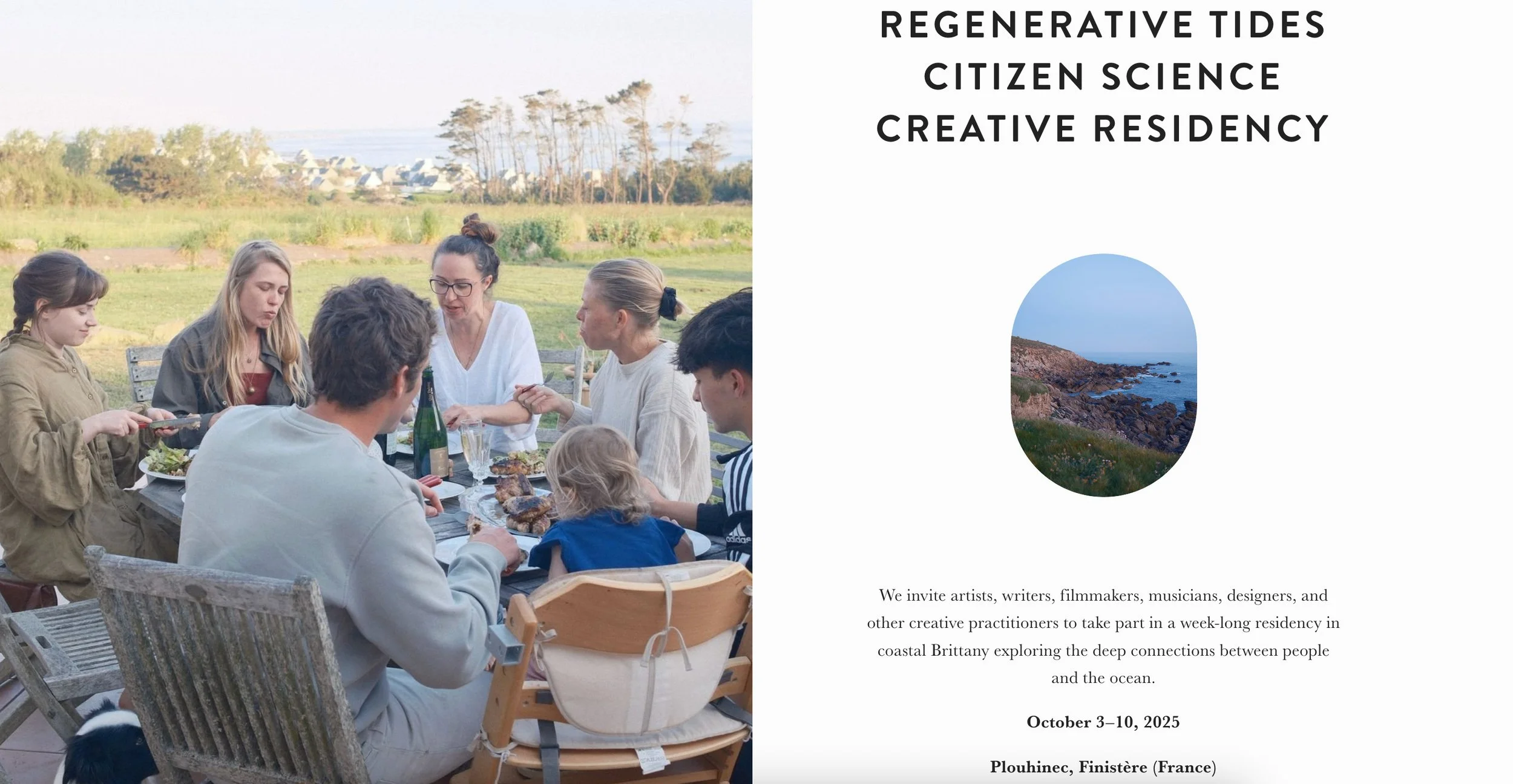
Our first ever creative residency blends creative practice with citizen science, field immersion, and environmental storytelling. Residents will contribute to our grassroots research on marine pollution from end-of-life boats while developing artistic responses that centre ecological care, lived experience, and ocean kinship.
Thematic Focus: Human–Ocean Kinship
Participants will explore themes of marine degradation, memory, regeneration, and interdependence, grounded in the local context of abandoned boats and fiberglass waste. Together, we will consider how creative work can shift narratives and support community-based environmental action.
Applications are closing in a few days (August 1st, 2025) so don’t hesitate to send yours.

Thanks everyone and see you in the boat yard next week with more updates!
Best,
Angie
(President and Co-Founder, The Floating Stories Lab Association)
