
We grow up in built environments that seem so permanent, we think that’s the world. As a kid, I didn’t notice nature pushing through; now I see nothing but. The signs are always there, in flowers growing through cracks in walls, rivers breaking defences, tarmacked roads bulging and boiling with tree roots. The longer I spent at sea, the madder seemed our attempts at control, how we set ourselves above and apart from nature. Even our language is upside down.

Susan Smillie’s The Half Bird is a beautifully crafted examination of freedom, control, intricate human relationships, and humanity’s place within the interconnected web of living systems on our planet. Written with lyrical precision and raw honesty, this adventure memoir recalls Smillie’s three-year journey at sea, charting miles across the water and an emotional and philosophical voyage into self-discovery and survival.
I finished Smillie’s page-turner in bed last night, saddened, really, at not wanting to part with her adventures and personal metamorphosis. In much the same way I became a passenger aboard Kiana Weltzien’s Mara Noka while producing her upcoming documentary film, I felt deeply connected with Smillie and Isean—from the early day sails building confidence, to turning left at Land’s Head to cross the English Channel into Brittany, then sailing south around La Pointe du Raz, passing the very place where I now lay reading.
The Raz was a massive anti-climax, the best kind. Entirely benign. No big waves. No fog. No engine problems. No adventure to regale and no regrets. A passage made memorable precisely for its lack of drama. It marked a big point in my journey, a step forward in my sea education. I had planned it well. Conditions had been so perfect I was sunbathing on deck as Isean left that notorious lighthouse in our wake. I will never forget the giddy mix of relief and pride, looking to stern as I lay smiling at the sunshine. The Raz, you say? No big deal. Up to Audierne and the Goyen River. The following day was blustery, all white horses at sea, the harbour walls holding us in a strong embrace. I looked at the webcam over the Raz de Sein. I expect it looked rough. I couldn’t tell. It was opaque. Swathed in heavy fog as the deafening sea roared out of sight. I shuddered over my moules-frites, gripped the stem of my second massive glass of vin blanc and drained it in a fug of happy relief.
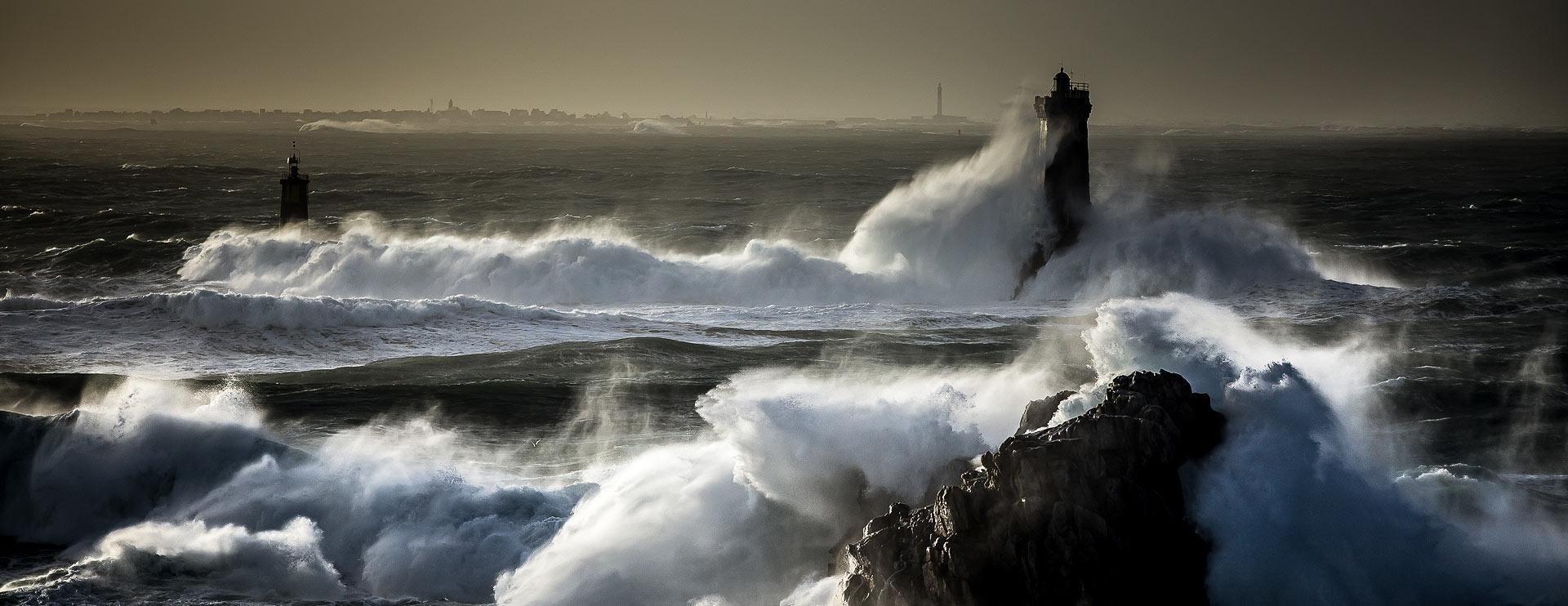
Pointe du Raz is known as a treacherous cape for sailors. Photo: pointeduraz.com
We took Remy’s visiting parents to Pointe du Raz, a pre-planned excursion during their short stay last week which coincidentally aligned with my reading of the above passage the night before. Though the air was cold and strong offshore winds whipped around us, the lighthouse stood composed, as if enjoying a rare chance to be wrapped in calm seas. Staring out to Île de Sein, clearly visible, I thought of Smillie and Isean, imagining their relief and joy at traversing this notorious passage free from its usual fury. By contrast, when our family first walked out to the point in September, we were greeted by a very different seascape: massive swells crashing against the base of the lighthouse built to endure the most rugged conditions. I wonder which will greet us - calm or storm - when we set sail north following our boat’s splash in the coming years, but if I’m to take anything from Smillie’s account, it’s the wisdom of being well prepared and taking seriously the importance of thorough passage planning.

Our boys at Pointe du Raz looking out to a calm sea state. Photo: Angie Richard.
The Half Bird’s title is partly a reference to the name Isean, which is Scots Gaelic for “chick”, and partly a nod to the form taken by the sirens of classical mythology, those temptresses who enchant and then imprison Odysseus. But if Smillie is lured towards the sea by a combination of restlessness on land and the thrill of finding herself accompanied by dolphins as she makes her way through the Pillars of Hercules and across the Mediterranean towards Greece, she is also swift to recognise peril. Sailing solo requires meticulous preparation, consistent awareness that weather conditions and sea state can change in an instant, and a readiness to draw on reserves of stamina and ingenuity.
It also requires an entirely different way of looking at the world. Smillie writes persuasively of her shift towards having and wanting less, in both material and emotional senses. She makes countless friends throughout her voyage and often wonders whether to stay a little longer in an especially beautiful or hospitable spot, but is keenly attuned to her need for a more portable, mobile life. And she is aware, too, of its fragility. A frightening night-time encounter with a group of desperate people fleeing Algeria brings home the reality that her journey is a matter of choice; chance meetings with aggressive men underline the particular vulnerability of the woman who chooses to make her way alone; the increasing frequency of unpredictable storms demonstrates the negative impact of human activity on the environment in which we live.” - The Guardian (2024).

Pylos, Greece, just one of the stunning locations along Smillie’s three-year sailing journey. Photo: web-greece.gr
At sea, Smillie embraces the uncontrollable forces of nature, finding solace in their indifference and honesty. The built environments of land—with their artificial permanence and hierarchical power structures—emerge as the true threats to her sense of security. The sea, with its untamed and egalitarian ethos, becomes a haven where she can step outside these dynamics. Smillie writes with a searing awareness of the gendered experiences of safety and autonomy, contrasting her vulnerability on land with her resilience at sea. Her stories of evading patronizing dockmasters, hostile officials, and even opportunistic predators spotlight a grim reality: for women, the dangers of human hierarchies often overshadow the raw unpredictability of nature.
This perspective—rarely articulated by male sailors—is a powerful critique of both gendered violence and societal structures. Male-authored sailing memoirs often revel in tales of battling storms or repairing vessels in remote anchorages, but Smillie’s account shifts the focus inward, interrogating the subtle and overt dangers women face simply for existing within patriarchal systems. Her decision to prioritize her own agency, even in the face of systemic obstacles, makes The Half Bird a quietly radical text.
We swayed gently on calm waters to the incongruous soundscape of crashing waves—the acoustics playing it all up to dramatic effect. I was exhausted and blissfully happy. I realised how completely I’d changed when I posted a picture online, expecting everyone to revel in my beautiful isolation, only to hear my dad wonders if I’m safe, out there in the dark, and friends wonder if I’m lonely. ‘Yes, I’m safe,’ I told him. I didn’t want to tell him how much safer I felt there—hidden in the middle of nowhere—than in a harbour with drunk men outside my boat. I was, I realized, now more at home at sea than anywhere else.
Smillie’s prose is simultaneously poetic and sharp, capturing the brutal beauty of the sea and the complexities of human interaction.
It makes me laugh how we have accepted the fiction that women are the more emotional gender. It’s a narrative that only works if we pretend anger isn’t a feeling. I met so many emotional men, all bruised pride and sulky questioning as I had the temerity to stop them stepping on my boat and taking charge.
Her language is not only evocative but laden with philosophical weight, pushing the narrative beyond personal memoir into the realm of ecological and existential inquiry. Smillie reflects on her manifestations of becoming a fit, athletic, fish and octopus hunting self-sufficient sailor prior to departure, only to acknowledge that “after days spent with only curious fish for company, I had lost my appetite for fishing.”
Sometimes, in bad weather, when dolphins surfaced beside me, I felt they sensed my tension, wished me well. As anthropomorphic as it is sentimental, no doubt; but why should we have the monopoly on feelings? Spend enough time alone with other creatures and that old hierarchy, the one with humans at the top, feels irrelevant. Inappropriate. Arrogant. We’re so maladapted in nature, struggling to keep ourselves safe. But it’s possible, I think, to regain lost ground. I began to feel a change in myself, a better connection to the wilderness. The longer I was at sea, the more I tapped into some inner knowledge. I wouldn’t go as far as to call it wisdom, but it does feel like intuition, something old.

Photo credit: Cat Vinton
When Smillie set out from Britain, sailing to Brittany’s namesake, Finistère, she faced a journey into the completely unknown. Much to the horror of Laga, the chatty, retired Breton lighthouse keeper, Smillie’s set up on board Isean is remarkably bare bones: no electronic chart plotter, no sextant, just two batteries - “the sacred engine starter and a small leisure one,” two solar panels, no heating, no Automatic Identity System (AIS), and a dodgy depth sounder. Creature comforts were scant; as she put it, “I wanted to sail.” Bravery is rarely a title we claim for ourselves; it’s more often an external judgment bestowed by others. In hindsight, the moments we’re deemed ‘brave’ often stem from decisions shaped by unique circumstances—decisions where the so-called ‘brave’ choice felt like the only viable path forward. It’s not always about courage in the traditional sense but about navigating a situation with the tools, instincts, or resolve we have in that moment. What others perceive as daring or bold often feels, to us, like necessity. I sense this in Smillie’s journey, written articulately by The Guardian:
Radical changes of direction seem to require a great deal of drama, at least in the recounting: a decisive moment, a flight from unhappiness, a marshalling of immense internal reserves. In truth, they are often more gently underdetermined than that, as is Susan Smillie’s absorbing account of her life at sea in her boat Isean. There were catalysts – the mutation of a long-term romantic relationship into a deep friendship, the sense of fracturing and fractiousness that beset the UK after the referendum in 2016 – but there was also a more gradual realignment of priorities, a slow realisation that there may be a different and more generative way to live. - The Guardian (2024).
Exploring relatable themes such as grief, resilience, and healing, The Half Bird offers an accessible narrative that avoids glorifying the ocean escapism often romanticized by sailing YouTubers—many of whom, like Smillie, turned to the sea later in life. To my delight, Smillie embraces the idea of normalizing human curiosity and the pursuit of what society often deems an ‘alternative’ way of living, writing, “It’s natural to be curious; it’s who we are.” Humans have, indeed, migrated for eternity for a plethora of reasons, curiosity among them. As for the questions of isolation—so often posed by land-dwellers to us nomadic, seafaring types—Smillie reflects on how both solitude at sea, immersed in unspoiled nature, and connection with communities on land are integral to the human experience.
…while I love community in theory, in practice it can be stifling - the cliques and politics, the small-town gossip, the judgements and differences of opinion, and the many many questions…Leaving a port after a period of time brought relief. At sea, the turtles don’t care about your status; the sea bream don’t ask you how you finance your lifestyle; the gulls have no opinion on your future plans. It is all simple again. I always felt light and free when I sailed away. But you can’t life forever alone at sea.
The Half Bird is a memoir that offers a fresh and necessary perspective on life at sea. Smillie’s reflections challenge readers to reconsider their own relationships with control, safety, and the natural world. Her journey—both physical and emotional—is a welcome inquiry into the power of embracing uncertainty and rejecting the structures that seek to confine us. For anyone seeking a sailing memoir that ventures beyond the traditional narratives of adventure and survival, The Half Bird is essential reading. It is a book that lingers, its insights likely to wash over the reader long after the final page is turned.
The Voyage Virage Book Blog and Club is an integral part of the Floating Stories Lab, our self-built research and storytelling sailboat-studio-in-progress. We aim to share books that Angie - and Remy - have read or are currently reading, incorporating our personal views and recommendations whilst encouraging a healthy dialogue with you, our community, to discuss some of these books further.
