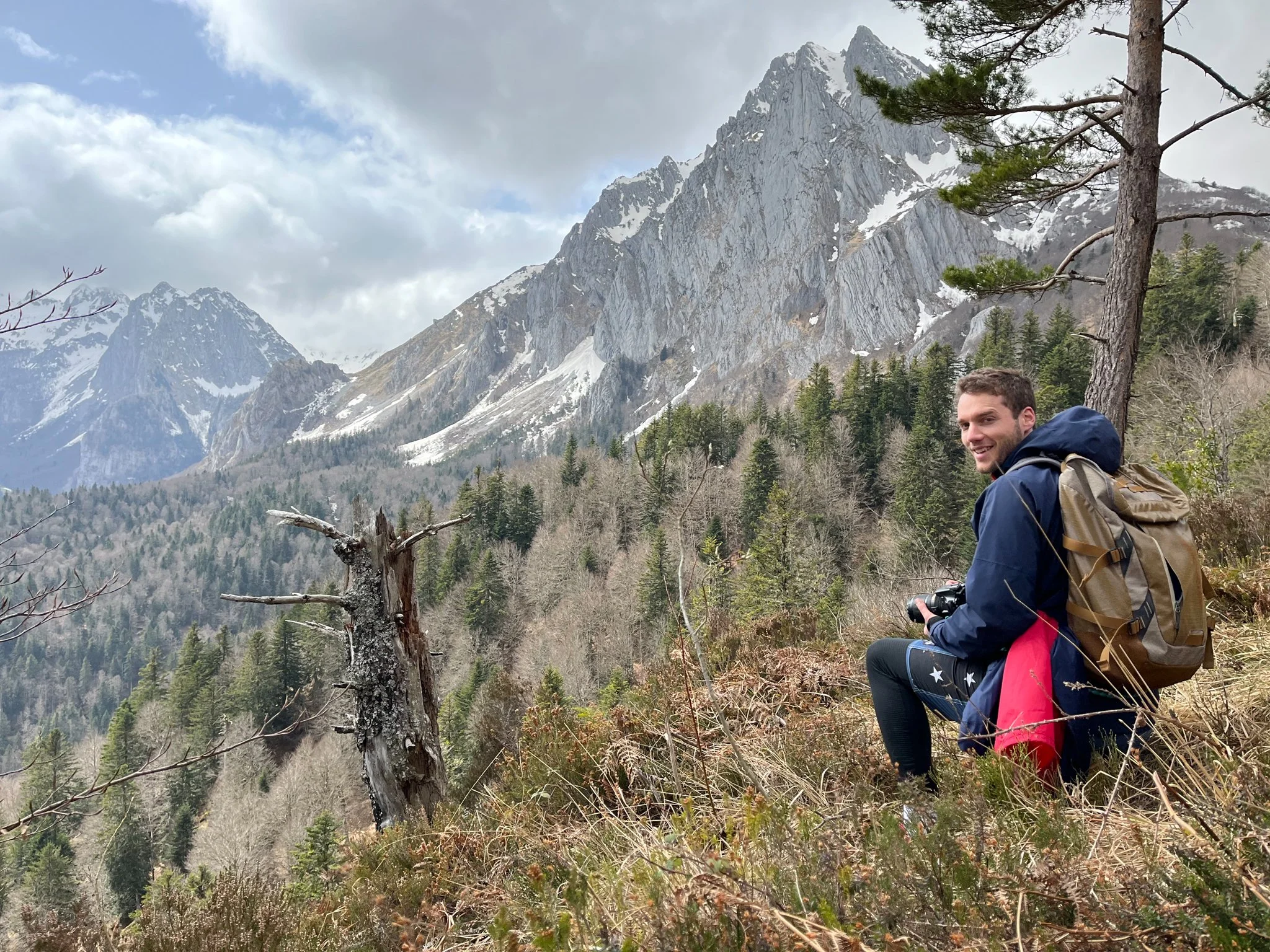
Remy taking in the spectacular view.
Our mission for this mild , late-winter Sunday trek was to enjoy a lesser known five-hour walk not far out of Lescun that I won’t name here. However, upon arrival to the starting point car park, we saw the dreaded sign you don’t want to see when you’ve just driven almost three hours from home with the kids and your border collie…the one that translates to: ’No Dogs’. France is remarkably dog friendly and our beloved dog-child Sage joins us most places, from restaurants to national parks. But alas, here we hit our first doggie road block, discovering more signs further explaining there were working shepherd dogs throughout the trek route, thus prohibiting domestic dogs from visiting. Fair enough, we thought. A quick google search and 15 minutes of detour driving and we were at the starting point a similar-length trek ‘Lac d’Lhers’, rated ‘difficult’ on the token public signpost but in hindsight it’s a moderate walk if you have reasonable fitness.
On the drive toward the Pyrenees from our coastal home, it was on our minds that we could run into challenges with snowpack on the upcoming hike. We don’t own crampons or snowshoes, and I was the only one with a pair of waterproof walking shoes. Though, considering the weather had been mild-to-warm lately, I thought we stood a good chance of completing the trek. We pushed on towards the parking spot despite the visible white caps atop the surrounding peaks.
The trek - a 12km round-trip with an elevation of 750m - officially starts from the quaint, grassy Anapia parking at 1,011m, and is expected to take around 4.5-5hours depending on your fitness levels and weather conditions. We left our car at 11:30am, equipped with four liters of water, mandarins, biscuits, and muesli bars. Sage was ecstatic to be back in the mountains, and considering the challenging pregnancy and miscarriage journey Remy, the kids and I had been through just weeks before, we all felt a huge relief to be in the majestic presence of the Pyrenees and breathing that crisp mountain air.
According to Wiki, “the Pyrenees are older than the Alps: their sediments were first deposited in coastal basins during the Paleozoic and Mesozoic eras. Between 100 and 150 million years ago, during the Lower Cretaceous Period, the Bay of Biscay fanned out, pushing present-day Spain against France and applying intense compressional pressure to large layers of sedimentary rock. The intense pressure and uplifting of the Earth's crust first affected the eastern part and moved progressively to the entire chain, culminating in the Eocene Epoch.
The eastern part of the Pyrenees consists largely of granite and gneissose rocks, while in the western part the granite peaks are flanked by layers of limestone. The massive and unworn character of the chain comes from its abundance of granite, which is particularly resistant to erosion, as well as weak glacial development.
The upper parts of the Pyrenees contain low-relief surfaces forming a peneplain. This peneplain originated no earlier than in Late Miocene times. Presumably it formed at height as extensive sedimentation raised the local base level considerably.”
The first component of the trek weaves through pine forest, with a gradual, steep climb taking you further up into the mountains. In the forest, we were protected from the chilly wind, yet as we began to approach the top of the treeline we could feel the breeze start to whip through and pierce our skin. Here, we were greeted by chunks of slushy snowpack, and we passed a couple who informed us that the next section was quite difficult, partly due to the steepness, sheer drop on one side, and the slippery, melting snow. As we continued with caution, we stopped several times to take in the breathtaking scenery: sheer vertical rock faces etched with wisdom, past and present.
Sage lost her snow virginity and reacted as expected, rolling about, sliding, and freezing her nipples in the muddy white snow (legit, they were quite raw when we got home). We proceeded onward until alas, we reached our point of no return. Snow covered the final stages of the trek up a steep incline towards a ridge that would have revealed our destination on the other side - the lake - but we would have to accept a premature end and tackle the final stage later later in the year. Another couple descended past us – with crampons – and they advised that even with their gear they could not complete the final stage to the lake, the ultra-slushy snow making it too dangerous to ascend further up the ridge.
We like to accomplish a trek, but as we learned from our experience in the Himalayas a few years ago, even when you reach a peak there is often another handful behind it. For today, we’d reached our limit and surrendered to the beauty that surrounded us and enjoyed our snack pack of chocolate biscuits.
During the descent, we all agreed to come back and complete the trek later in the spring. The kids also affirmed they would like to start doing overnight hikes and by the end of the trek we had decided to start preparing to tackle the GR10, the famed trekking trail that runs the length of the Pyrenees, from the Atlantic Ocean to the Mediterranean Sea. Once the snow melts, we’ll come back to complete Lac d’Lhers and camp the night as part of our training.
One of our trekking rituals is to treat ourselves with a cold beer (orangina or grenadine for the kids) at the end, but we often find all the bars and restaurants are closed at the time we finish walking, especially over the off season. This time around we prepared a roadside picnic and to our delight the Anapia parking sported a little picnic table for us to enjoy our well-earned treats. We had to wrap our picnic at little faster than expected, though, for the wind was picking up and snow clouds gathering. Pleasantly exhausted, we hopped back in the car and slowly made the drive home, already planning our next trek for the weeks to come.