
Goodbye Southwest France, hello Bretagne, but where?
Originally posted on Substack on Aug 11, 2024. Subscribe to our Substack page to receive our latest news and updates straight to your inbox.
Can you believe it’s our final weekend in the southwest? On Monday, we begin our migration to Bretagne, where we'll set up camp one week at a time, gradually easing into this exciting new chapter.
I’m trying to catch you all up to real-time, but first, let's step back a few weeks to the second part of our ‘Bretagne Field Trip’ and the days following our fun afternoon sailing Benoit Castel’s Hitia 17, a self-built Wharram catamaran.
In this edition, we splash Benji Flao’s Tiki 28, meet innovative boatbuilder Pascal Petit, unbox our boat plans with Hanneke Boon (Wharram Designs), and make a life changing decision…
Louloute, a Tiki 28
With Hanneke Boon from Wharram Designs camping with us in Plomeur, Lorient, we ventured over to the Billie Marine boatyard in Hennebont for the re-launch of French artist Benji Flao’s Tiki 28, Louloute. Hanneke would be joining Benji and his kids on a sail from Lorient up to Douarnenez for the second installment of the annual Maritime Festival. She had already participated in the first stage, sailing from the UK to Brest on a traditional wooden monohull.

Benji Flao making final adjustments before re-splashing Louloute, his Tiki 28.
Our intention was to check out the boatyard as a potential location for our Narai Mk IV build. We were quite certain Lorient would be the right place to relocate for the next few years to construct our Wharram, though we’d have to adapt to city life.
Once again, we were humbled by Hanneke’s attention to technical detail. She jumped right in to help Benji with a few pointers as he readied the boat just before it splashed into the adjacent river, the Blavet. We were joined by Benoit and his friend, Pascal Petit, an innovative boat builder who had met both Hanneke and James Wharram years ago on the Atlantic Coast of France.

Pascal, having almost died from an allergic reaction to epoxy, is now building an all-fiberglass (GRP) Wharram-inspired catamaran nearby. His simple agricultural tent workshop, which we visited that afternoon, was filled with tools, templates, molds, and the hulls-in-progress.

Pascal and Hanneke in Pascal’s simple boat workshop.
Benji welcomed us with a warm smile as he finished prepping Louloute to be carried the short distance from the boatyard to the launch ramp by tractor-trailer. With precision, Billie Marine’s tractor pilot lined her up at the water’s edge, and when Benji and his crew were ready, they gave the boat a final nudge. Into the water she plunged, to the cheers of those watching on land and a toot from the tractor.
I rubbed away a tear that escaped down my cheek. It was drizzling anyway; no one would notice the emotion I felt for a stranger and his boat being launched after a period of hard work on land. We hadn’t even decided on a location for our build, let alone made our first cuts of plywood, but I knew that one day we would be readying our boat for splashing—a liminal moment between the build phase and the thousands of nautical miles and adventures that lie ahead.

Boat building tools from Pascal’s workshop.
Unboxing Our Boat Plans
The next day, we picked a dry space next to the campground’s restaurant, ready for the moment we’ve been excited about for months: unboxing our boat plans. Hand-delivered by Hanneke herself, we are not ignorant to the privilege of having Hanneke’s encouragement for our 41ft Narai Mk IV build.
(If you’re new here, we first met Hanneke - head of Wharram Designs - on board her Pahi 63, Spirit of Gaia. Check out the video we made from our time on board.)
Having the plans in our hands officially kicks off the R&D phase of our build. The plans for classic designs like our Narai were made before epoxy and fiberglass became commonly used, when resourcinol glue and nylon were still applied to marine grades of plywood. We’d like to avoid fiberglass if we can, due to its impact on marine ecosystems, but, ideally, we don’t want to go back to using resourcinol glue and nylon, with nylon being a petro-sourced non-biodegradable material.
(I’ve just submitted two articles to Practical Sailor that will be published later this month [gratefully, they have allowed me to re-publish both pieces for our Substack members], going into more detail about the materials we wish to explore and the issues with fiberglass.)
Remy and I, thankfully, have very different-thinking brains. He’s more analytical with attention to detail and the ‘micro’, whilst I’m more of a 'macro-vision’ person who also needs visuals to help with comprehension. Both of us learn-by-doing (‘Sailing Learning By Doing’ is also a great YouTube channel about sailing and traveling the world, by Vernon Deck and Marie-Morgane). Wharram Designs’ plans are visual, all are hand-drawn, many of the build plans drawn by Hanneke herself, a brilliant illustrator, designer and builder. Remy and I poured over the plans, with Hanneke frequently reminding us that Step One is to read the red booklet first, as the answers to many of our initial questions were already typed on its pages.
Changing Life Plans
The next day, we said goodbye to Hanneke as she moved on board Louloute with Benji and his two kids, ready to release the lines early the following day and set sail for an overnight stop in Audierne before continuing to their destination, Douarnenez (read on to the end of this post for a note from Hanneke about her trip and some photos). We returned to camp to enjoy a final two days exploring Lorient, visiting a school, and indulging in the local fare: moules frites (mussels and fries) and oysters. I couldn’t help but wonder how much fiberglass (GRP) I might be ingesting, given my involvement in recent scientific research that discovered shocking levels of GRP in mussels and oysters collected from Chichester Harbour in the UK.
Some might simply say, “Don’t eat them if you’re worried about it.” The choice to avoid known contaminants in our food chain is certainly a privilege, but many communities around the world rely on seafood for nutrition. The Bretons, in particular, have a longstanding history of collecting and eating shellfish. I’m currently researching human-oyster kinship stories for my Regenerative Tides project, exploring our deep relationship with these fascinating creatures, often dubbed the ‘lungs’ of our ocean due to their water-filtering abilities. Sadly, fiberglass particles are consumed by the oysters during this filtering process, having a detrimental impact. This isn’t a problem to ignore; we need firm and effective policies and accountability supported by the public.
We hadn’t planned to venture beyond the Morbihan region of Bretagne. Finistere, known for its wildness, seemed like a stretch this time around, considering Remy was attempting to work remotely and I had a ton of work with my ongoing MA studies.
“You can’t come all this way and NOT come to the Maritime Festival in Douarnenez,” reasoned Hanneke. “All the fleet will be sailing from Brest, and it’s such an incredible sight. You must come.”
I’ve always been proud of our adaptability, something we honed while backpacking across Asia with Ryder and Hunter and very little money several years ago. We knew the Finistere region was known for its wild, remote, and beautiful landscapes. It felt like we should check it out, but we assured ourselves that we were content with the planned relocation to Lorient. Despite not being the most beautiful city—over 60,000 bombs dropped by Allied forces during WWII razed 90% of Lorient in an attempt to knock out the submarine base controlled by the occupying Germans—Lorient was still practical. The city might not have much architectural wonder, but we could live on the outskirts, ideally in an apartment, for a few years while building the boat at one of the boatyards. At least, that was the loose plan.
Outside the city, Lorient had spectacular beaches. We sailed a Wharram Designs Hitia 17 built and owned by Benoit Castel. Read about it HERE.
I hopped online and found a lush-looking campsite in Douarnenez. It was slightly expensive, but I figured we wouldn’t find much better given the festival. My cinematographer friend from the southwest, Max Garenne (check out his work HERE, it’s impressive), who grew up on a traditional wooden sailboat with his family, had mentioned that his brother Luc was living in a quaint coastal village in Finistere. Max insisted that if we were going to Douarnenez, we must reach out to Luc and his partner Megan, as they might be interested in our Wharram build. (Indeed, Max had mentioned before to me that his dad thought James Wharram was quite the genius.) I dug up Luc’s contact details, sent him a text, and sure enough, we were welcomed to stop in for a coffee.
Some people believe in fate, and perhaps I did too in the past. But I’ve seen and experienced a lot—both positive and extremely negative—and I’ve come to believe that believing in fate is a privilege. With our resources stretched, we made the decision to extend our enjoyable research ‘holiday’ and act on introductions that soon led to life-changing decisions...we fell in love with Finistere.

Beaches in Finistere reminded me of my childhood surfing along remote southern Australian coastlines.
Our remaining three days were filled with lots of walking to meet up with Hanneke and Benji at the Maritime Festival, where we were awed by the volume of traditional wooden sailboats, and exploring the coast around our new friends’ place. Spacious, uncrowded beaches with clear waters lapping on white sand in sheltered bays; it was summer, and the weather was spectacular during our short stay. For the first time in five years of living in France, we felt like we’d discovered a place we could call home—not just for the next few years while building the boat, but possibly forever. A place to plant trees, grow veggies, build our Wharram in the backyard, and invite friends to come stay and help. A place to explore the coast, learn from the many local sailors, and immerse ourselves in coastal living—think spearfishing, surfing—all the things that filled Remy’s and my childhoods, respectively. A place to return to following our planned circumnavigation.
This might come as a shock to some readers, as we’ve been voicing our desire to relocate to Bretagne for a few years to build our boat then take off on a circumnavigation, unsure if we’d return to France afterwards or relocate to Australia. I’ve lived semi-nomadically for two decades, happily moving when my heart and soul desired, but during that time have always developed strong land connections, growing food and enjoying the perks of having a land base (a place to store my books, for example). Remy and I have dreamed of a sister project: the Living Land Lab, where we could further explore regenerative ways of living learned from our upcoming world sailing trip. We are inspired by Breton sailor/engineer Corentin de Chatelperron and his Low-Tech Lab (based in Finistere, by the way), and have experimented with self-taught no-dig gardening on Remy’s parents’ land in the past (check out this video HERE). But we hadn’t believed we could possibly have our own home AND build our boat at the same time. Perhaps, though, we CAN create that opportunity.
The long drive back to Remy’s parents’ house in the southwest gave us a chance to talk through scenarios. Lorient was the sensible choice—school, football club, boatyard—while Finistere, on paper, seemed more complicated. The school and football club were a decent 30-minute drive away in Douarnenez, and the village we’d like to move to is more remote, raising concerns about the kids becoming isolated.
But as a friend once shared with me, “Make decisions with your heart and solve the consequence of that choice with your head.”
Our hearts are with Finistere. We will make the rest work, one step at a time.
And so tomorrow, I’ll drive off to Finistere with Ryder, Sahara, and Sage to set up camp - yes, we will be camping in tents until we find a temporary rental and Remy’s finds a new job - ahead of Remy and Hunter’s arrival on Tuesday. Remy will drive up in a rental van to relocate our remaining ‘stuff’ from one small storage box to another closer to where we will be relocating (out of respect for the local community, as we are ‘blow-ins’ migrating to a new place, I will not reveal the name of the village we are moving to). We’ll be looking that home to call our own, where we can build the boat in the backyard—true to James Wharram’s philosophy that the hulls can be built on land and later assembled at the water’s edge. (Have you read People of the Sea by James Wharram with Hanneke Boon? Highly recommend!)
Instead of sacrificing our happiness to live in a city for years while chipping away at our Floating Stories Lab dream, we are reminding ourselves that it’s important to enjoy the process - it’s the journey that counts, right? Our kids are growing up in the blink of an eye, and we want to instill in them the marine-centric and minimalist-living values that boat life offers while still living on land. Finistere, we hope, can enable this life education.
Do you follow us on Instagram? I’ll be posting stories over the next few weeks as we camp out and explore our new location. Please also join me, Angie, over at my personal Substack Kinscript, too, where I share ‘tales of kinship through the twists and turns of living abroad (France), motherhood, and hand-building a wooden catamaran with my family.’
Will you financially support the Floating Stories Lab? Please consider upgrading to a PAID subscription for 50€ per year, or invest 150€ to be a founding member. Your contribution supports it all: research and development, the boat build, Regenerative Tides initiative, and all the content I’m producing so as to keep this all a knowledge exchange and community experience.
The Floating Stories Lab is a reader-supported Substack publication. To receive new posts and support our work, consider becoming a free or paid subscriber.
P.S. I’m trying to convince Remy to start his own Substack in French (which we could look to have select posts translated into English, too). Most English-speaking folks will recognise my (Angie) voice here in all our public-facing content, but Remy is an exceptional writer (in French) and philosopher, and I believe our community will certainly benefit from hearing from him more often.
A note from Hanneke about her adventures in Bretagne:
In the last 10 days, I’ve been part of the great maritime festivals of Brest and Douarnenez (in Brittany). For the first time since my teens, I sailed on a monohull—a beautiful, recently built traditional one— from Falmouth to Brest (Men A Vaur). Having gotten so spoiled with the motion of a catamaran, I found the heel and rolling motion of the single hull made life aboard much harder and riskier on deck.
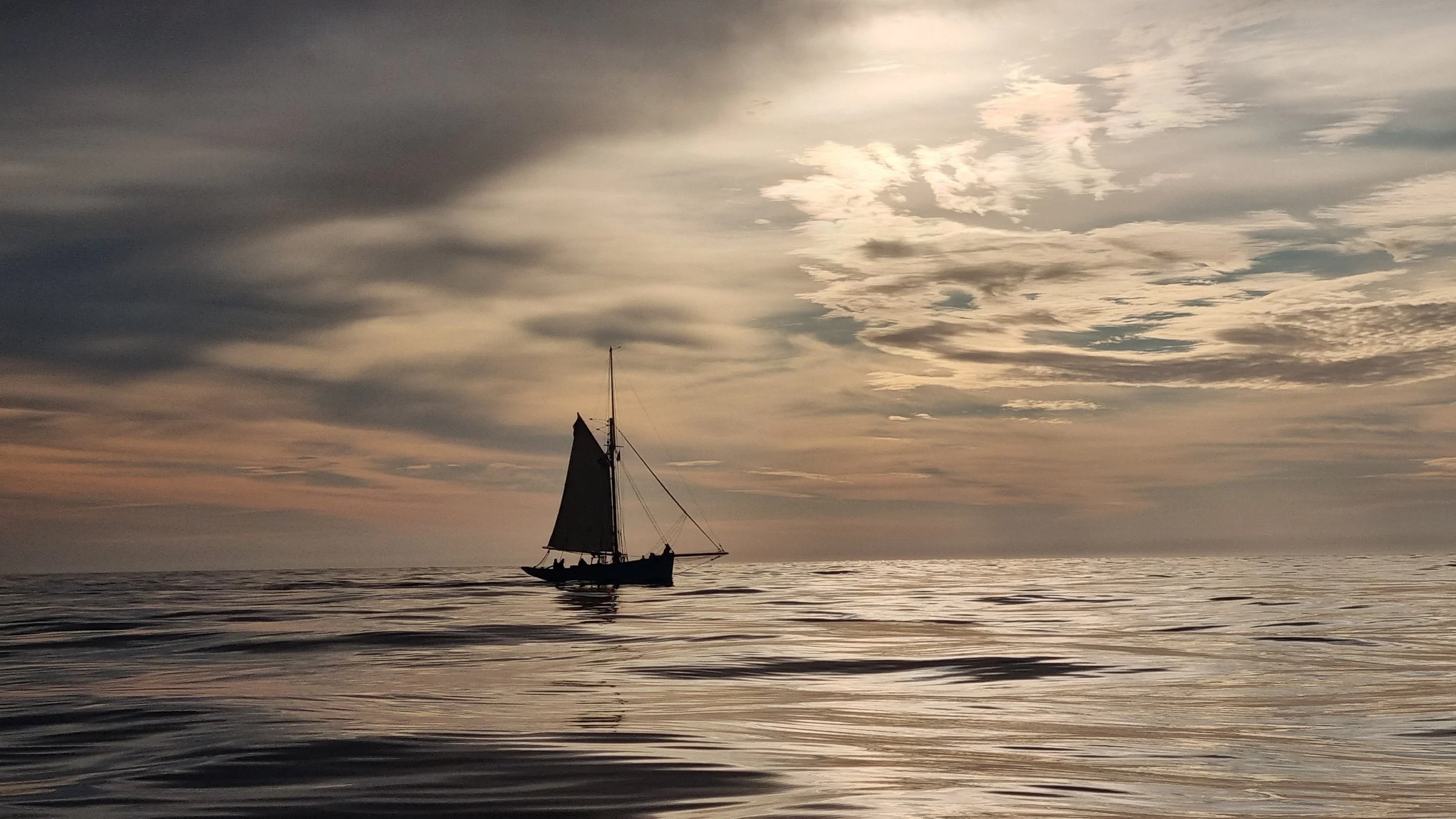
Photo: Hanneke Boon
Afterward, I took a bus to Lorient to meet up with Benjamin Flao, the artist responsible for the drawings in the beautiful Wharram article in Voiles et Voiliers. He owns Tiki 28 No. 4, Louloute. I sailed with him to Douarnenez, where we met up with hundreds of boats sailing from Brest. The sight was incredible—so many traditional boats under sail. Now, with the rain having arrived, I sit in the crew tent catching up with Facebook.

Benji at the helm. Photo: Hanneke Boon

Louloute beached in Douarnanez, the harbor filled with traditional wooden boats in the background. Photo: Hanneke Boon
