
Collège du Bois de Locquéran welcomes FSL and Dr. Corina Ciocan to kick off our collaborative research project
First published in our FSL Substack Newsletter. Click Here to subscribe.
Hi Folks,
I write to you this morning following a stunning sunrise, viewed over a pot of hot coffee from the comfort and warmth of our kitchen table. This time of the morning is always my favorite to write, when the house is quiet. This morning, I am contemplating the huge month of September we’ve just had at Floating Stories Lab, with much progress being made at the boat yard cutting our Movingui legacy hardwood into usable planks, to my recent Port Townsend visit, and preparations to host the first ever FSL Citizen Science Creative Residency kicking off later this week. We cannot wait to welcome the eight selected artists coming to join us in a week-long program to explore human-ocean relationships grounded in the local context of abandoned boats and subsequent fiberglass pollution. You can meet the final eight participants HERE.

Dr. Corina Ciocan from University of Brighton presenting her research to students from Collège du Bois de Locquéran in Brittany, France, about bivalves ingesting fiberglass and resin from end-of-life boats. Photo: Angie Richard/FSL
Most recently, we welcomed our scientific partner Dr. Corina Ciocan to Plouhinec. Together, Corina and I made a visit to Collège du Bois de Locquéran, the middle school embedding our ReTISS citizen science initiative into their ‘Euro’ curriculum, which merges English and Biology for two hours a week. Over the next year, the middle school students will contribute to important research, mapping end-of-life boats in their local village, collecting and analyzing bivalve samples for fiberglass pollution, and creating a short video to communicate their school’s participation in the project.

Dr. Corina was warmly welcomed by the school’s biology teacher, Gwen, giving a presentation about the problem of end-of-life boat pollution on marine ecosystems, with a particular focus on the scientific work of her team at University of Brighton who discovered micro fiberglass ingestion by oysters and mussels in Chichester Harbour. The kids listened attentively, connecting the issue to their local context, as the school fronts the biodiverse Goyen Estuary, and a cluster of dumped wooden and fiberglass boats.
I popped down to the Goyen before class to collect a handful of organisms for Corina to teach the kids how to analyze correctly. I have been saving this site to map with the kids and our upcoming creative residency participants, so despite driving past the cluster of dumped boats countless times in the past year, I’d not yet walked around the site at low tide until that morning. I was, frankly, shocked. I collected fragments of paint, fiberglass, and other plastic pollution shed from the boats on to the mud, algae and plant biota growing around the high tide line and under the boat hulls. I viewed closely cracked and thereby exposed fiberglass from the damaged boats, along with exposed electrical wiring, plumbing, shedding paints, and all kinds of waste that come with end-of-life boats.

Up close with a dumped boat in the Goyen Estuary, Audierne, Brittany, France. Photo: Angie Richard/FSL
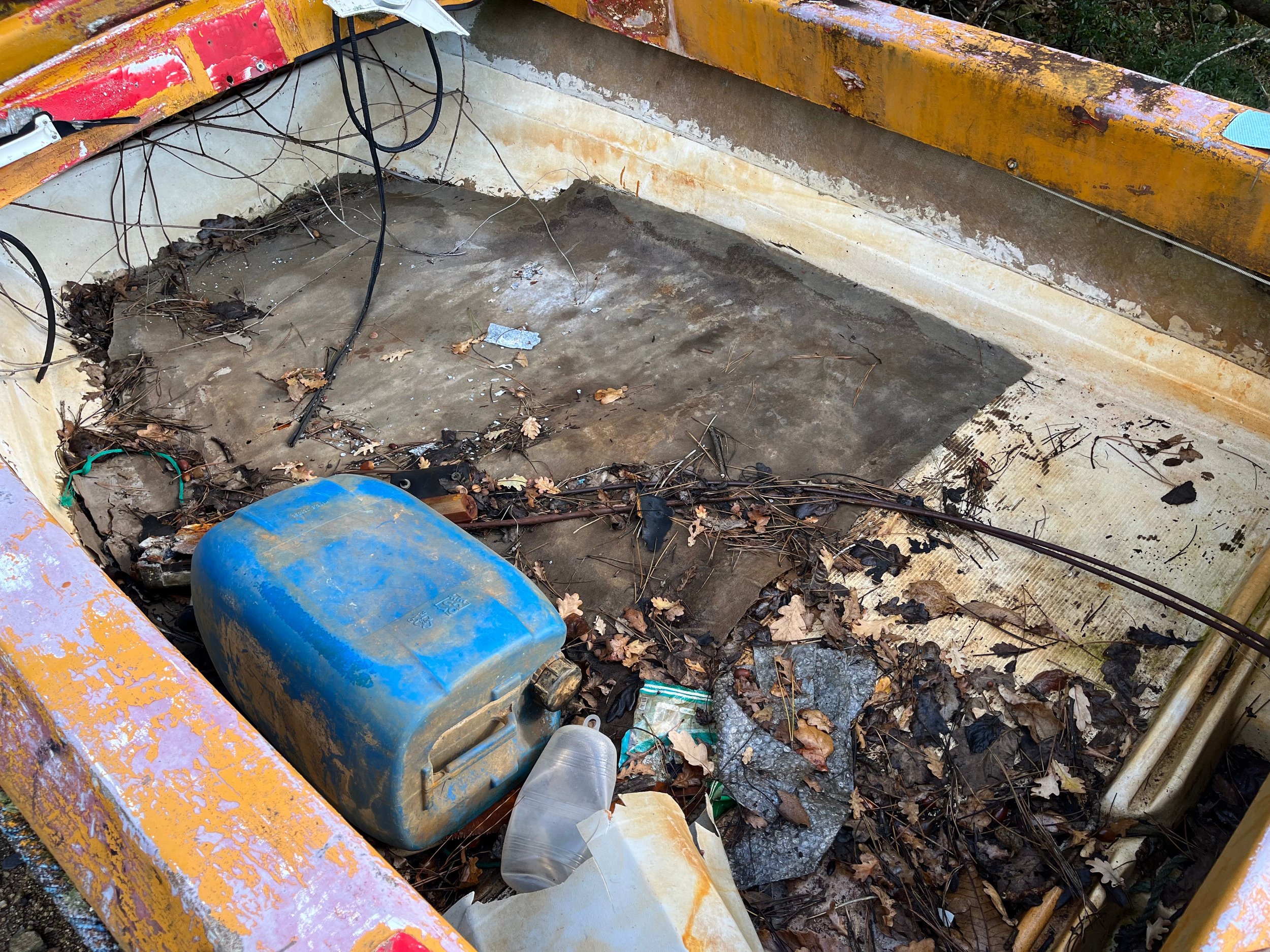
Abandoned boats are typically accompanied by hazardous waste and litter, either from the boat wreck itself or additional dumping. Photo: Angie Richard/FSL
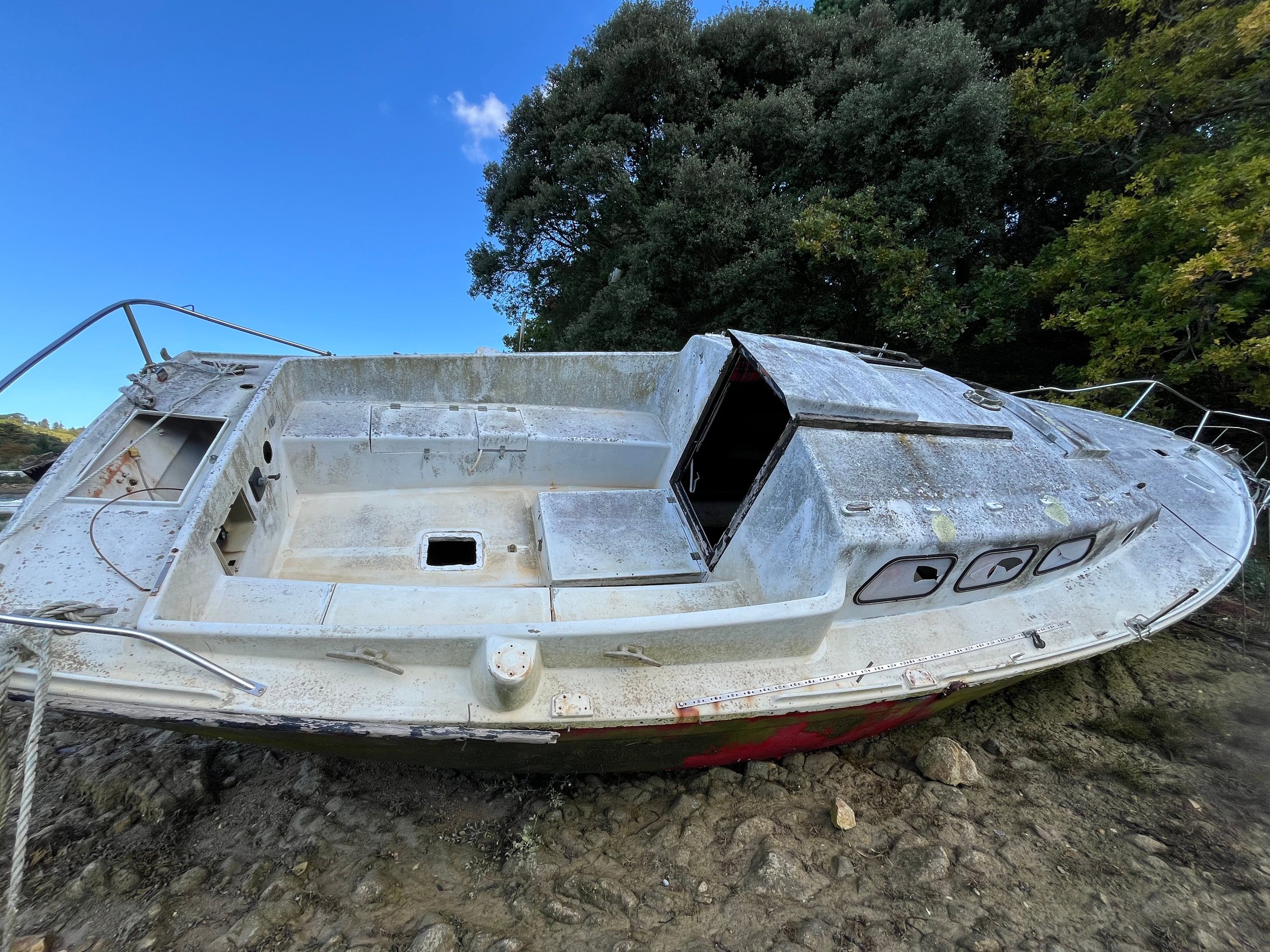
Amongst the cluster of ‘Bad Boats’ dumped in the Goyen are older wooden wrecks and more modern fiberglass boats. Materials from both types pollute the estuary. Photo: Angie Richard/FSL.
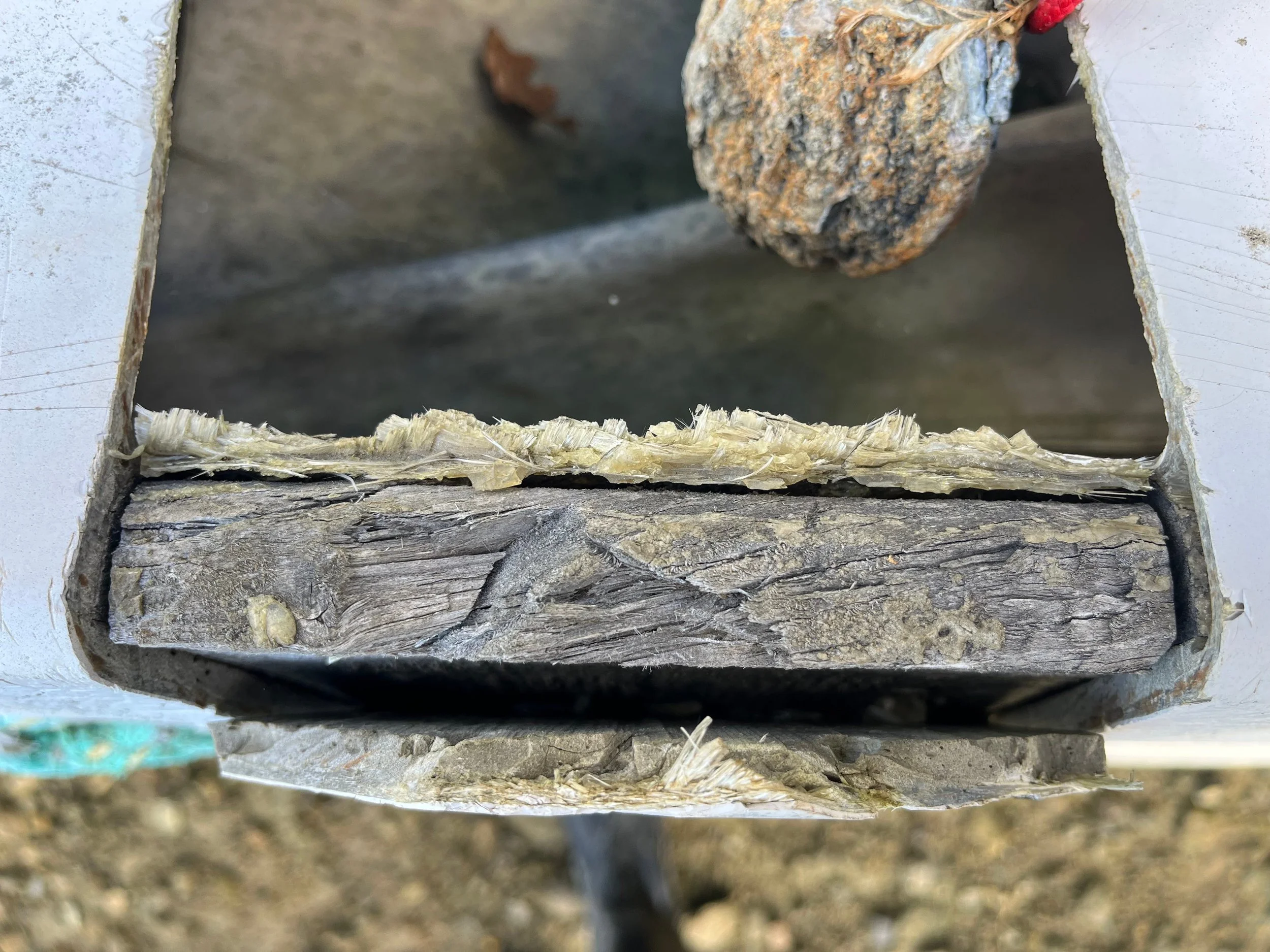
Even without a microscope, if we look closely we can see cracked and exposed fiberglass on these dumped boats. With an asbestos-like chemistry, fiberglass exposed like this presents a grave danger to human and nature health. Photo: Angie Richard/FSL.
As I walked towards the water, now at low tide, I hesitated when I heard the cracking of shells—I was walking atop hundreds of oysters and mussels that grow on anything they can cling to along the sides of the estuary, like rocks and, sadly, bad boat waste. I collected some of the organisms in my wire basket and hurried home to place them in water with a touch of salt for those we would not be analyzing in the school lab I would return to the river so as not to waste their lives.
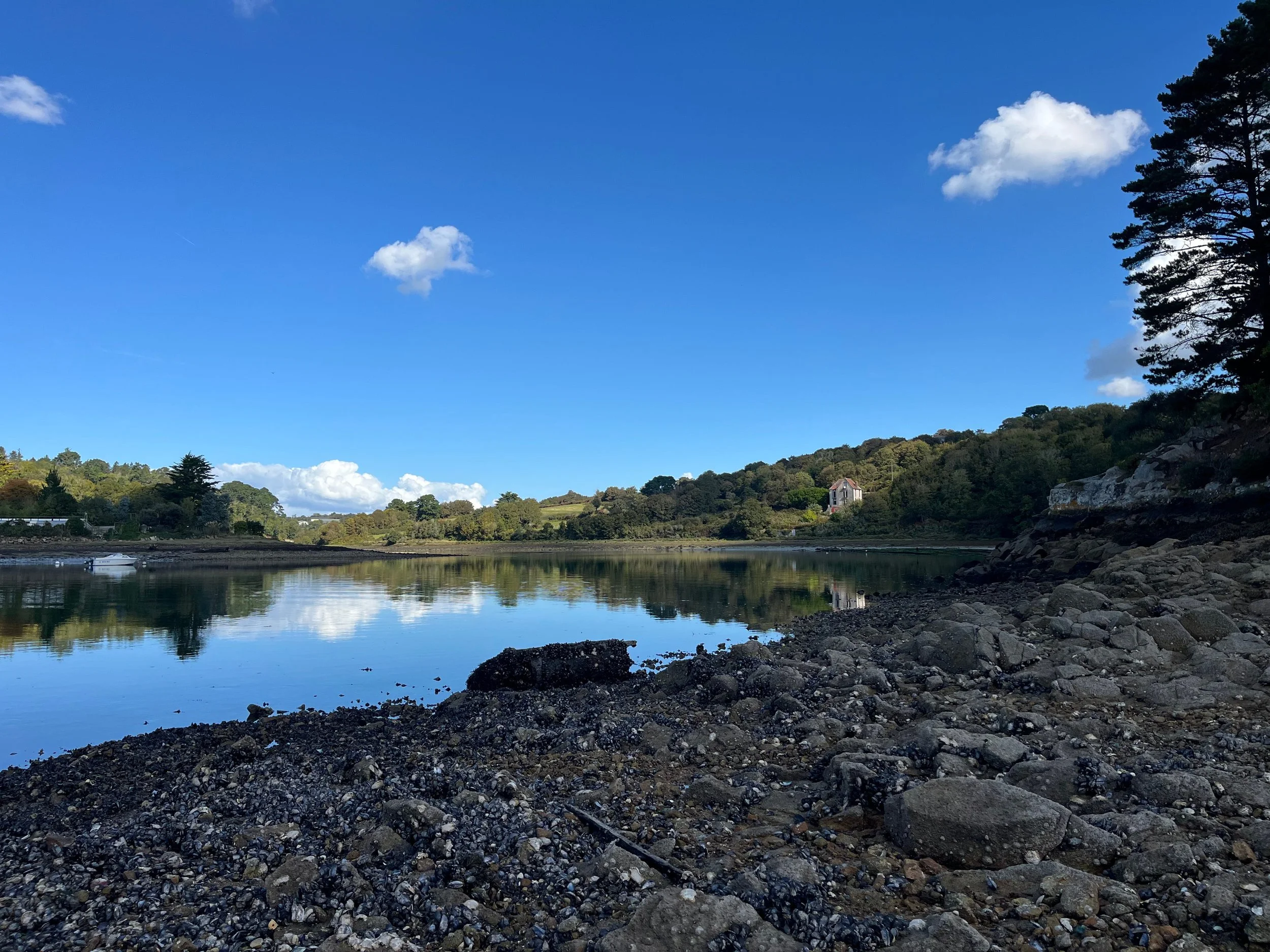
Oysters and mussels populate the rocks on low tide along the Goyen, directly in front of clusters of abandoned, polluting boats. Photo: Angie Richard/FSL.
Back in the school lab, following Corina’s presentation and a sound introduction to the impacts of fiberglass pollution, Gwen pulled out the microscopes and I also introduced the kids to the handheld 4K bluetooth microscopes we are using in our ReTISS fieldwork. We looked at the fiberglass, paint and plastic samples I had collected from the shore to give the kids a better view. They were shocked to see the shards and splinters so exposed, especially now knowing the impact that ingesting these materials has on bivalves as Corina had shared from her research in the UK. The kids learned to record photos and video on the handheld microscope, collecting important data for our mapping research.
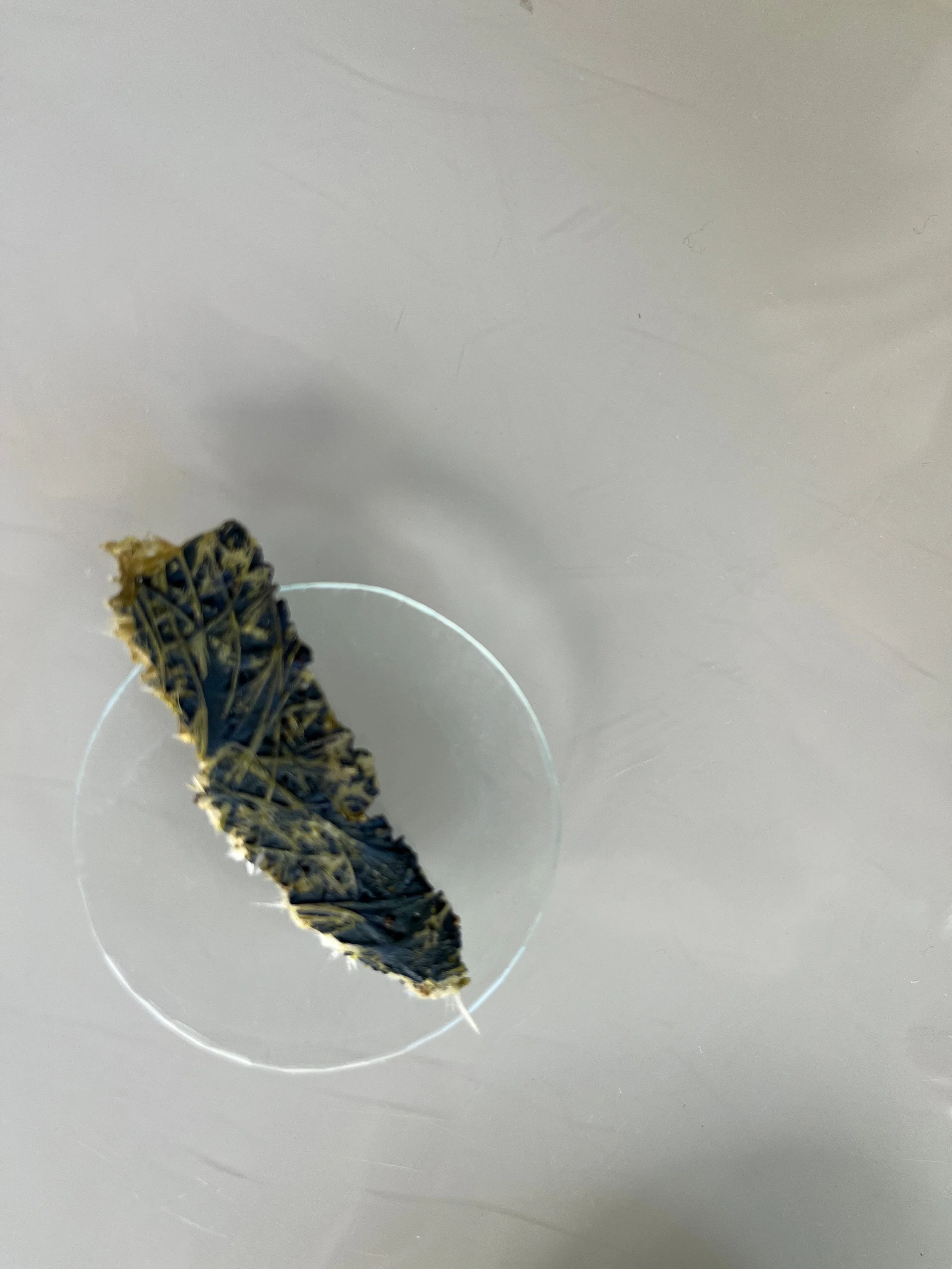
Fiberglass, paint and resin from one of the damaged boats found lying on the mud under the boat. The kids analyzed this sample under the handheld, bluetooth microscope, recording the data, contributing to research. Photo: Angie Richard/FSL.
Finally, Corina and Gwen opened four mussels, explaining first the anatomy of the organisms and showing us the gills under the microscopes. This was a first for me, too, and I was fascinated watching the tiny hair-like fragments of the mussel’s cilia filter the water even after the organism had been dissected. We ran out of time to have a thorough search for microfiberglass particles, however one group of students discovered a long strand of plastic in their organism sample under the scope—plastic ingested in to the mussel’s lungs. With the method of analysis now under their belts, the kids will now play a vital role in our research over the coming months. The issue is certainly close to home for these kids. When asked how many of them eat oysters and mussels regularly, over half the class raised their hands. Indeed, we live amongst a rich culture with deep ocean-human kinship relations stretching back generations.
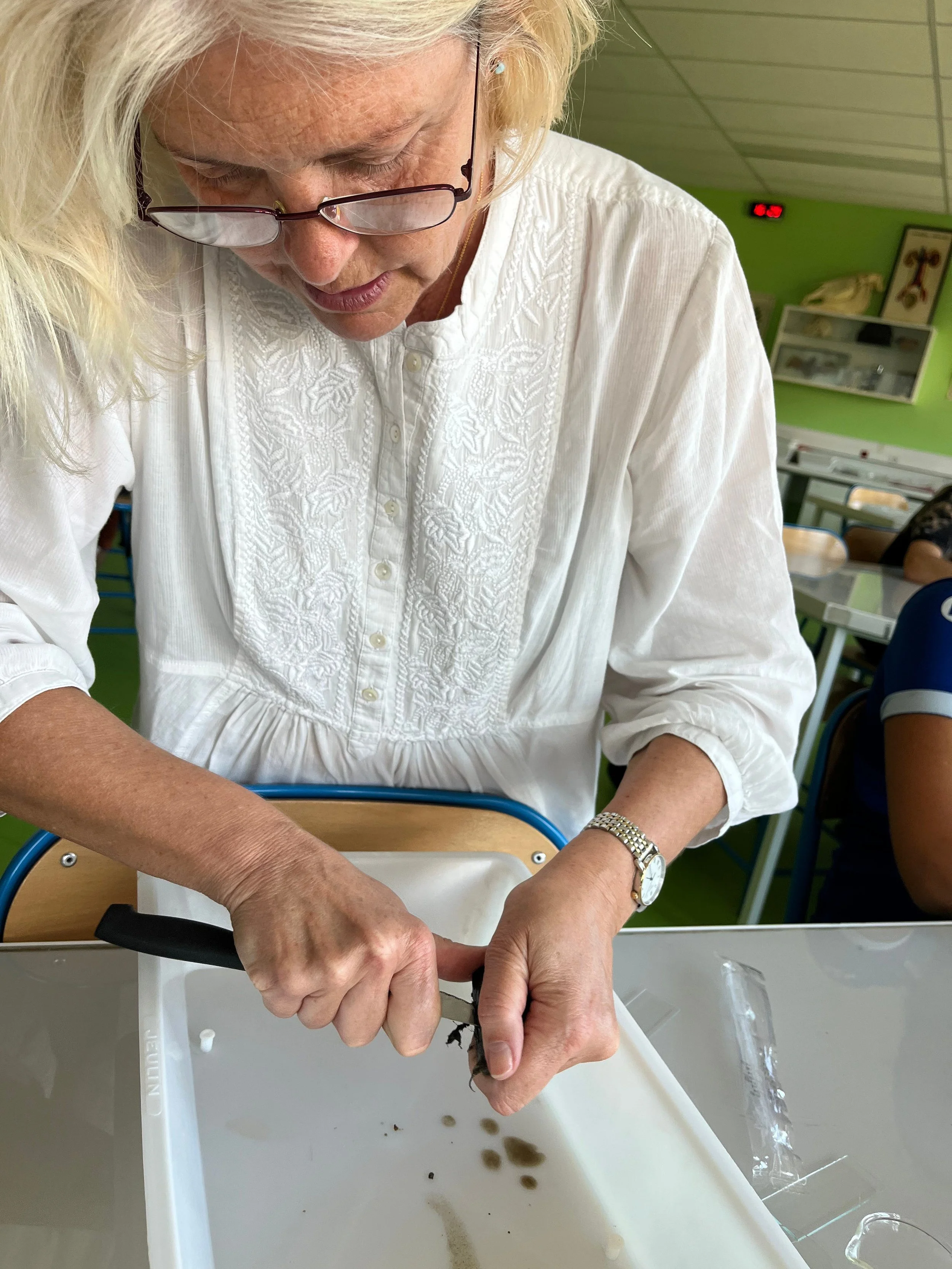
Dr. Corina Ciocan opening a mussel collected from the Goyen in front of the cluster of Bad Boats. Plastic fragments were found by students looking at the lungs of the organism under the microscope. Photo: Angie Richard/FSL.
Learn all about our ReTISS Citizen Science initiative HERE, and do check out the interactive map of Bad Boats now beginning to populate as citizen scientists add boats in Brittany and the UK. If you’d like to participate, you can download our how-to Field Guide HERE.
To help us get ReTISS in more schools and train citizen science community leaders around the world, please consider becoming a PAID member of the Floating Stories Lab.
