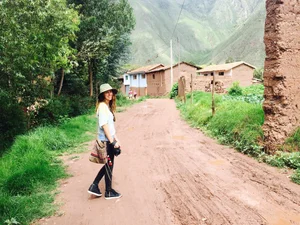
First published in our Substack newsletter.
Happy Easter folks!
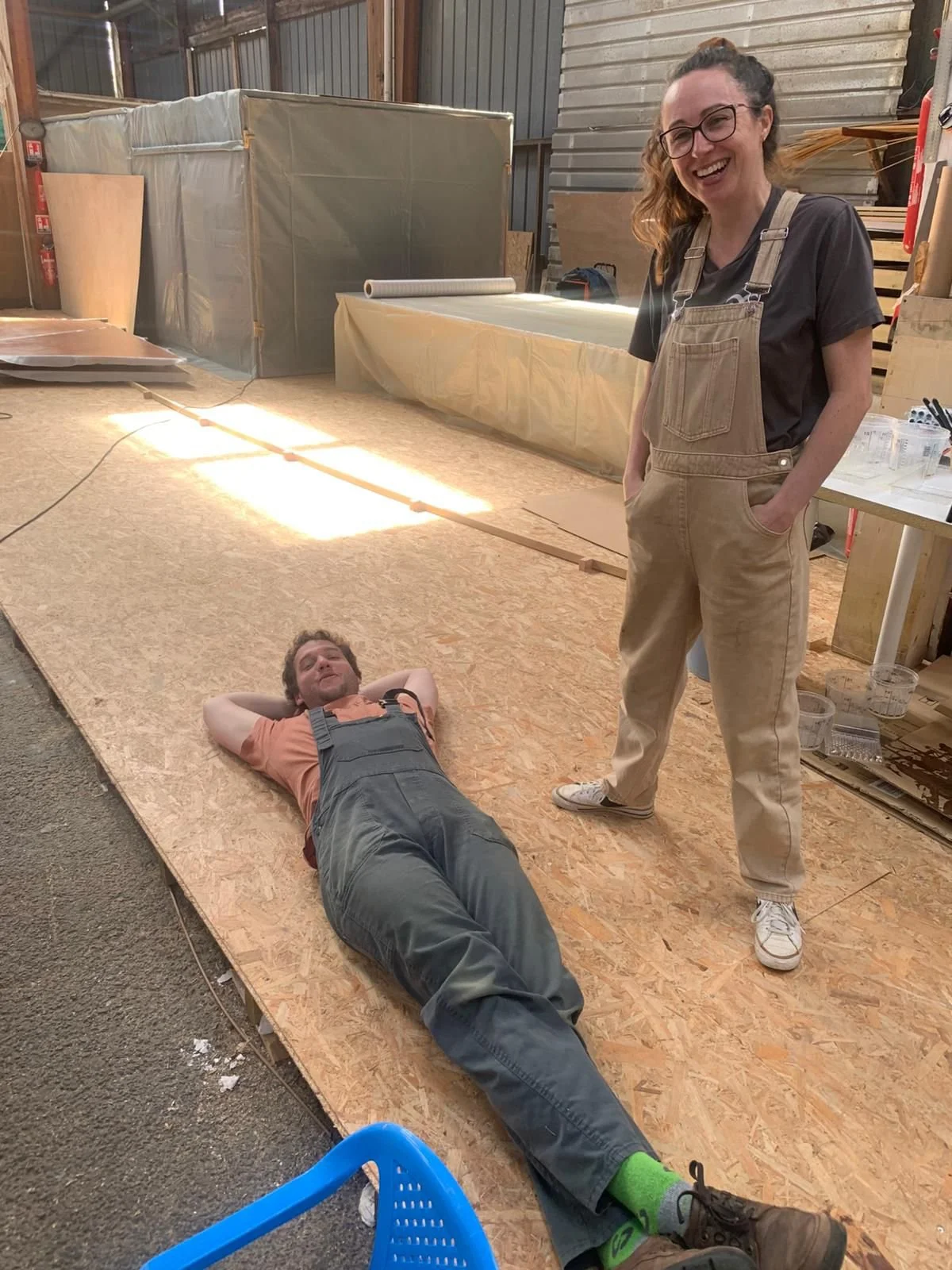
Remy and Angie taking a break in the boatyard. Photo: Simone.
I write to you with a big smile at our family dining table as a chicken roast cooks for our routine Sunday roast. We will be in the boat yard later like all Sunday afternoons, so our weekly big lunch with the kids at home is a pleasure and our way of remaining somewhat grounded during these busy times.
And busy it’s been.
The Floating Stories Lab is celebrating its one-year anniversary as an association this month—though we’ve not quite reached a full year in the boatyard.
When I trace the path here, it feels almost improbable. From our nomadic family backpacking adventures across Asia and beyond, to my growing discomfort with the extractive methodologies of the documentary projects I later participated in… to an ‘ah ha!’ moment sitting on the edge of a jetty in Raja Ampat after a film shoot, questioning what a different way forward could look like—just as a sailboat came into view, quietly planting the seed for a floating storytelling and research platform.
And now, to be sitting here today, one year into turning a far away dream in to reality, reflecting on the community that has taken shape around FSL—both here in Brittany and through digital spaces like Substack (and our buzzing WhatsApp community for members)—the recent progress on the boat build, our UN Ocean Decade endorsement for ReTISS citizen science…it all feels truly remarkable.
We will have a video coming out in June highlighting a year in the boat yard, but I do want to take the time today to truly thank many of you for being here since before the association even started. We shifted the project to a community-centric structure to “ensure that this project serves far more than our family,” and so many of you jumped on board to support in a myriad of ways before we had even built the flooring at the boat yard.
The growing community is humbling—and still only a glimpse of what is to come when we launch FSL’s 12m Wharram catamaran and begin to circumnavigate.
And even though we dream of sailing every day, it’s the present journey that keeps us anchored. The salty breezes moving through the boatyard push us forward toward splash day—still more than two years away—and carry us through the harder moments, like when Remy broke his neck at the very start of the build.
Sharing all of this together is what truly drives us. It’s what brings joy into the now.
Hand-building both the boat and FSL as a living, breathing community ecosystem makes it feel—tangibly—that better futures are possible.
This past two weeks have been particularly buzzing in the boatyard. We finally drew all of the bulkheads at full scale and cut them out, with the help of Pascal Millot, one of our new and more regular volunteers. This paved the way for a HUGE milestone moment: the beginning of epoxy work!
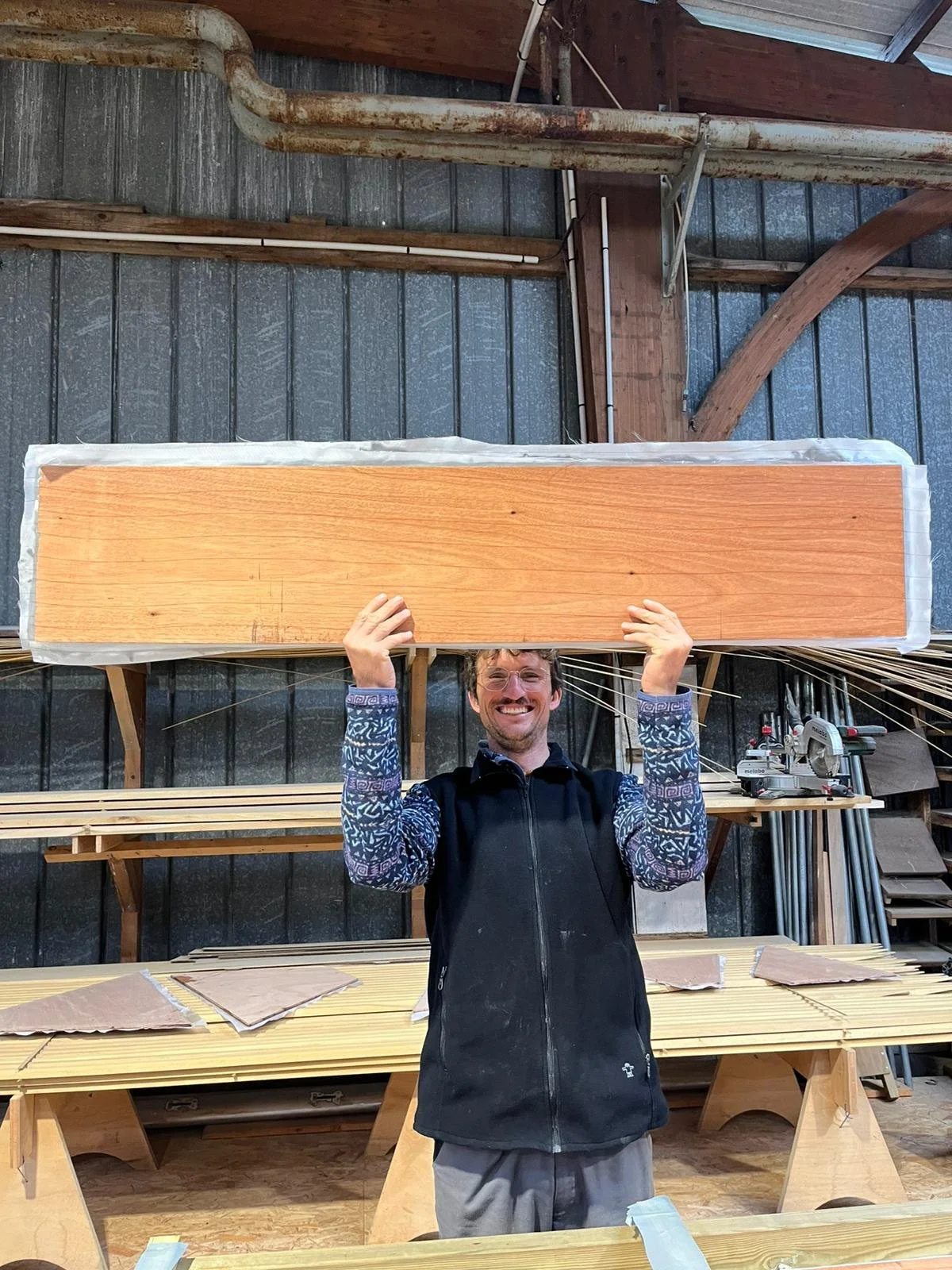
Volunteer Simone holding a piece of plywood coated in epoxy and peel ply.
Our local advisor, Pascal Petit, gave Remy, Simone and I our first epoxy and peel ply tutorial on Monday, and since then we have powered forward as we work around a deadline of having all of the bulkheads and backbone pieces epoxied and removed from the drying cabin by April 10th at the very latest. This is to ensure we can begin the drying cycle for the Movingui hardwood, which will take approximately three weeks to dry, just in time for the Boat Build Residency participants to arrive in May.
Though we had excellent results stress testing the Australian 100% BPA free bio epoxy, Change Climate, we currently cannot receive more due to supply chain issues. We thus chose to use a French composite brand Resoltech’s part-bio epoxy 1020 ECO, and their 1026s hardener, appropriate for the still-cool conditions here in Brittany.
This has turned out to be a great choice, with the epoxy so far being a dream to work with, odorless (we still mask up as anyone should do working with any resins, including bio), and having fantastic results with peel ply. I honestly feared the epoxy stage for months, having never done anything like this before, and now I love it. Pascal is pleased and can’t wait to teach me how to make fillets :)
The benefits of peel ply are that it minimizes sanding and reduces consumption of sanding discs, inhibits air for better curing, and is probably the best way to protect the resin and keep the surface clean right up to the ‘last minute’, ie before varnishing or painting.
We have chosen to do two coats of epoxy on the backbone and bulkheads now. Yesterday we removed the protective peel ply from the first coat of cured resin, gently ran an orbital sander with a 120-grit disc over the surface before cleaning and applying the second coat of resin and peel ply.
For the scarf joins (a topic of chatter in YT comments and in our member’s group recently) we did not apply a second coat; the joins will be glued as we begin to assemble the backbone in the coming weeks. We’ll dive into all of this in an upcoming video :)
We highly recommend The Gougeon Brothers On Boat Construction book to learn more about best practices for scarf joins with epoxy, and we are also grateful to the technical team at Resoltech who are advising us on best practice with their products (not sponsored guys, they are just great to work with!).
With the help of Simone and Ben, we got the second coat of one face of almost all 10 racks of plywood pieces yesterday, and today* Remy and I will prepare the second face ready for epoxying tomorrow.
*A shout out is required here to our teen boys who have not only helped across various stages of the build so far, but have stepped up most recently to babysit on Sunday afternoons and public holidays so Remy and I can work together.
Don’t forget that the JOB LIST is a publicly accessible spreadsheet; you can keep track of our progress or look at what jobs you might want to volunteer on.
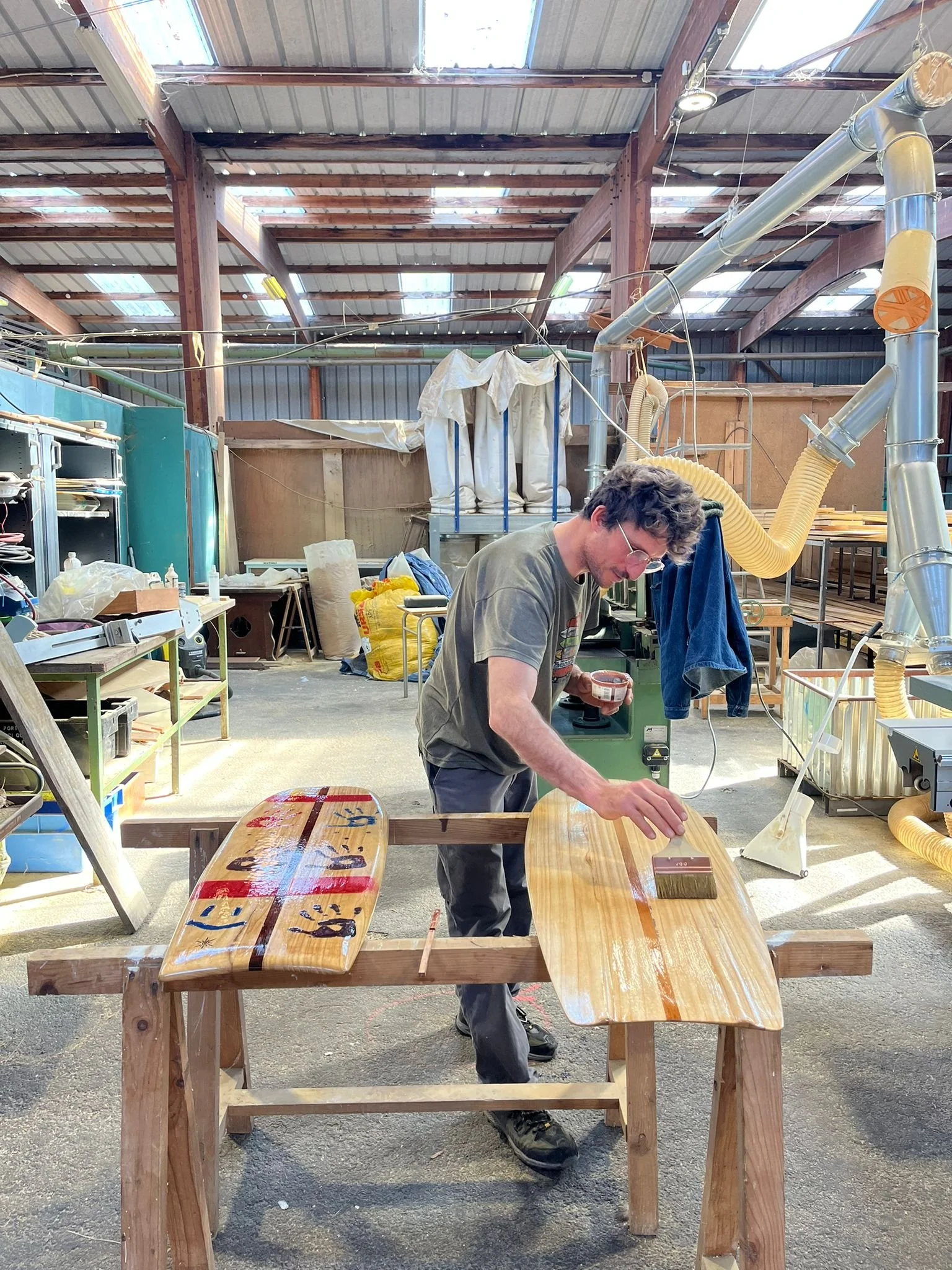
Simone’s handmade wooden belly boards. Instagram.
Simone is also hand-building beautiful wooden belly boards for small wave sliding; check out his Instagram and get your orders in for summer.
Happy Easter, have a great weekend!
—Angie
President and Co-Founder, the Floating Stories Lab Association
FSL Memberships
The beating heart of FSL is our membership community of volunteers, collaborators, advisors, and ocean-loving sea people. We call this a ‘relational network’ and welcome all folks wanting to get involved.
Memberships start at 20€ per year and provide grassroots financial support across all aspects of the association.