Field Notes Tracking Microplastics in the Goyen River Estuary, Brittany, France
Our second visit to College Bois de Locqueran—the local middle school we’re working with on our ReTISS citizen science initiative—took place on Friday afternoon. Following a chat with a local mum, I popped down to the Goyen River Estuary on the Audierne side before meeting the students to collect a few organism samples to test for fiberglass pollution later in the school lab. It’s here a small hard yard is perched along the river banks, fronting a car-park that I learned used to be where boats were worked on out in the open. If I was going to find GRP, it could be here, the mum suggested.
Coinciding with one of the largest tidal coefficients of the year, I slipped down the rocks to the exposed mudflats and started looking around. In a few minutes I sighted a large European Oyster, then another. This species was largely wiped out, though there have been significant efforts to restore them. I was surprised to find them in the river, as I usually find only the Pacific variety. I popped two in my harvesting basket for analysis, along with a few mussels and cockles. (Anything we don’t test in the lab is returned immediately to the site of origin.)


Photos above: Audierne side of the Goyen, next to the Aquashow, where boats were worked on out in the open and a small hard yard remains.
This field work is a great opportunity to learn—through hands-on immersive experience—about the biodiversity of estuaries and our coastal ecosystems. When you take the time to walk around the mudflats at low tide, you get to see what lives below the water; organisms vital to the health of these living systems, and, humans. I observed a worm disturbed by my digging and watched it bury its way back in to the mud, remembering a conversation Dr. Corina Ciocan and I had last year at the GRP Symposium at the University of Brighton about our fears that soft shell organisms like worms may be even more vulnerable to fiberglass pollution, knowing that the micro-GRP fragments spear the flesh of oyster and mussel lungs, and sea fleas, based on previous research results. I left the worm, though, as I’ve not learned how to dissect or analyze correctly and didn’t want to take it’s life for nothing.
I also documented fragments of blue plastic paint flakes—I see paint flakes now on every field trip when documenting end-of-life boats. If you’re not familiar with the impact of this common marine industry pollutant, check out the Oldenburg study, where scientists found that most of the plastic particles in water samples taken from the German Bight, an area in the south-eastern corner of the North Sea which encompasses some of the world’s busiest shipping lanes, originate from binders used in marine paints (https://uol.de/en/news/article/an-underestimated-source-of-microplastic-pollution-4819). Looking around at the small fishing boats moored and exposed on the mud, I noted most had blue bottom paint on their hulls below the water line. Back in the car-park that used to be an extended boat repair hard yard, I also noticed round drops of blue paint stained on the ground. It’s easy to connect the dots once you start taking the time to notice them.


Photos above: Paint flakes found in the mudflats and the carpark adjacent a small boatyard.
The kids and I met up back on the Plouhinec side of the river, joined by SVT (biology) teacher Gwenaelle Loriant and English teacher Isabelle Guellec. We hopped down to mudflats a bit further down river, adjacent to the main marina. Finding far less living organisms on this side, the kids began collecting plastic trash and observing the birdlife and other biodiversity based on empty shells found, like a lobster head, crabs, cockles and mussels. With a few more cockles added to our living organism samples, it was then time to head back to the school lab.


Photos above: Field work in the Goyen River Estuary, Plouhinec.
Trained two weeks prior by Dr. Corina Ciocan herself, the kids knew what to do and set to work. I was particularly eager to see what we would find in the European Oyster sample, given its vulnerability as a species and the size of the one we found. Before bringing it back to the lab to dissect, I’d consulted remotely with Dr. Corina, who confirmed the species and told me that after November we should not touch them, as they enter their peak reproduction period.


Photos above: Examining European Oyster and local mussel pollution for GRP and plastic pollution from boats.
Taking a small piece of gills (lung) flesh and placing it on the microscope slide, the students immediately found microplastics in the gills. Across the room, another group of students called out “Mrs Angie!”; they found microplastic in the gills of their mussel. And in yet another mussel gill sample, we strongly suspected GRP shards.
Videos below:
1. Plastic fragment in the gills of the European Oyster sample.
2. Plastic fragment in the gills of a mussel sample.
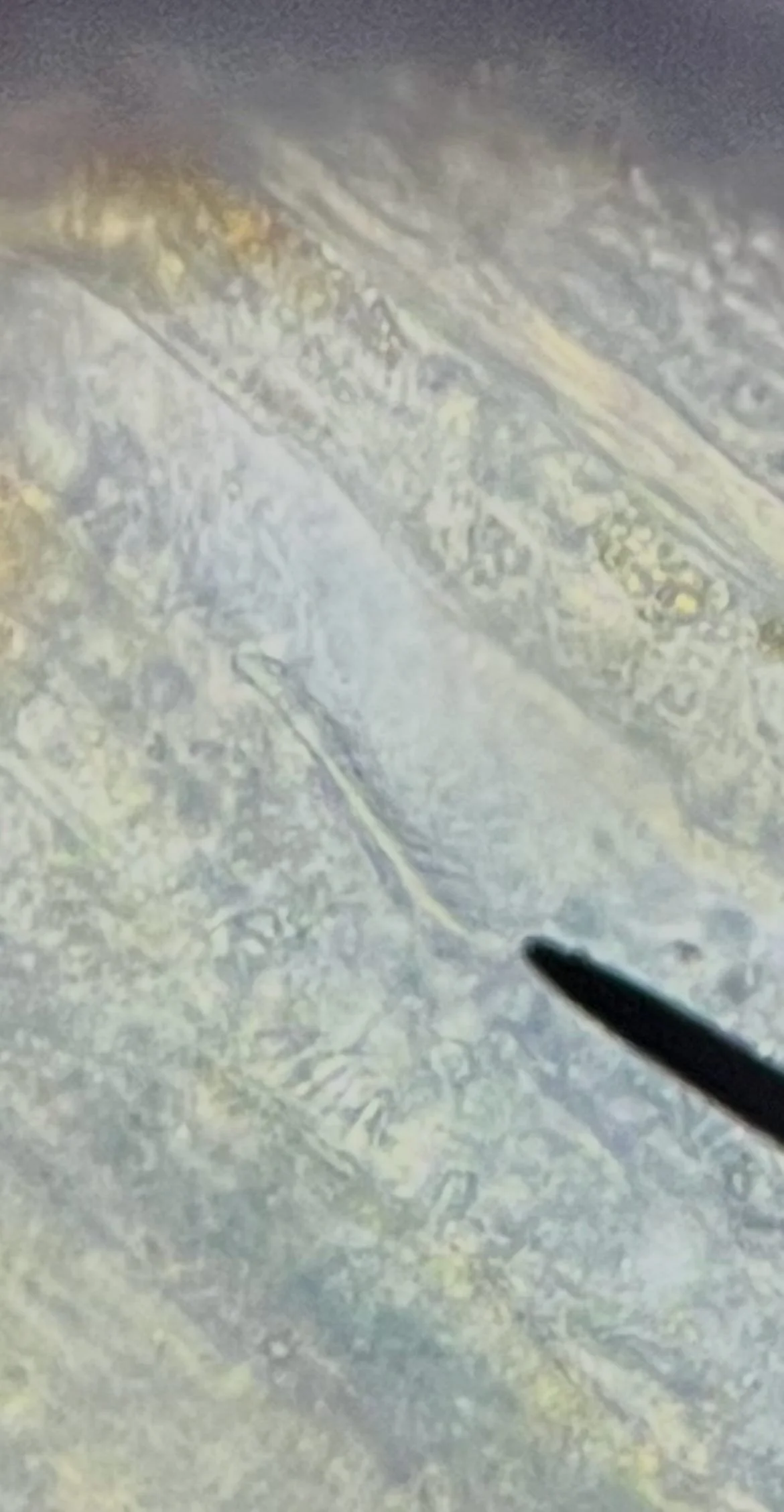
Photo: Suspected GRP fragments in the gills of a mussel sample.
It is indeed sobering to discover—on two separate fieldwork occasions—plastic and suspected GRP fragments in the lungs of every organism we investigate under the microscope. In addition, the volume of plastic trash—large and small—lying around the low tide is alarming. The mudflats we stood upon to conduct our fieldwork would be, only hours later, completely submerged. What happens to all that plastic?
We also just completed the first ever FSL Citizen Science Creative Residency, welcoming artists from near and far for a week-long immersive dive within the ReTISS project. I can’t wait to share more about the residency in our upcoming newsletter. Below is a sneak peek!

Photo: Residency participants Felipe (Brazil) and Marjolaine (France) examining the hull of a damaged GRP lifeboat abandoned in the Crozon Peninsula, Finistere, Brittany.


Photos above: Maren (Germany) testing algae dying for photography; e2 (USA) sketching the landscape before an underwater freediving excursion; jellyfish up close and beautiful; Marjolaine (France) holding a sea urchin during her first ever freediving experience.