I’m perched on the edge of the bow of our ‘topside’ film crew’s motorboat, Captain Saman at the helm. He has slowed the boat and we are gently putting back to the resort, an afternoon drone filming session complete. Dan, our film team’s drone pilot, passes me his polaroid sunglasses to protect my eyes. I’m fixated on the horizon as the sun creeps closer to being completely enveloped by the sea. Ancient rock formations tower over our starboard side. There’s no wind as we idle and I wait for the green flash I’m striving to see as the sun dissolves. And there it is. Vivid, rapid, there. My first green flash sunset.
Lying off the coast of West Papua, Raja Ampat is home to the most biodiverse coral reefs on our planet, attracting underwater lovers from all over the globe. I’ve been here in the Misool region of this spectacular island archipelago for the past two weeks filming an episode of a natural history series ecosphere that I’m co-producing with Australian immersive tech studio PHORIA and Bristol’s Silverback Films.

Raja Ampat, Indonesia.
I’ve been learning how the indigenous folks here had lived in balance with their coastal habitat for centuries until large scale commercial fishing moved into the region, hungry for new waters to fish as stocks depleted elsewhere. Sharks and manta populations were swiftly devastated, as too the wellbeing of the local island communities. Observing the devastation firsthand when they stumbled upon a recently abandoned shark finning camp on the remote island of Batbitim, divers Marit and Andy Miners felt moved to act. Andy contacted local clans and asked for their permission to build a conservation centre on Batbitim Island, which the elders granted. With the support of the local communities and folks from all over the world, Misool Resort and Misool Foundation were born, linking private eco-tourism enterprise and conservation. Our virtual reality documentary will focus on the Misool Foundation’s efforts to create a highly successful Marine Protected Area (MPA) and showcase the remarkable positive impact that this community-supported conservation program has had in restoring reef health and marine biomass for the past 10+ years.

Misool, Raja Ampat. Photo: Angie Richard
Misool Marine Reserve
Our day begins, as usual, well before sunrise. The team clambers sleepily onto Saman’s boat, being careful to keep our camera gear dry by wrapping it all in tarps and housing in waterproof cases and bags. Our first filming location today is at Misool Foundation’s Ranger Station on Yellu Island. We motor over as first light approaches.
Saman cuts the outboard motor as we drift in to the shore at Yellu Island, the rangers already on the beach picking up rubbish, part of their morning routine. Our crew is welcomed, and I am introduced to Nanda Sachra, Misool’s Marine Conservation Program Manager. Nanda lives on the ranger station – the only woman among a team of men – and we click immediately. She’s flanked by two cute tan-and-white puppies whom have clearly adopted her as their human mother.
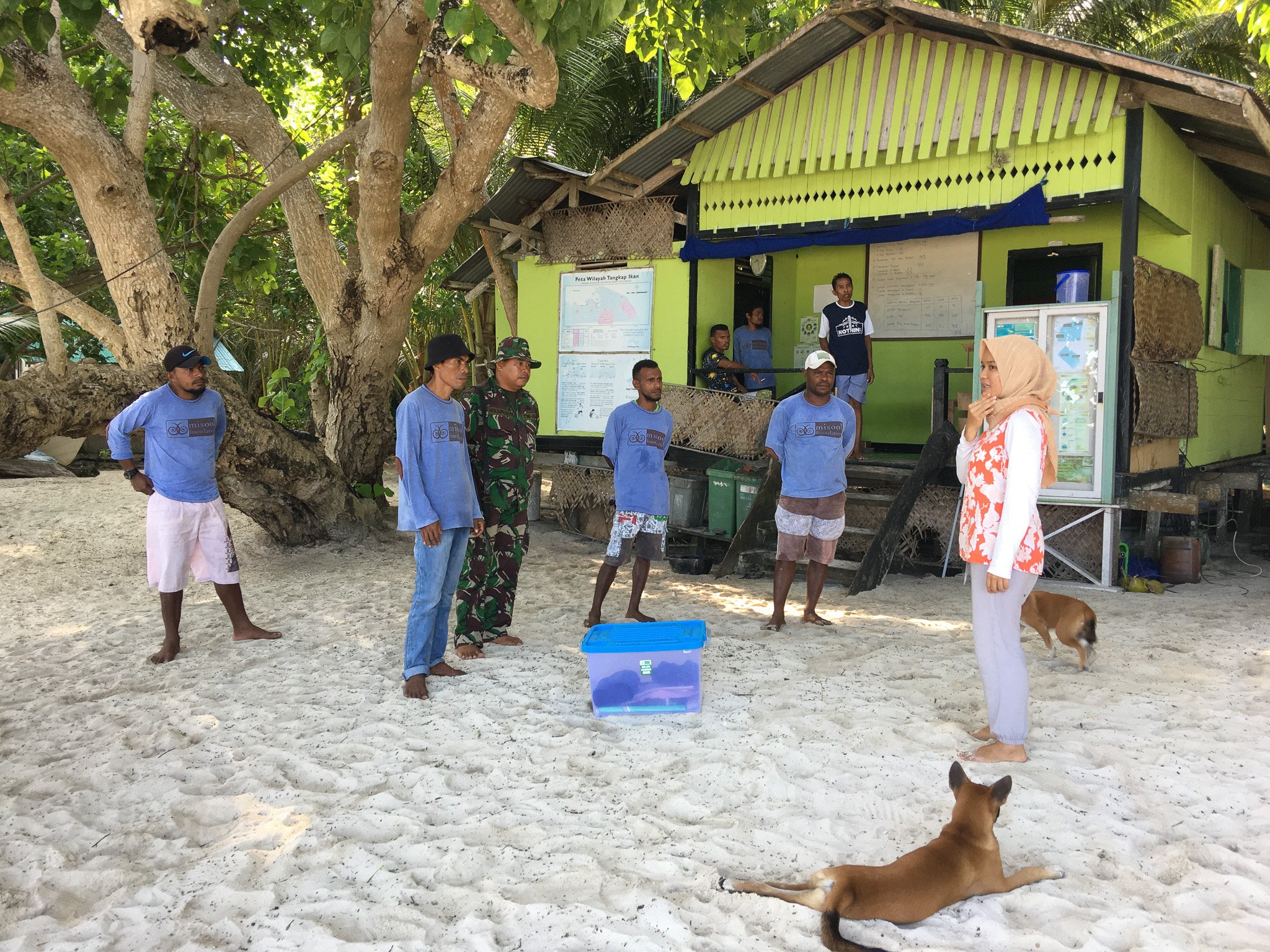
Nanda briefing the rangers before their morning patrol. Photo: Angie Richard.
We film Nanda preparing the rangers for their morning patrol, and then sit down with her at the water’s edge to eat a wholesome cooked breakfast picnic pre-packed by the Misool Resort staff. Since 2005, the partnership between local communities and Misool Resort enabled the creation of the region’s first No Take Zone, or marine protected area. The MPA’s success supported further expansion, resulting in expanding the Misool Marine Reserve which today covers some 300,000 acres/1220 sq km, comprising 2 distinct No-Take Zones and a linking restricted-gear blue water corridor, all of which are leased directly from the local villages.
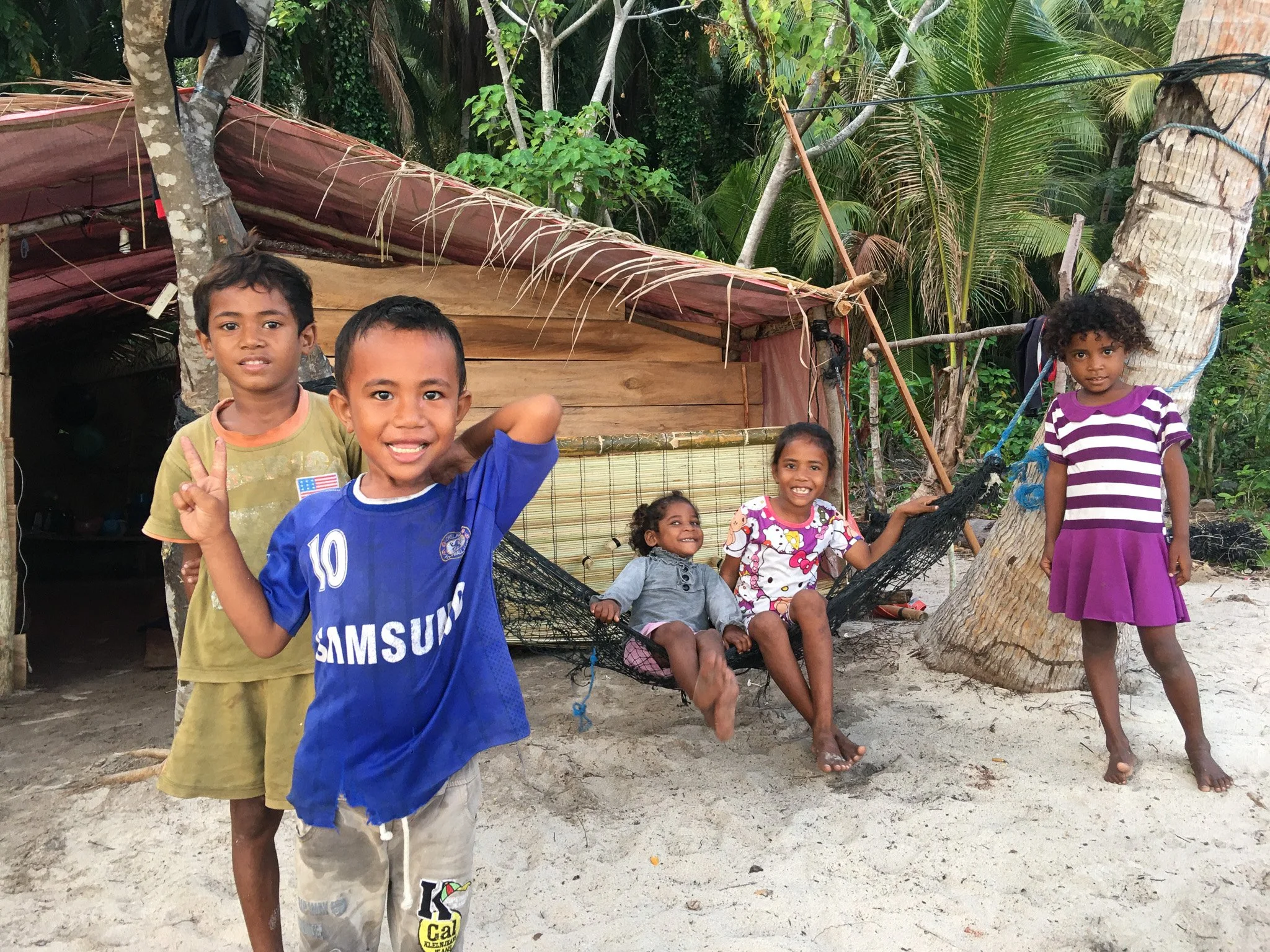
Local children from a neighboring island community at a temporary fishing camp outside of the MPA zone in Misool, Raja Ampat. Photo: Angie Richard.

Misool’s Marine Protected Area. Copyright: Misool Foundation

Filming a local fisherman outside of the Misool Protected Area. Photo: Angie Richard.
Inside the two No Take Zones, all extractive practices are prohibited: no fishing, no collecting turtle eggs, no reef bombing, no cyanide fishing, no netting, and no shark finning is allowed. The resort has been both increased biodiversity, reef and species recovery, and better catches for the local fishermen who enjoy spillover catches outside the zones.
Misool Ranger Patrol
Protecting the reserve is the Misool Ranger Patrol, teamed by local villagers, some of whom are former shark fishermen who have been able to switch their livelihoods to focus on marine conservation. We will be joining them on a patrol later in the afternoon.
The Misool Foundation team have been conducting scientific surveys to analyse fish biomass at several sites within the Misool Marine Reserve since 2007, their data showing that, on average, fish biomass increased by 248% between 2007 and 2021. A separate 2012 study established that there are 25 times more sharks inside the Misool Marine Reserve than directly outside of it. Oceanic Manta sightings have also increased 25-fold between 2010 and 2016.
Misool represents one of the most pristine reef systems left on earth — one of only a handful of places in the universe where biodiversity is improving rather than declining. - Dr. Mark Erdmann, marine biologist, coral reef ecologist, and Vice President of Conservation International’s Asia-Pacific marine programs.

Diving in Raja Ampat.

Filming Misool’s rangers protecting turtle nests. Photo: Angie Richard.
The patrol team returns after we finish our breakfast and filming an interview with Nanda, and we are invited to join them to a nearby island known for turtle nesting. Saman motors us over to the stunning, human-free island, dropping our team off into the narrow bay then heading back out to sea so as not to be in the way of our filming. I call Nanda on the long-distance radio handset; she’s in the ranger patrol boat and gives them the signal we are set up and ready for their approach to the bay to conduct their turtle checks. Joseph, our director, has the VR180° camera mounted to his chest with an Easyrig gimballed body harness, enabling forwards and backwards camera movements without destabilization. Yawing the camera from side to side and unstable shots are a no-go in virtual reality filmography to avoid making the user feel nauseous when reviewing in headset. The rangers pull into the bay and conduct their research. Turtle tracks are indeed present, so they proceed in locating the nests made the previous night and set up steel nets to protect the future hatchlings from predators - this time, the non-human kind.
Misool Resort
By lunch we are back at Misool Resort and tucking into a delicious feast at the restaurant that fringes the house reef. Joseph and our executive producer Trent are due to dive again this afternoon along with Misool supporter, video engineer specialist and talented underwater filmographer Brent , hoping to capture some more remarkable Oceanic Manta Ray footage at one of the world’s best dive locations where these majestic creatures are known to frequent. To ensure the Misool area is not overwhelmed by tourists and visiting divers, the team here also monitor the dive sites, so if you visit the region independently – such as by sailboat – be sure to call the Misool team up on the VHF radio for permission to dive before jumping straight in.

ecosphere: Raja Ampat Director Joseph Purdam diving with the VR180° rig in Misool, Raja Ampat. Photo: Phoria.
I slip on my fins in the water and walk slowly out to the house reef past turtles munching on sea grass. I have a few hours spare before heading out with drone pilot Dan and Captain Saman again to film aerial footage at various locations in the late afternoon light. Admittedly, I am not a diver. I have never taken the opportunity to learn and I also have a fear of relying on artificial breathing apparatus to keep me alive deeper below the surface. It’s a fear I intend on overcoming sooner than later, but I’ve not managed to get my dive certification before this trip and so it’ll be the snorkel and mask for me. Though Misool is definitely the place to come if you’re a keen diver, it certainly won’t let a snorkeler down, and just as the staff doesn’t discriminate if you’re hopping in to the water without a dive tank, neither does the marine life.
As soon as I begin kicking out to the edge of the house reef I become one with the world below me, sighting baby black tip reef sharks instantly. I am privileged to have snorkeled in impressive locations around the world, from the Great Barrier Reef in Australia to coral gardens in the Mentawai Islands, Indonesia, to the Caribbean waters off Colombia. But nothing could ever have prepared me for my experience her in Misool. It’s another world, one of the rare places on earth where biodiversity is improving rather than declining. As I let the current push me gently clockwise around half of the resort’s island, I encounter more marine life and spectacular corals in thriving numbers than I can ever could have imagined and contemplate the ocean’s remarkable ability to recover from negative human practices when we remove those practices from the equation.
Alongside Marine Protected Areas like the one here in Misool, Community Managed Marine Areas are equally essential to enable both planetary health and societal wellbeing at scale. Coastal communities rely on their relationship with the sea and being able to continue to fish sustainably in their backyards is fundamental to their wellbeing and livelihoods. In fact, many coastal communities had practiced their own No Take fishing management for centuries, if not longer, before mass scale fishing vessels – many of these foreign - began to come and overfish their waters.

Misool Resort and its impressive house reef snorkel and dive sites. Photo: Misool Resort.
A Sailboat dream
I finish my snorkel and return to the resort’s main boat dock just as a private sailboat crew throws its lines to a couple of Misool staff standing by. A family visiting the region, they’ve come to chat with the resort’s General Manager to learn of recommended, safe anchorages nearby, sights to visit, and – importantly – the dive site protocols. A spark ignites within me, goosebumps cover my skin despite the humid tropical heat. After two weeks exploring one of the most magical ocean regions by motorboat, living by the tides, learning from the communities who call Raja Ampat home, and feeling completely at one with the ocean, an idea begins to swell…
As our film crew dismantle the camera kit and pack our bags to return to our home countries - Australia for the rest of the team and France for me - the resort staff distribute face masks and warn of an infectious disease outbreak that has apparently been taking the world by storm. Cut off from internet, TV, and any form of news, we have no idea what has been unfolding over the past few weeks. As we step off our final boat ride and re-integrate into urban society in Sorong, we quickly learn about the Covid-19 outbreak.
Shortly after my return home several days later, Remy and I are locking up our rental apartment and driving to his parents’ property where our family will be locked down for the next months. As the challenges of France’s strict pandemic lockdown mesh with my memories of Misool, I share with Remy the seed that had been growing within me since the day that sailboat docked beside me in paradise:
“Let’s move onto a sailboat and travel around the world, learning how we can all be more regenerative again,” I share one afternoon whilst lying in our experimental no-dig permaculture garden.
The Floating Stories Lab dream is conceived.
Enjoy Angie’s sneak peek recorded VR playthrough of the ecosphere:Raja Ampat episode followed by the ecosphere VR official trailer.
Further Resources
Misool Resort - eco-luxury resort and world class dive locations.
Misool Foundation - protecting Misool’s biodiversity.
ecosphere VR - Natural History Documentary Series in cinematic VR180°.
World Nomads Scuba Diving Travel Insurance - Simple and flexible travel insurance to keep you safe on your next dive trip. Buy at home or while traveling, and claim online from anywhere in the world. (Voyage Virage Affiliate partner.)