
Below me awaits deep, turquoise water. I throw my twin-fin surfboard in and dive off the edge of a small fishing boat. Jeberdi, the local surf-guide from the fronting village Mereman (‘woman man’) doesn’t waste a heartbeat shredding the three-foot limestone reef left-hander I’m paddling towards.

Jeberdi shredding in PNG
Like all the locals riding western-style shortboard ‘thrusters’, Jeberdi proudly surfs atop a second-hand donated board he’s claimed. These donations coming predominately from Australia and Japan have allowed these locals to graduate from their handcrafted wooden ‘splinters’ (chunks of wood) to the modern shortboard, improving their surfing skills to match the quality of waves on offer that fringe their villages.
I gaze toward the hundreds of slender coconut palms that overlook the break and feel eyes on me; through the palms is an entire village of kids and young mothers who have gathered to cheer us on. Inspired, I throw caution aside (I’m a chicken at hollow reef breaks) and paddle for an incoming wave, high-lining along its smooth green wall. Flicking off on the inside next to dry-reef, I look up to the clan of hooting locals. Clapping and cheering my wobbly performance has made their day; their warm response has made mine.
In Papua New Guinea’s coastal villages, locals live day-to-day. In tune to their natural environment, they fish - by hand - just enough to feed each other, gather greens to steam on the side, or visit the market for fruit and vegetables grown in the highlands. A hunted wild pig is a rare village treat.
Simple huts are constructed from local bush materials cut down with the common machete, and these dwellings are lived in until the scars of weathering call for a new home (usually built from scratch, next door).
Kids as young as toddlers play in the abundant ocean, sharing ‘splinters’ in the strong surf. Those who can’t get hold of these slabs of wood bodysurf naked with giant smiles, running barefoot across the sharp reef, swimming hard against the sweeping currents, and taking off deep. Their smiles are addictive.

The smiling faces of PNG
I finish up with a small peeler on the inside, then bellyboard a wave into the main bay, some 50metres down from the crowd. By the time I scramble up the rocky bank, I’ve got a personal welcoming party of 60+ kids, some naked with machetes, laughing, smiling and offering sincere warmth as you’d never find at any five-star hotel.
A young girl in a faded lime green tee and knee-length board shorts bends down to offer me her thongs (flip-flop sandals), taking my board under her arms then ushering me upwards toward the masses. Jeberdi informs me later that her name is Winifred, is about 12 years old (she doesn’t know her exact age), and is not married nor with child yet because she “surfs too much”. I like her instantly.
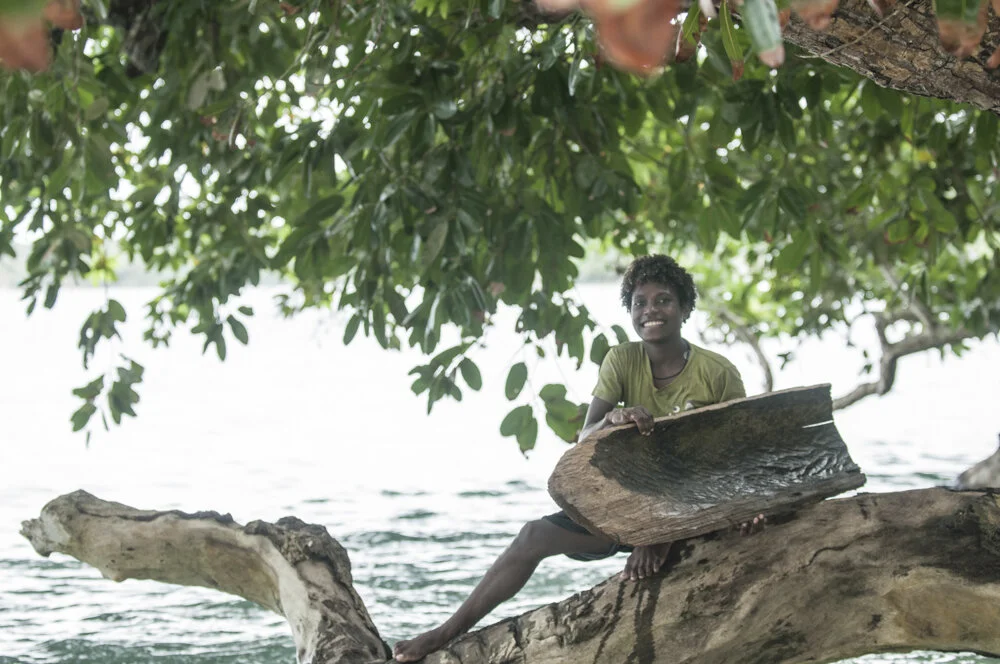
Winifred, PNG
I’m told stories of mothers being beaten during childbirth by their doctors (to shut up the screams of endurance and pain) and being beaten at home by their husbands. In the slowly growing world of surfing in PNG, the disrespect continues as women are left waiting on the beach until the men are done riding the already-scarce donated boards. It’s not uncommon to birth up to 10 kids, and infant mortality is at one of the world’s highest rates (at the time of writing). Surfing is helping to break the cycle of gender injustice, and as a result, young girls like Winifred might just have the chance to escape the abuse and gender disparity rife throughout PNG as the local surf villages begin to recognize the need to eradicate such behavior. These stories tug closely at my heart, for I too have endured such abuse, and in many ways, surfing has also helped me heal, picking up the slack where society has failed.
Jeberdi ushers me back toward his village. The kids run ahead, diving into the bay, taking turns jumping off a jagged rock into the calm water, giggling with a carefree innocence that is forcibly lost in Papua New Guinean adolescence.

I catch a wave in PNG.
Waiting for us on the beach is Justice Nicholas Kirriwon, a Supreme Court Judge and local clan leader from Tupira Surf Club in Ulingan Bay, where I am a guest for the week. ‘Uncle Nick’, as the locals call him, is one of the key influences driving community development through surf tourism. He drives us back to the coastal grounds of Tupira where we are met with a head-high evening session at the right out front with the other Aussies in our group, Chris Binns - a surf journalist - and surf-board donation drive initiator Marty Brown. The quality of surf at Tupira is something of surfers’ folklore: outgoing tide overnight succumbing to an incoming tide all day, consistent sets averaging three feet with forgiving shoulders, the occasional sucky cover-up during tidal pulses, and crowd limits capped at 10 people at any time.

Angie and Jeberdi, paddling out for another round.
For most of us fed up with sharing holiday session with the throngs of Aussie punters in the waves off Bali and Fiji, who want to experience remoteness and authentic culture, PNG is the proverbial ‘paradise’, attracting out-of-form surfers (like me), and hard working guys like Marty - a fireman from Mornington Peninsula. Marty discovered the northern breaks in early 2000 and has been coming back ever since. The inspiration for Marty to donate 140-something surfboards to the local surf clubs, the very reason we are all gathered on this trip, came after his first viewing of Adam Pesce’s award-winning documentary Splinters at its Australian premiere, where Marty met Andy Abel – President of PNG’s Surfing Association. Abel has been the driving force behind the development of surf culture and tourism in PNG for over twenty years, and what impresses me most is his commitment within the country’s surfing plan to supporting gender equality both in and out of the water, a challenging goal in an otherwise very patriarchal culture.
In Splinters, the abusive treatment of women by members of PNG’s Vanimo Surf Club was exposed in scenes of brutal domestic violence followed by Abel’s plea to the male surfers of the camp to treat their women with equality. In the film, he is also shown asking that the role of Vanimo Club’s Vice President be given to a female. At the international premiere when the scenes sparked an outcry, Abel questioned the critics and raised the overlooked truth that domestic violence and inequality of women was rife globally, not just in the surf camps of Papua New Guinea. Indeed, I wonder how many male surf association directors around the world are working hard to ensure women’s rights like Abel.

The girls with their new surfboards after sharing their cultural ceremony with our team.
To reinforce his efforts of empowering women through surfing, Andy has personally painted half of the donated surfboards’ noses pink, knowing the males will be too embarrassed to ride a female-embossed board.
Our final day is met with a lengthy ceremony on Tupira grounds, lands once used and abused by the logging industry but now reserved for the use of locals and their eco surf camp. Addressed by important dignitaries and attended by more than 800 local villagers, Marty presents the collected boards, placing them into the hands of the locals; half are indeed painted pink and passed to a handful of eager women to share. Though reliance on donations is not a long term objective, and the clubs welcome international shapers to come and train interested members in low-impact surfboard production, for the moment such a board drive has an immediate positive impact.
A young mother is on the beach with her baby and one of the pink-nosed boards as I am about to paddle out for my final sunset surf. She pulls her newborn off her breast and passes the baby to a friend before paddling out beside me. In the surf she is fearless, and though we can’t communicate in the same verbal language, we share in the universal language of ‘surf stoke’ as we share waves with our female comrades. When the mother has had her fill of waves, she paddles in, whipping out a now engorged boob and filling her bubba with more milk. The sky is painted with an evening glow and I have faith that the sun will rise tomorrow with new rays of hope for these lady sliders and the generations to come.

A young mother runs out for a wave in between breastfeeding her infant baby.

Our group with the stoked young kids in PNG

A young child traveling by boat in PNG.
