
On 18 March 2024, the European Boating Industry (EBI), together with the European Commission and national authorities, convened a high-level dialogue on the end-of-life (EOL) of pleasure craft. The resulting report sets out an ambitious roadmap: harmonised regulation, improved dismantling, cross-industry recycling pathways, and a transition toward circularity by 2030.
The dialogue is welcome. It acknowledges a long-standing problem and brings industry, regulators, and recyclers into the same room. Yet, when read alongside recent peer-reviewed science, the report also reveals a critical blind spot that risks undermining the very circular economy it seeks to build.
That blind spot is this: end-of-life boats are not inert objects waiting for recycling, they are already active sources of environmental contamination, long before dismantling ever begins.

An end-of-life boat rots in the Goyen River Estuary, Brittany, France. Photo: Angie Richard/Floating Stories Lab.
Below I will draw on two recent scientific papers to clarify what is currently missing from the EBI framework, why it matters, and how citizen-led, place-based evidence can strengthen—not weaken—Europe’s path toward responsible boat lifecycle management.
From “waste” to ongoing pollution
Throughout the EBI report, end-of-life boats are primarily framed as a future waste management challenge: vessels to be collected, dismantled, transported, and recycled more efficiently. The language is consistent with existing EU waste frameworks and circular economy policy.
What is largely absent, however, is any treatment of what happens while boats are abandoned, neglected, or slowly degrading in coastal and estuarine environments—often for years or decades.
This omission matters because recent science shows that glass-reinforced plastic (GRP) boats do not simply sit idle at end of life. They fragment. They shed. And their materials enter surrounding ecosystems.
What the science now shows
In May 2024, Ciocan et al. published a study in the Journal of Hazardous Materials documenting, for the first time, widespread fibreglass contamination in natural bivalve populations adjacent to boatyards.
The researchers analysed oysters (Ostrea edulis) and mussels (Mytilus edulis) collected from Chichester Harbour in southern England, a site with active recreational boating and maintenance facilities. Using micro-Raman spectroscopy, they confirmed the presence of GRP-derived glass fibres in soft tissues, including digestive glands.
The reported concentrations were striking:
Up to 11,220 fibreglass particles per kilogram (wet weight) in oysters
Up to 2,740 particles per kilogram in mussels.
Accumulation was significantly higher in winter, coinciding with peak boat maintenance activity, sanding, and repair—suggesting a direct link between everyday boat handling and environmental release of GRP particles.
Importantly, the authors are careful not to over-claim. They note that the precise physiological consequences of fibreglass ingestion are still being investigated. But they also emphasise that bivalves are high-risk organisms due to their sessile nature and filter-feeding behaviour, and that microparticle accumulation is associated in other studies with impaired feeding, inflammation, and altered physiological processes.
Their conclusion is unambiguous:
“Our results highlight the need for better regulation of public access to slipways, commercial boat maintenance facilities and create a better ethos of end of life boat management in general, in order to minimise further exposure and spread of GRP/microplastic contaminants in aquatic environments.”

Shedding fiberglass and resin collected from water samples in Chichester Harbour, Uk, under the microscope. Photo: University of Brighton.
Degradation begins long before dismantling
A complementary perspective is offered by John Summerscales and team’s review of abandoned fibre-reinforced plastic vessels, which situates GRP degradation within broader patterns of weathering, structural collapse, and climate-driven damage.
When wooden components rot or fail, GRP structures are left unsupported and progressively break down under tidal, wave, and storm forces, generating smaller fragments over time. Abandoned vessels are often untracked, left in estuaries, marshes, or intertidal zones, where recovery is complex and expensive.
Crucially, the paper points to a systemic mismatch between projected composite waste generation and existing recycling capacity:
Europe is projected to generate approximately 683 kilotonnes of composite waste by 2025, based on existing estimates.
Global FRP recycling capacity is currently estimated to be below 100 kilotonnes per year.
As a result, current waste handling capacity accounts for only around 15% of the rate at which composite waste is expected to accumulate.
In this context, framing recycling as a near-term solution without addressing the interim environmental phase risks overlooking where much of the harm is actually occurring.

Exposed fiberglass on the hull of an abandoned boat viewed through hand-held bluetooth microscopes in situ in Brittany, France. Photo: Floating Stories Lab.
Where the EBI report falls short
Read alongside this evidence, the March 2024 EBI report reveals several structural gaps.
1. No assessment of ongoing ecological exposure
The report acknowledges abandoned boats as a visual and navigational problem, but it does not address chronic material release—fibreglass, resin fragments, coatings, and associated particles—into surrounding waters.
There is no reference to:
Microfibreglass shedding
Bioavailability to marine organisms
Accumulation in food webs
Seasonal peaks linked to maintenance and degradation
These processes are now empirically documented, yet remain outside the policy frame.
2. Circularity is discussed without the “pre-EOL” phase
Circular economy discussions focus on design, dismantling, and recycling technologies. What is missing is the long, unmanaged interval between functional use and formal end-of-life treatment, during which boats often sit unregulated and unmonitored.
From an ecological standpoint, this phase may be the most consequential.
3. Data gaps are acknowledged—but citizen science is absent
The report repeatedly notes:
Poor registration systems
Inconsistent tracking of vessels
Lack of harmonised data across Member States.
Yet it proposes no role for community-based monitoring, citizen science, or local data generation, despite growing EU recognition of citizen science as a legitimate component of environmental knowledge production.
This is a missed opportunity.
Why this matters for policy—and for industry
None of this invalidates the EBI roadmap. But it does suggest that a circular economy framework built solely around future recycling risks underestimating present-day environmental costs.
From an industry perspective, this is not an accusation but a governance gap. Externalised impacts that remain unmeasured cannot be managed, and unmanaged impacts eventually return as regulatory, reputational, or financial risk.
From a public interest perspective, the question is simpler: how long can ecosystems be asked to absorb degradation while systems for collection and recycling remain incomplete?
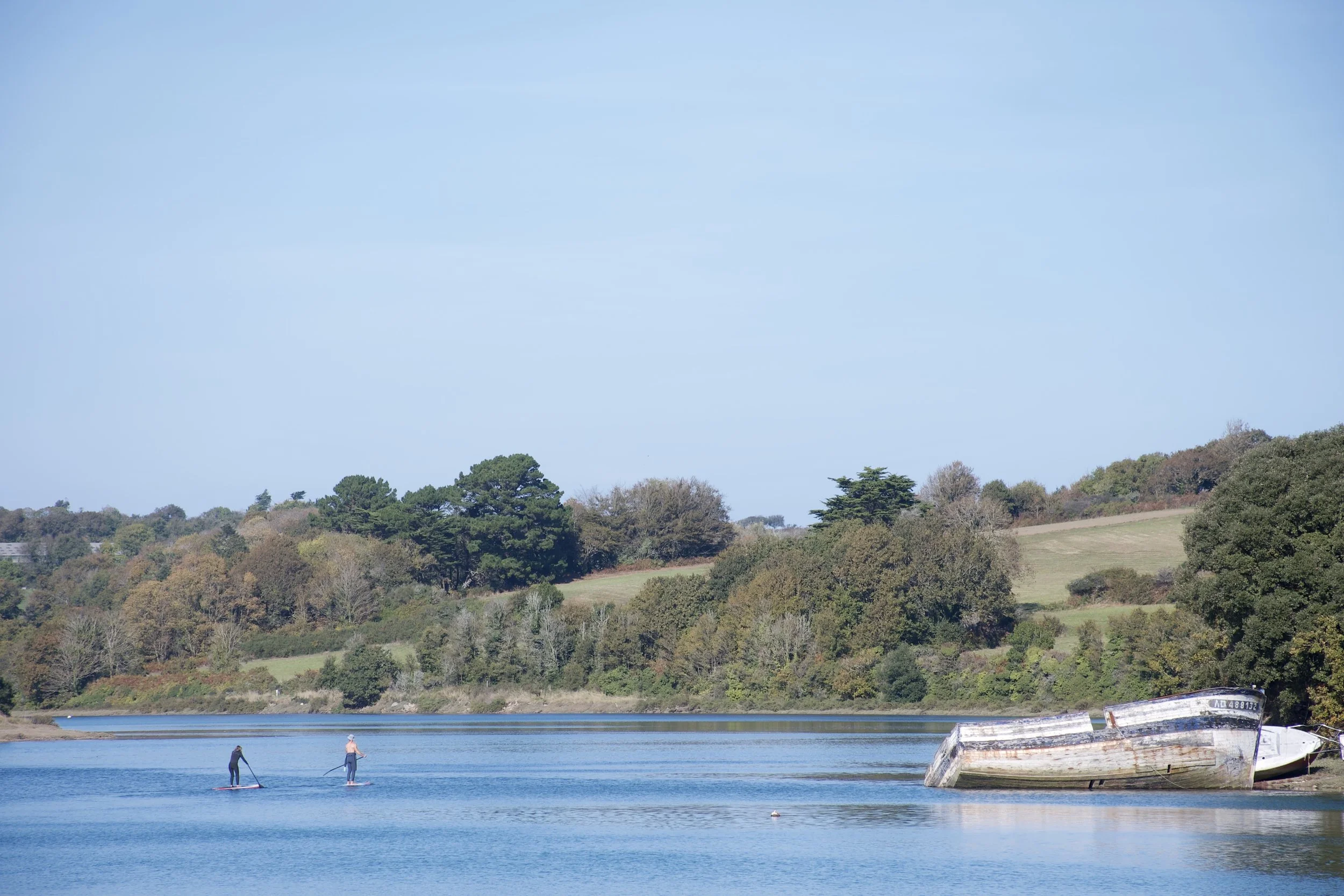
Paddle boarders drift past rotting, abandoned boats in the Goyen River Estuary, Audierne/Plouhinec, Brittany (France). Photo: Angie Richard/Floating Stories Lab
A missing layer: place-based evidence
At Floating Stories Lab, our work begins where policy frameworks often thin out: on the shoreline, in estuaries, beside abandoned hulls.
The ReTISS (Regenerative Tides) initiative builds on established scientific findings by:
Mapping abandoned GRP boats in situ
Documenting visible degradation and context
Collecting environmental samples with scientific oversight
Making data publicly accessible and place-specific
This approach does not replace industrial solutions or regulatory reform but complements them by making visible what is currently invisible: the lived, local reality of end-of-life boats as active environmental actors.
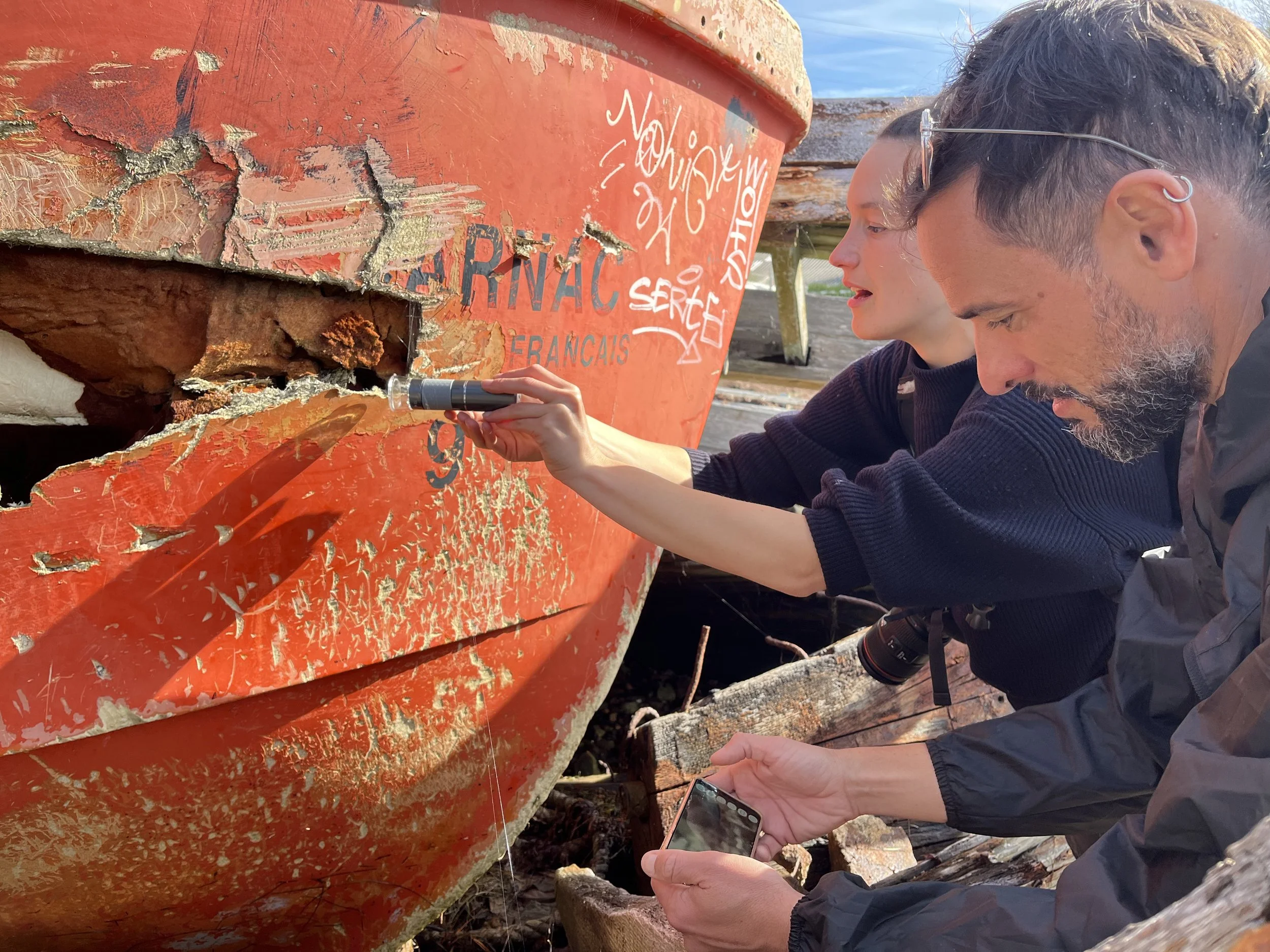
Citizen scientists collecting valuable data in Brittany, France, as part of Floating Stories Lab’s ReTISS initiative. Photo: Angie Richard/Floating Stories Lab.
Toward a more complete conversation
The EBI dialogue ends with an open question: Who takes the lead, and what is our timing?
Scientific evidence published since—and in some cases before—the March 2024 report suggests another question must be added:
What happens while we wait?
If Europe is serious about circularity in the boating sector, the answer must include:
Recognition of pre-dismantling environmental impacts
Integration of ecological monitoring into EOL strategies
Support for citizen-generated data that fills known gaps
A shift from viewing abandoned boats as static waste to understanding them as dynamic pollution sources
The science is no longer silent on this issue. The challenge now is to let it reshape the conversation.
Floating Stories Lab works at the intersection of citizen science, storytelling, and marine ecology. ReTISS is a pilot initiative exploring how community-led evidence can inform more just and effective responses to end-of-life boat pollution across Europe.
