We awaken in our warm tents despite the cold outside. Yesterday’s spectacular driving weather has not stuck around to bless us with a day of exploring in the sun. Instead, the sky hangs low and grey. A strong breeze shakes the surrounding foliage, but we are quite protected in our ‘Grand Comfort’ tent pitch. Sage potters about, sniffing new scents on an empty stomach. As we’re without a camp stove to cook a warming breakfast, the boys happily resort to sugary cereal whilst Remy and I wander off to pick up a baguette, croissants and jam from the small grocery store next to the campsite’s restaurant Sablé.
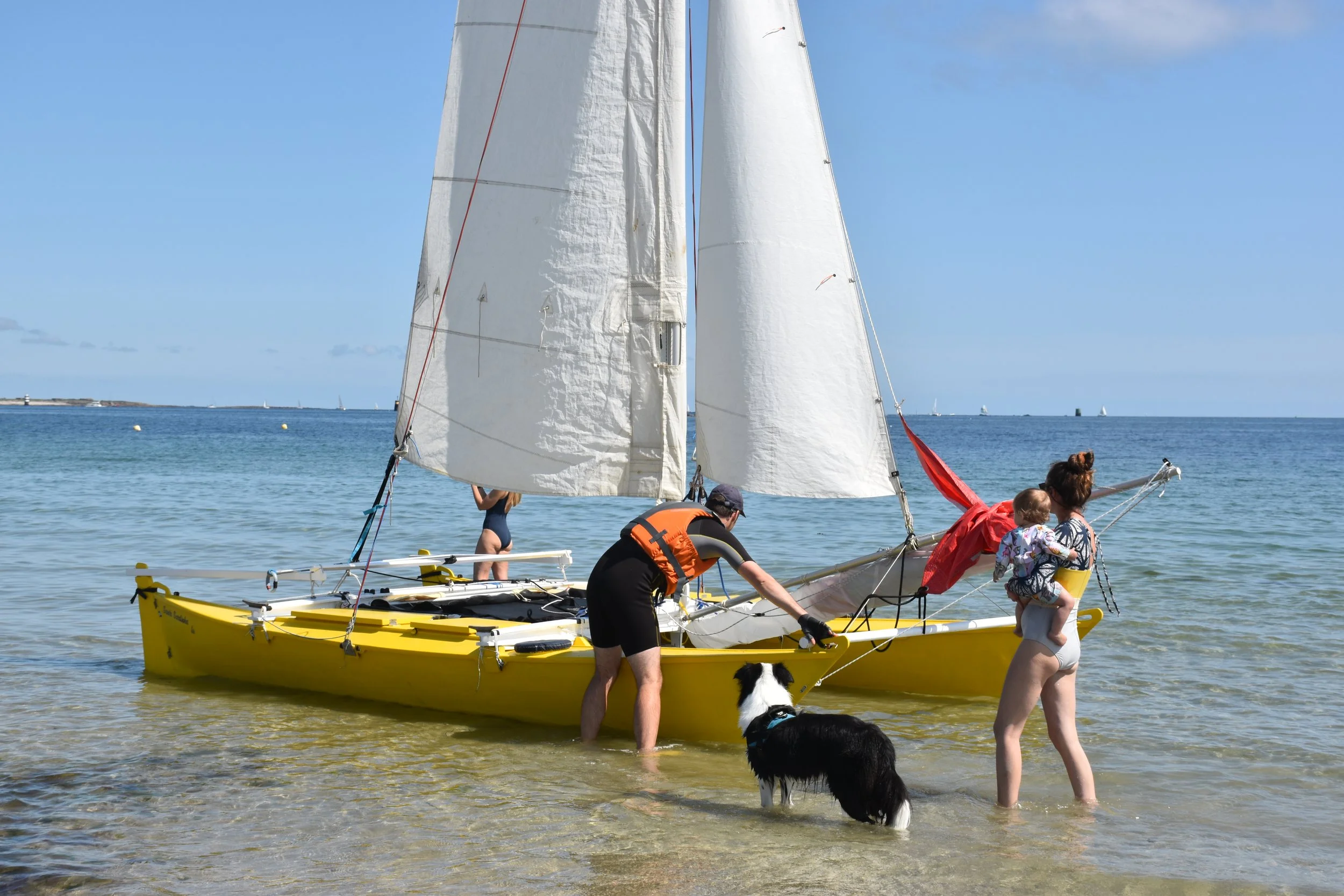
We take our time eating, plates on laps on camping chairs. Sage is fed, then we take turns showering at Sauvage’s clean public amenities, naively hoping that by stalling our plans to begin exploring the peninsula we might be able to entice the sun to return. Eventually our impatience to head out for the day overtakes our desire for sun and we dismiss the further waiting for a weather window. We drive off under threatening grey skies towards Pointe de Conguel at the tip of the peninsula. Pulling into the carpark, we pop Sage on her harnass and lead as a father and son slide into their wetsuits next to us, spear guns laid beside their feet. Remy is reminded of his childhood in Africa, growing up spearfishing from the age of four with his father, minus the grey clouds, long-sleeved wetsuits, and chilly winds. To our left, a pair of young men are tacking their way into the small bay on a Hobie Catamaran.
Pointe de Conguel

Pointe de Conguel is a sandy cape dotted with grassy patches and rock formations that offers a pleasant walking track from the carpark past protected flora to a rocky lookout point. We follow the trail and inhale the comforting sultry smell of ocean and seaweed tossed up by the wind. At the tip of the cape we view bigger sailboats cruising past, their sails filled. “I’m so impressed with the landscape,” Remy says, “it feels wild, at least more than home in the southwest.” I nod in agreement and join my sons who are poking their fingers around in the rock pools. We round the cape and track back along the beach. Looking out to sea, my mind drifts forward, as it often does, to our plans to live aboard a sailboat. What a perfect place to sail, I think, exploring the outer islands, living off the sea. Birds drift overhead and potter about the shore. Vibrant wildflowers are growing resiliently in the sand. Our kids chase each other with seaweed washed up on the beach and behind them, the man and his son from the carpark walk out into the water, spear guns in hand. It is Sunday, perhaps they will take home a fish to feast on with their family for lunch? Remy is right, it’s wilder here. I feel right at home.
Port Haliguen
We jump out of the wind back into the car and scoot around the corner to Port Haliguen, just as the sun finally starts to pierce her way through a break in the clouds. It’s lunch time and we are hungry. Parking in the back streets, we wander slowly down towards the port’s main hub and stumble upon a quaint, stone-clad building, the kind you see might in watercolor paintings. We soon discover the building is a creperie, and as one cannot come to Bretagne without sampling the local crepes, we follow the signage down a neat, narrow stone laneway lined with potted flowers and are greeted by the restaurant staff of Creperie du vieux Port. Inside the olive-green gates awaits a charming garden courtyard, and the waitress leads us to a table at the rear atop wooden decking in the shade; the sun is now out in full. Along with crepes, Bretagne is known for its cider. Remy orders he and I a tall bottle of the local plonk to share. We are lost in the food menu long enough for the waitress to come and go twice before we can each order with confidence. We can’t go past the local fare: specialties de blé noir (buckwheat specialties).

Lush garden dining at Creperie du vieux Port.
Remy and I salut our glasses with a “chin chin”. “Oh, yum, this is outstanding,” I pronounce, though I’m hardly a cider critic. Lunch arrives and we dive in. After a small tasting of each other’s plates, I’m convinced my Port Anna crepe is a solid choice, featuring jambon serrano, mozzarella, salade, tomatoes séchées, crème balsamique, and copeaux de parmesan. Sage sleeps peacefully under the table as we eat our delicious meals in this splendid setting. Dessert crepes ensue, along with coffee and a quick tour of inside the stone cottage; traditional stone charm is paired with modern décor to produce a gorgeous interior dining space. It seems we were lucky to get a table on a Sunday without a reservation, for by now both the entire restaurant – inside and out - is full. We pay the bill and promise to be back on a future visit.
An Uninhabited Island
Bellies full, we walk around the port to digest under the radiant sun. A sailboat motors into the well sized marina. “Let’s rent paddleboards?” I suggest. We flick through google maps and call up some rental companies, but soon learn everyone is closed on Sundays, at least in the off season. We connect with the manager of one rental business, Nature School Quiberon, who is willing to meet us at their beachside rental hut back towards the middle of the peninsula to unlock the doors and loan us a paddle board and kayak. We arrive and discover the wind is completely blocked here, the ocean calm and inviting. Leaving phones and cameras in the car, we pull on our wetsuits and drag the heavy paddle board and kayak to the water’s edge. We’ve been informed by the manager that the uninhabited island in view across the calm bay is a fantastic spot to visit – about an hour’s paddle - so long as we don’t let Sage near the bird nesting zone.

Bird life in Quiberon.
Hunter and I step onto the paddle board, Remy and Ryder settle Sage in the kayak and take their places, paddles in hands. The arm-powered journey to the island is no easy feat; I’m by no means surf fit following my miscarriages and surgeries and I can feel the sting of my arm muscles being strained as they search for memory. “I love my life,” Hunter proclaims. I smile, taking in this proud-mum moment. Mind you he’s sitting on the front of the paddle board by now doing absolutely nothing. Remy and Ryder reach the bay first, and as Hunter and I approach we do what we’ve been talking about doing for the past hour: dive off the paddle board into the crystalline water, reveling in the simplicity and pure joy that can come with ocean play. Sage, kitted out in her lifeguard-yellow doggie life jacket I’d bought her before the trip, swims out to greet us, sheer happiness reflected in her beaming eyes. The bird nesting zone is 50 meters to our left and on the main part of the island, so we stick to the shore but its covered in hundreds of small rocks and shells that don’t make sun baking overly comfortable. We instead spend an hour playing around in the water, swimming over patches of seaweed, taking turns jumping off the paddle board.
Switching ocean craft, Hunter and I take Sage in the kayak on the way back. To my delight, she falls asleep halfway across the bay, with her head and one leg resting over the edge. Even when water drops land on her head as my paddle passes from one side to the other, she doesn’t flinch. When we reach the shore, a little wave has developed, and the boys launch straight into some bodysurfing while Remy and I enjoy a moment together in the shallows, rummaging our hands through the thick, wet sand. Sage has a vomit from all the sea water she’s swallowed, so I take her up to the beach umbrella we’d borrowed from the nature school manager and pour fresh water into her portable dog drinking bag. I take a swig of water myself, all this sun, ocean and exercise has left me parched.
Our beach afternoon continues for a while longer until our bellies start to rumble again, and our fingers are wrinkling from hours spent blissfully free playing in the water. This is what life is about, enjoying the outdoors with kin – our human family and the non-human natural relatives that surround us – in a landscape unspoiled by humans yet where we also seem to naturally fit in.

Enjoying a cold beer at camp after a fantastic day of discovery.
Back at camp, we hit the showers then the kids go off to play table tennis just behind our tent site. “Want a beer?” I ask Remy. “Sounds good!” I pull two cold Coronas out of our cooler box and Remy and I settle into our camping chairs and cheers each other to a day well spent. As the clouds begin to roll in, we round up the kids and Sage and make a bee-line for Sablé for our second night in a row. Sure, enough before we finish dinner the rain starts and we’re in for a heavy night of it. The kids, exhausted, fall asleep almost immediately when their heads hit their pillows. I’m more concerned about their less-than-waterproof tent and find it hard to drift off. I think about our plans to visit Carnac tomorrow – a fascinating historic site centric in my research for an upcoming project that I’ve been very excited to explore in real life. Geez I hope the rain clears. I yawn. It falls harder. Fatigue, fused with the day’s contentment, takes over any worries and I snuggle into Remy and fall asleep to the sound of pelting rain on the thin, polyester dome protecting us from the storm.
To be continued…
Further Resources
Creperie du vieux Port - exquisite traditional crepes Breton-style served in a charming stone-clad cottage restaurant. Bookings recommended.
Nature School Quiberon - surf school, rental surf and paddle boards, kayaks, and other beach equipment.
Sauvage Quiberon Campground - where we stayed and highly recommend. Aside from generous tent pitches, they have new, well equipped wood cabins if tent camping isn’t your thing, and are also RV - and DOG - friendly.
Sablé - fantastic restaurant opposite the campground and beach. Seafood is the specialty but the menu is extensive enough to suit all palettes.
Featured Travel Posts