I recently completed Siddharth Kara’s Cobalt Red: How The Blood Of The Congo Powers Our Lives, a book that explores the gross negligence and lack of accountability of the world’s big tech corporations to safeguard human wellbeing at the bottom of the Cobalt supply chain. Cobalt is an essential component to almost every lithium-ion rechargeable battery made today, and 75 per cent of the world’s cobalt comes from the mineral-rich lands of the Congo (DRC). As the world sprints towards a so-called ‘Green’ revolution, the race is on to secure cobalt deposits, mostly without regard for the health and safety of the men, women and children who suffer daily in deadly mining pits. It’s a negligence we cannot ignore.
Remy was raised for nine years in neighboring Republic of Congo, enjoying the fortunes offered to a French expat child. A foreign privilege that stems from a twisted history of slavery, patriarchy, colonialism and neo-colonialism. Though Remy’s childhood memories are idyllic, everyday life across the Congo is much more arduous, with around 60 million Congolese people (DRC) living in poverty (World Bank). For perspective, in 2022 nearly 62 per cent of Congolese lived on less than $2.15 a day.
In addition to providing the cobalt that powers our devices and electric cars, Congolese lands also provide the world with the petrol, copper, tin, gold, diamonds and more. The region is also home to natural wonders such as the Congo Basin, which harbors approximately one quarter of the world’s rainforests, adding incalculable value to the planet. Whilst the troubles of the Congolese people may seem a world away to folks outside the region (including sheltered expats), we not only rely on the health of the Congo Basin and surrounds, but we are also complicity in outsourcing the violence that many Congolese suffer on a daily basis through the pillaging of its resources.
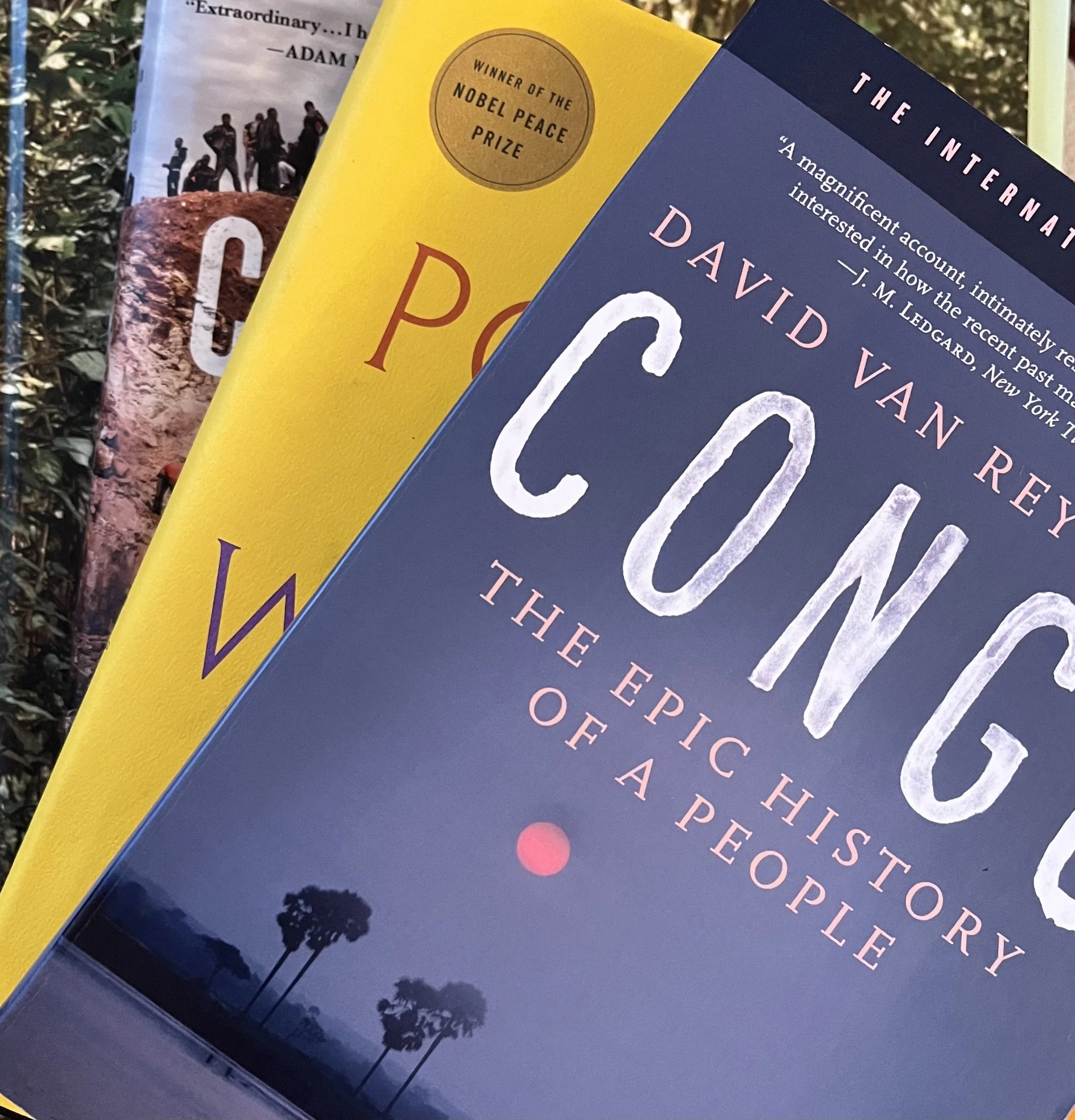
Mirroring a common tragedy across the planet that devalues both human and non-human lives in the name of profit and power, the horrors of the Congo should not be buried with our indifference. So, too, should we recognize the capabilities of the Congolese people. Nobel Peace Prize winner Dr Denis Mukwege, recognized as the world’s leading expert on treating rape issues - a skill born from the tragic suffering of Congolese women and child victims of senseless conflicts - looks to hope for his people and the world in his book The Power Of Women: A Doctor’s Journey Of Hope And Healing. Dr. Mukwege recently announced that he is running for President, a frightening (how many times has he been near-assassinated?!) and yet deeply hopeful prospect; should he win and lead his people, we could very well see the beginnings of Congolese healing and regeneration just could ripple out across the world.
It is on this hopeful note that I share with you four books from the Congo that have moved me deeply. Each of these books explores Congolese history, its horrors, and hope through different lenses. I hope the knowledge shared in these pages inspires advocacy in each of us to hold space for the people and lands of the Congo, uniting in action to help enable Congolese people to create the positive futures they justly deserve.
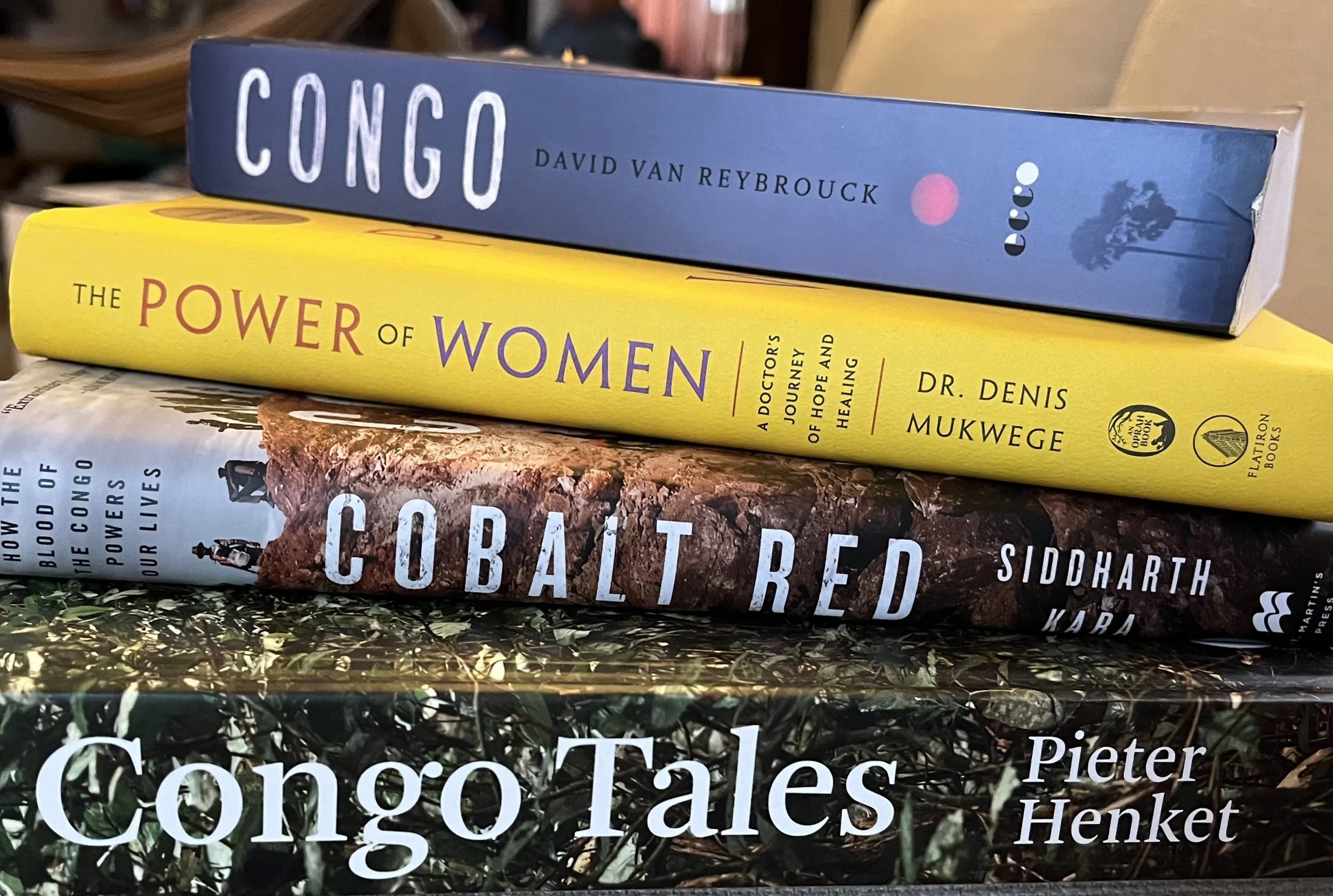
English Title: Congo: The Epic History Of A People
Author: David Van Reybrouck
Page Count: 656 Pages
Published: 2015
Summary
From the beginnings of the slave trade through colonization, the struggle for independence, Mobutu's brutal three decades of rule, and the civil war that has raged from 1996 to the present day, Congo: The Epic History of a People traces the history of one of the most devastated nations in the world. Esteemed scholar David Van Reybrouck balances hundreds of interviews with a diverse range of Congolese with meticulous historical research to construct a multidimensional portrait of a nation and its people.
Epic in scope yet eminently readable, both penetrating and deeply moving, Congo—a finalist for the Cundill Prize—takes a deeply humane approach to political history, focusing squarely on the Congolese perspective, and returns a nation's history to its people.
English Title: Cobalt Red: How The Blood Of The Congo Powers Our Lives
Author: Siddharth Kara
Page Count: 288 Pages
Published: 2023
Summary
Cobalt Red is the searing, first-ever exposé of the immense toll taken on the people and environment of the Democratic Republic of the Congo by cobalt mining, as told through the testimonies of the Congolese people themselves. Activist and researcher Siddharth Kara has traveled deep into cobalt territory to document the testimonies of the people living, working, and dying for cobalt. To uncover the truth about brutal mining practices, Kara investigated militia-controlled mining areas, traced the supply chain of child-mined cobalt from toxic pit to consumer-facing tech giants, and gathered shocking testimonies of people who endure immense suffering and even die mining cobalt.
Cobalt is an essential component to every lithium-ion rechargeable battery made today, the batteries that power our smartphones, tablets, laptops, and electric vehicles. Roughly 75 percent of the world’s supply of cobalt is mined in the Congo, often by peasants and children in sub-human conditions. Billions of people in the world cannot conduct their daily lives without participating in a human rights and environmental catastrophe in the Congo. In this stark and crucial book, Kara argues that we must all care about what is happening in the Congo―because we are all implicated.
English Title: The Power Of Women: A Doctor’s Journey Of Hope And Healing
Author: Dr. Denis Mukwege
Page Count: 320 Pages
Published: 2021
Summary
From Nobel laureate, world-renowned doctor, and noted human rights activist Dr. Denis Mukwege comes an inspiring clarion call-to-action to confront the scourge of sexual violence and better learn from women's resilience, strength, and power.
At the heart of Dr. Mukwege’s message will be the voices of the many women he has worked with over the years. Dr. Mukwege will use individual cases to reassure all survivors that, even if their psychological wounds may never fully heal, they can recover and thrive with the right care and support.
Dr. Mukwege’s dramatic personal story is interwoven throughout as he explores the bigger issues that have become a focus of his advocacy. He will seek to explain why sexual violence is so often overlooked during war, and how governments need to recognize and compensate victims. He will also stress the importance of breaking down the taboos surrounding assault, and the necessity of building a system that supports women who come forward.
His words advocate for saying ‘no’ to indifference and he asks readers to reckon with the West’s involvement in perpetuating sexual violence in places like the Democratic Republic of Congo, and to confront the abuse taking place in their own communities.
Sexual violence does not occur in a vacuum. The conflict in the Democratic Republic of Congo, which has raged for over 20 years and has claimed an estimated 5 million lives, is inseparable from Western patriarchy and economic colonization. And this cycle of violence and spoils is not limited to Congo. Dr. Mukwege’s work has led him to South Korea, Latin America, the Middle East, and elsewhere in Africa, where he has found striking similarities in women’s testimonies.
The truth is, through the intricate ties of the global economy, we are all implicated in violence against women – whether it occurs amidst the fighting in the Democratic Republic of Congo or on college campuses in the West. And Dr. Mukwege’s writing will address men as well, encouraging and guiding them to become allies in the fight against sexual abuse, in war and in peace.
Building more inclusive, gender-balanced societies will require developing what he calls “positive masculinity” – a systemic change in male behavior and attitudes towards women. Dr. Mukwege hopes to inspire other men to speak out and join the struggle, rather than leaving women to fight the battle alone. He will also make the case, drawing from his experience and a wealth of research on the topic, that when women are involved as economic and political decision makers, all of society benefits.
The Power of Women will illuminate the enduring strength of women in the face of violence and trauma, and give hope for the potential of individuals to turn the tide.
English Title: Congo Tales: Told by the People of Mbomo
Author: Stefanie Plattner (Editor), Pieter Henket (Photographer)
Page Count: 176 Pages
Published: 2018
Summary
Launching a new education and conservation project that connects people from different cultures, this dazzling series by renowned photographer Pieter Henket gives ancient folklore a modern-day spin.
The Congo Basin in Central Africa harbors approximately one quarter of the world's rainforest. In the heart of this forest is Odzala-Kokoua National Park, an ecological wonderland that is home to untold numbers of rare gorillas, forest elephants, and birds. It is also home to people who have lives vastly different from much of the rest of the world. In this stunning photographic series, Pieter Henket presents images of the children of Odzala-Kokoua telling the oral history of the Congo in enchanting and creative ways. Shot over the course of a month, Henket documented the children of this remote region as they designed, planned, created costumes for, and acted out a series of myths-- about their tribes, their landscape, and the animals and plants that they live among. Their stories will educate others unfamiliar with a way of life that is so completely in harmony with nature. Filled with vibrant images that highlight the area's magnificent flora and fauna, this photographic project, which was three years in the planning and execution, offers an exciting opportunity to learn about nature and the environment and it delivers an optimistic message about trust, cooperation, and conservation for the next generation of policy makers.
*Disclaimer: Voyage Virage has affiliate partnerships with Amazon and Bookshop.org, and we may receive some revenue should you purchase books from the links shared.
Want to support our work at Voyage Virage?
Contribute to our project via PayPal
Subscribe to our substack community
Inquire about becoming a supporting partner or sponsor.