
Here at Voyage Virage, Remy and I advocate for regenerative lifestyles whilst acknowledging that the everyday products we depend upon for work and life have become more difficult to repair. From mobile phones to laptops and household appliances, we seem to chew through electronic products at alarming rates.
So at the beginning of the summer when our fridge stopped chilling, we certainly did not want to purchase a new one, but paying to have it repaired would have been even more expensive. With the liveaboard sailing lifestyle dream hovering above us on the horizon, Remy thought he would take the opportunity to have a crack at fixing the fridge himself - after all, if something breaks whilst crossing an ocean we’ll have no choice but to DIY.
Unsurprisingly, pulling the fridge apart was no easy feat. Manufacturers of tech electronics and household appliances incorporate ‘planned obsolesce’ into their business strategies - the process of a product becoming obsolete, that is, unfashionable or no longer usable is planned and built into it from its conception, by the manufacturer (Source: User Experience in the Age of Sustainability, 2012). Many products are built to fail within five years and are deliberately near-impossible or too expensive to repair.
Thankfully, with the help of YouTube tutorials, a new part purchased, and sheer determination, Remy was able to fix our fridge just enough to get about another year out of it, but it was no easy feat. Soon, though, it will be bound for the déchetterie (household waste center/dump) like so many other short lived electronic products.
Horrifically, the world throws out around 40 million tons of electronic waste each year (Source: The World Counts), or 800 laptops per second. ‘E-waste’ has become one of the fastest growing waste streams in the world, with 85% of our E-waste going to landfill or incinerators to be burned, releasing toxic chemicals that pollute the planet and cause harm to the health of humans and non-humans alike. Most countries, particularly in the global north, also export their waste, making it a truly degenerative stream. Agbogbloshie in Ghana, for example, is home to the largest electronic waste dump in Africa, where high levels of toxins seep into the food and water sources that are then consumed by the people.
Like many consumers around the world, we have had enough. We are committed to REPAIRING, and are proud members of the the Right To Repair chapter Europe.
International Repair Day - help us put pressure on EU policy makers!
Saturday 21st October is International Repair Day, following the link you can find a swag of tools to help you support this event, spread the world on social media and see all the events happening near you.
You can also create or share video content or a letter for European policymakers to push for ambitious legislation.
1. Share a 1-minute video and letter to European policymakers to push for ambitious legislation
If we are to truly make repair available to everyone, for all products, it needs to be affordable. Right To Repair has released this 1-minute video explaining how monopolistic anti-repair practices are making it hard and expensive for citizens to repair what they own.
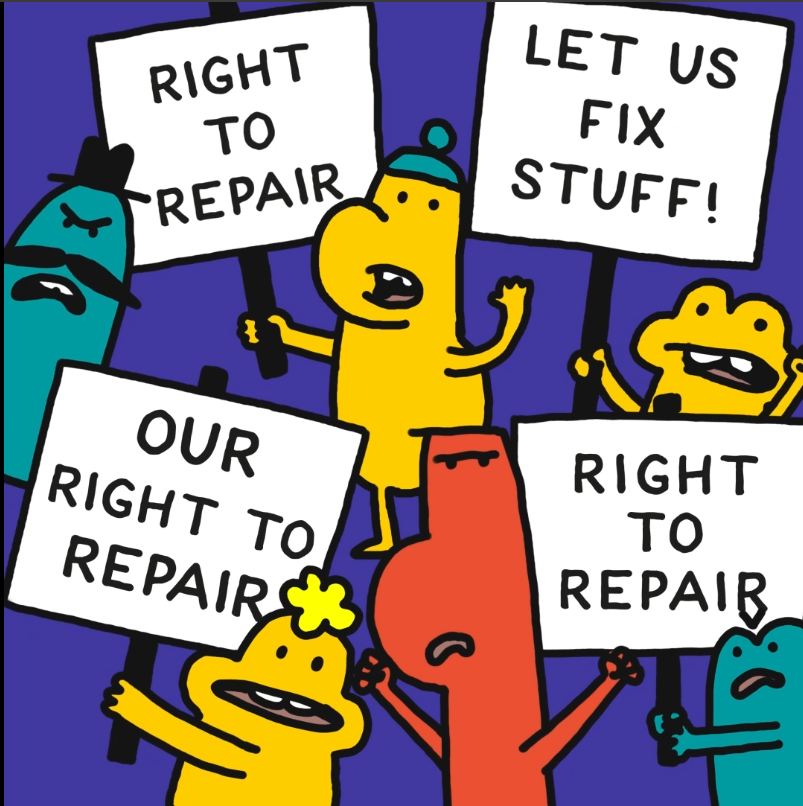
Click on the picture to watch the video and sign the letter.
Right To Repair also prepared a letter that each of you can sign and send to your national representatives in just a few clicks, to demand a real and universal Right to Repair. Please participate ahead of the crucial vote of the Internal Market and Consumer Protection (IMCO) Committee scheduled for 26th of October. (If you can, please personalise the email by adding something in your native language, as it will be sent to EU representatives from your country.)
2. Broadcast yourself and make your voice heard!
In this crucial time, we’d like the politicians working on repair rules to feel the repair community looking at them and holding them accountable to deliver a true affordable and universal right to repair. We therefore need your faces and voices. Right To Repair are inviting you to create short videos asking for a universal right to repair - all details and guidelines are here.
3. Join and promote Right To Repair action in Brussels on 24th October
Last but not least, Right To Repair are organising a game stunt in front of the European Parliament on the 24th of October at 12:00. Combining a celebration of Repair Day and the important upcoming vote on repair rules, a fun game is organised: The Price is Right - Repair Edition. Members of the European Parliament, NGOs, youth-led organisations and others will try to guess the price of a spare part compared with the price of the product, to show to our legislators how the price of repair is often absurd.
If you happen to be nearby, come amplify our voices for a universal right to repair.