The journey to southern Portugal was long and arduous, a solid 12-hour drive split over two days from our home in southwest France, across Spain, and through four climate regions. We were welcomed in Portugal by the bright sun and the smiling Hanneke Boon, Designer and Head of Wharram Designs, who had just arrived from her home in Cornwall, UK. From an e-introduction just several weeks earlier to boarding the water taxi together and finally approaching Spirit of Gaia, Hanneke and the late James Wharram’s 63-foot Pahi model Polynesian wooden double canoe, our excitement was palpable.
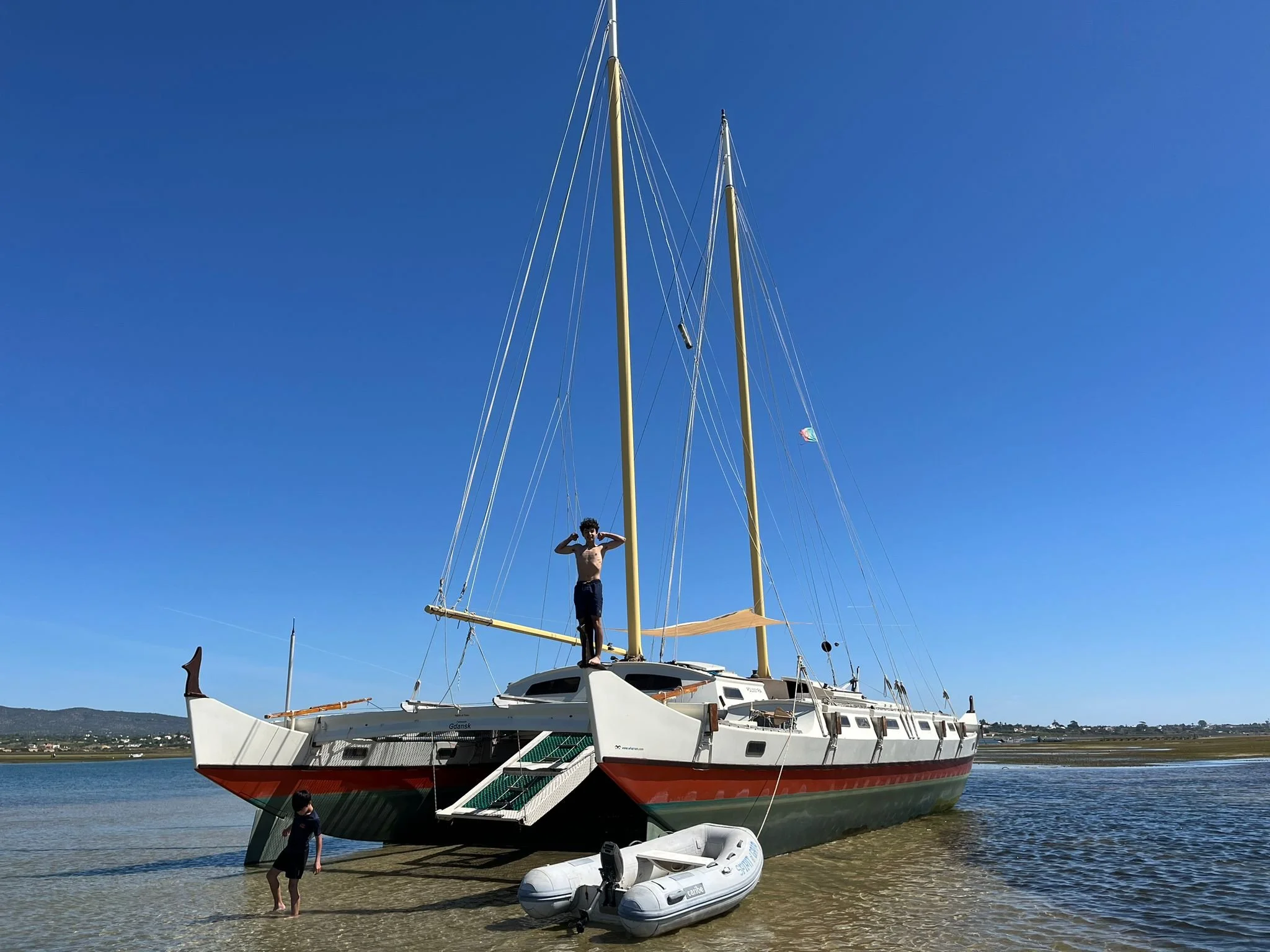
Spirit of Gaia, Pahi 63, Designed by Hanneke Boon and James Wharram.
Stepping aboard Gaia was surreal. It seemed large from a distance, yet immediately felt welcoming the moment our bare feet touched the deck. Our first task was to erect shade over the spacious wooden slatted deck, open all the cabin hatches, and give the cabins a thorough cleaning. We then attended to immediate repairs with Hanneke, such as fixing a broken line attached to one of the tillers.
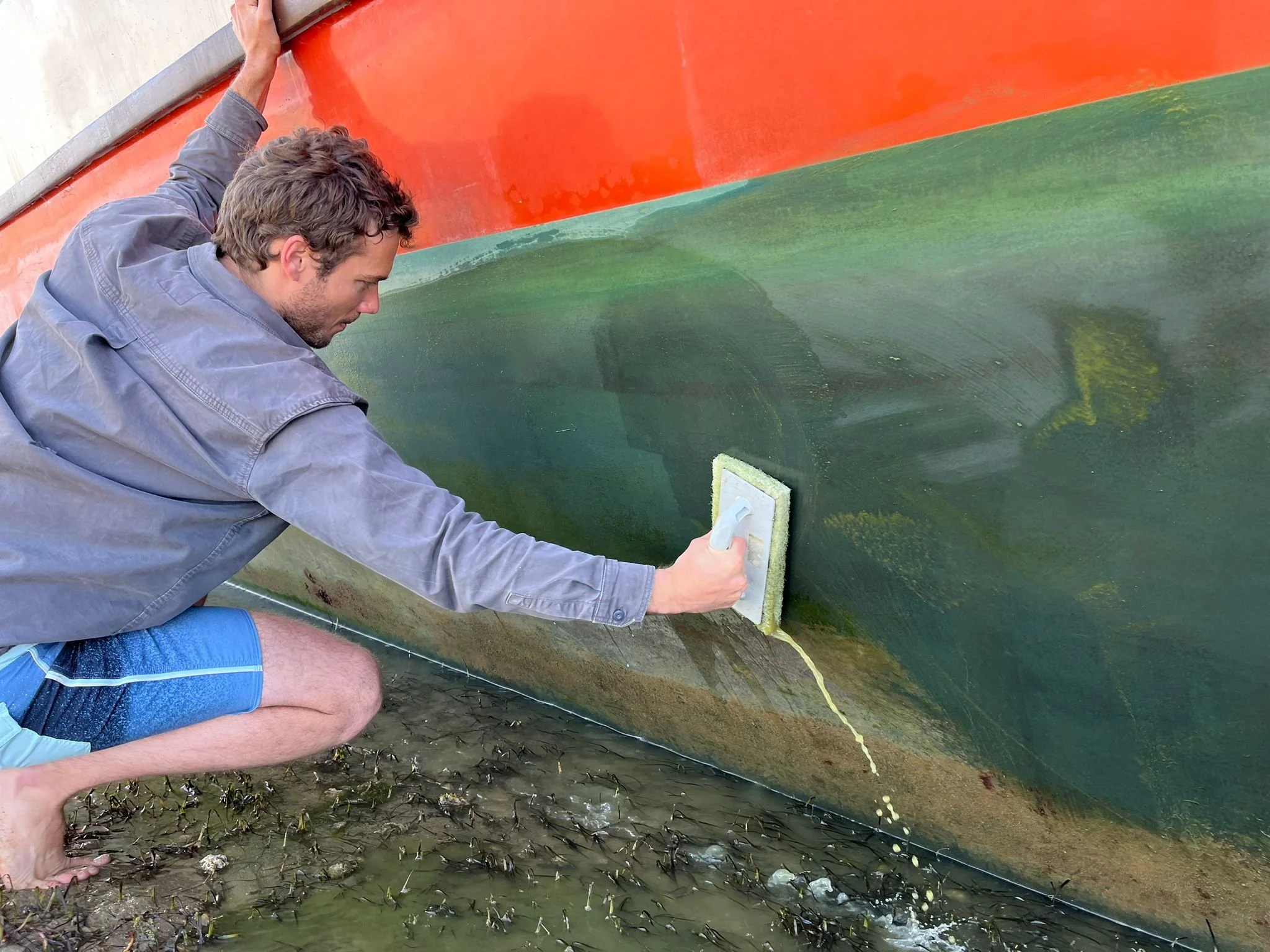
Remy scrubbing Gaia’s huge hulls.
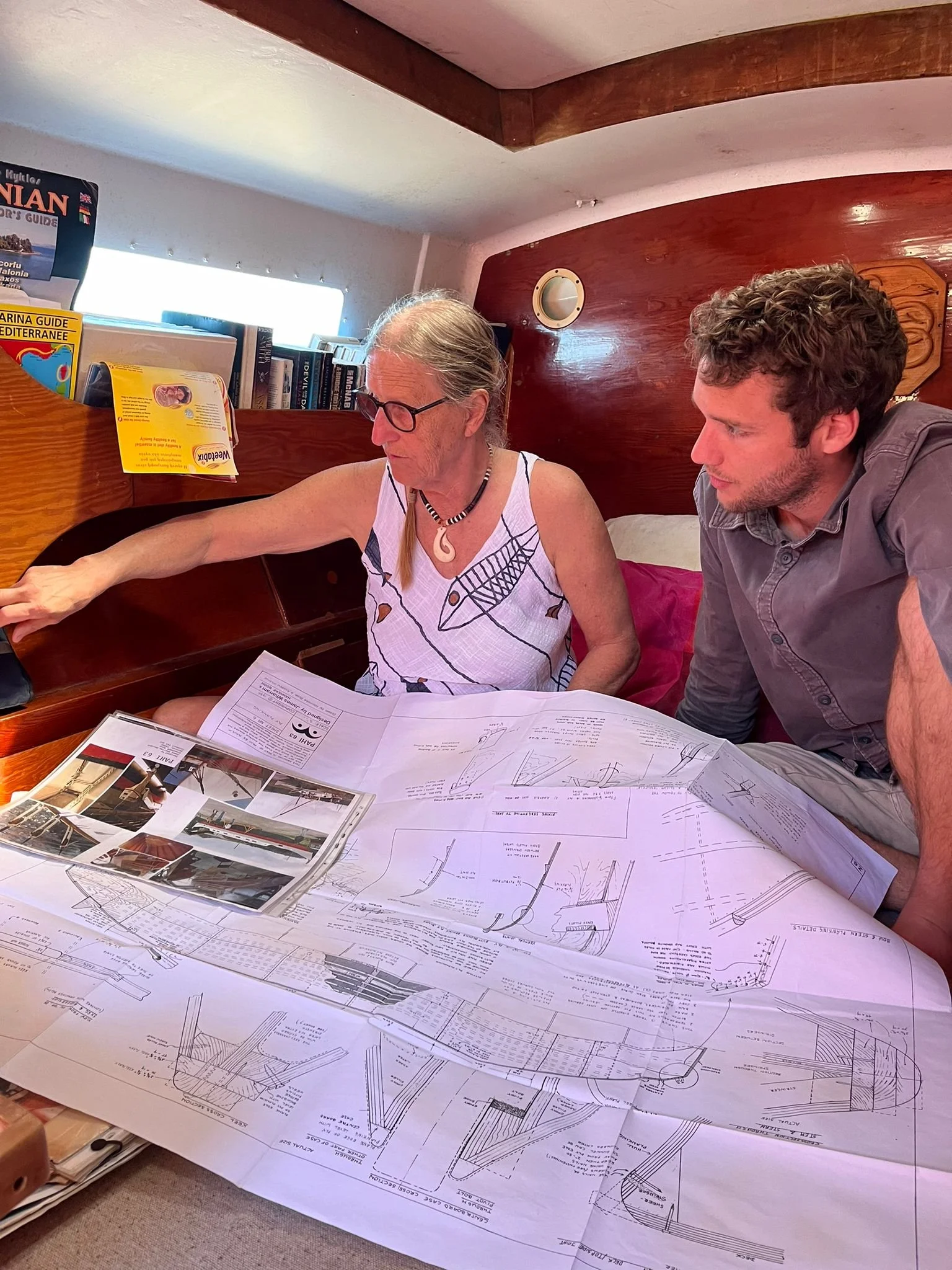
Hanneke Boon talks through Gaia’s design plans.
Our learning curve began instantly. “Can you tie a bowline?” asked Hanneke. “Um, we haven’t tied any knots for quite a while…” I replied, a little embarrassed. Here we were, enthusiastic sailors, aboard her beloved sailcraft offspring, discussing our plans to build our own classic Wharram Narai Mk IV and sail around the world as a family, yet struggling to remember how to tie a bowline. Despite our inexperience, Hanneke was unfazed and took the lead, teaching us as we went. The next four days were filled with lessons: tinkering with the dinghy’s outboard engine, scrubbing the hulls at low tide, practicing knots, diving into technical discussions about Gaia’s build, and getting recommendations for modifications on our own boat. We experienced firsthand what it was like to live at anchor on this kind of minimalist boat.
Remy took charge in the galley as the cook, while a chore I despise at home—washing dishes—became a welcome daily ritual. Sitting on the deck with two buckets of salt water—one with soap for washing, one for rinsing—and a garden spray bottle of precious fresh water to rinse off the salt, felt almost meditative. Sahara spent her days nappy-free, eating finger food on the deck, and enjoying an afternoon bucket bath in fresh water. Ryder and Hunter explored the low tide, with Ryder collecting cockle shells and mussels to later cook on a BBQ with new friends on two nearby catamarans.
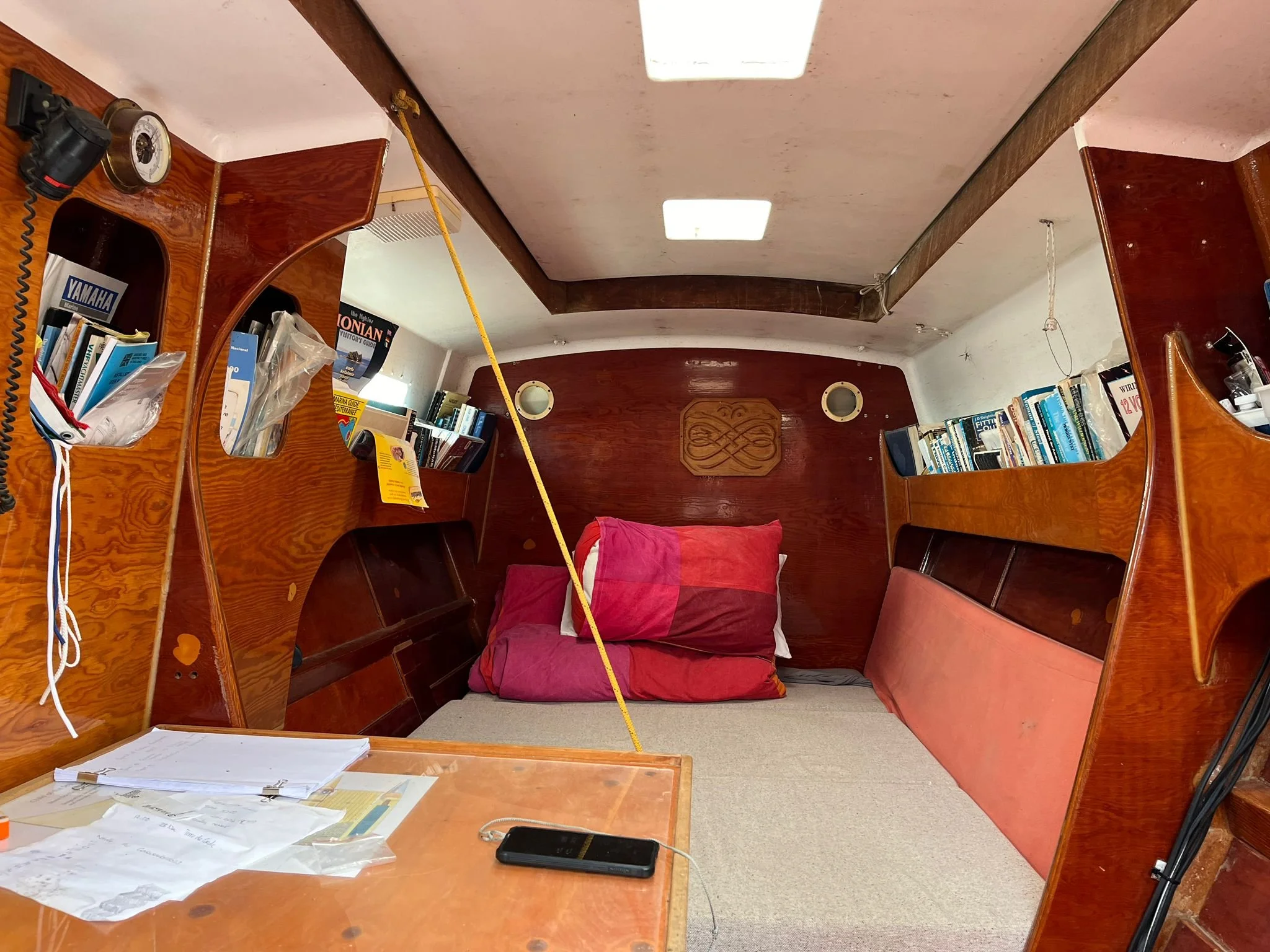
Gaia’s chartroom.
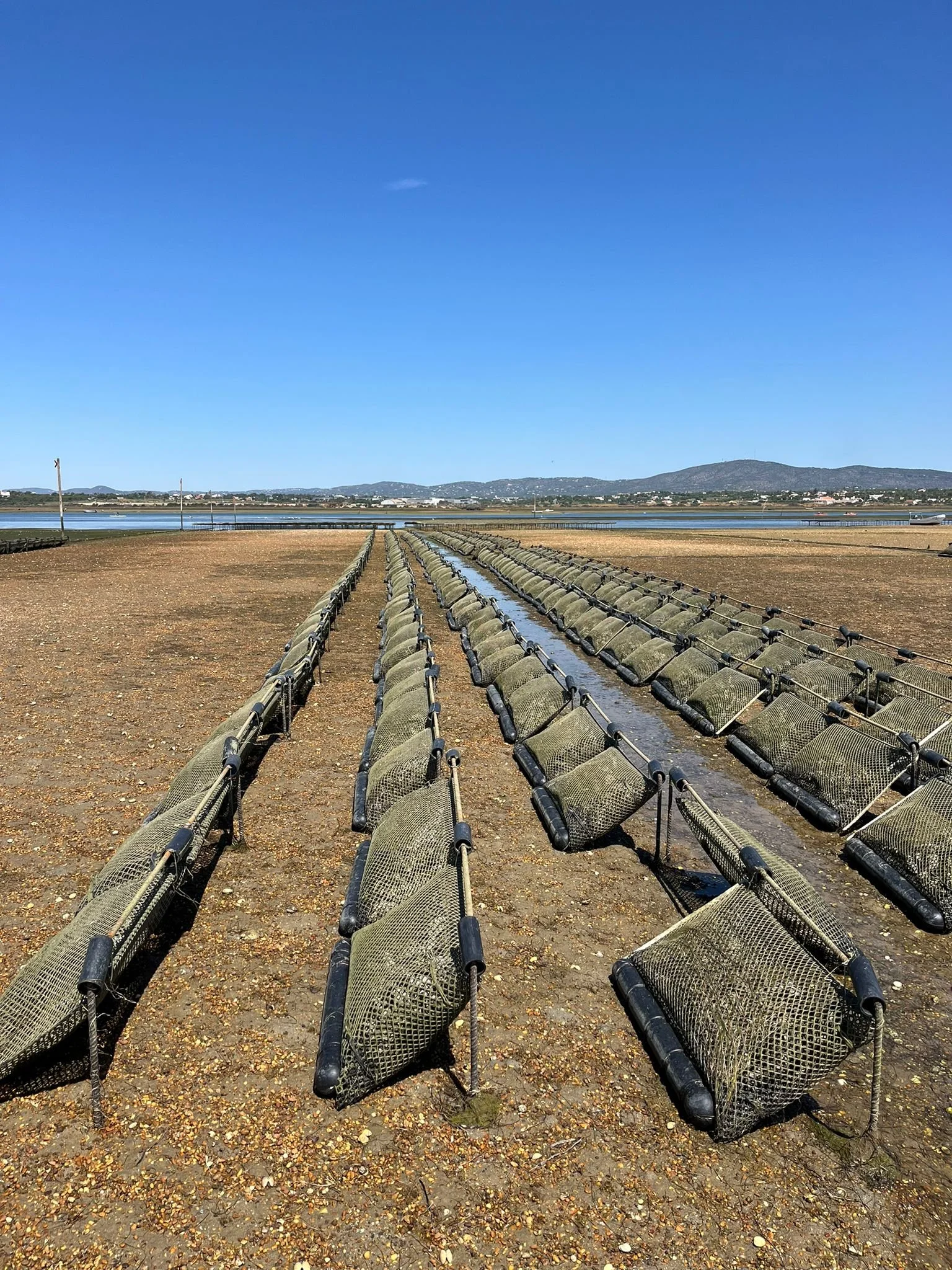
Oyster farm in southern Portugal.
One afternoon, we waded over to visit an oyster farm, curious about how different cultures farm this species we were becoming familiar with through our collaborations with scientists at the University of Brighton. Recent research reveals the devastating impact end-of-life fiberglass (GRP) boats are having on oyster populations in the UK and other marine species. Scientists collected oysters and mussels from areas near active boatyards and found significant amounts of fiberglass particles in their tissues. Using advanced techniques, the team, led by Corina Ciocan, discovered up to 11,220 particles per kilogram of wet tissue in oysters and 2,740 particles per kilogram in mussels. These findings are especially concerning because these creatures are filter feeders, constantly filtering water for food and inadvertently ingesting these particles.
Since its boom in the 1960s as a wonder material for boat building, fiberglass has been adopted by many Wharram builders to increase the longevity of their boats through improved waterproofing and hull resilience. The plans for classic Wharram boats, such as the Narai 4 that we plan to build, list nylon and resorcinol glue. We are contemplating a build using more eco-friendly bio-composites, but we need to do much more research. In an age where timber and plywood (the process of producing plywood is also not particularly eco-friendly) are decreasing in quality yet increasing in cost, it’s quite the conundrum.
(I will be speaking at a Symposium on end-of-life GRP boats at the University of Brighton on July 5 to present our project and collaborations with the scientific team and wider community. Learn more.)
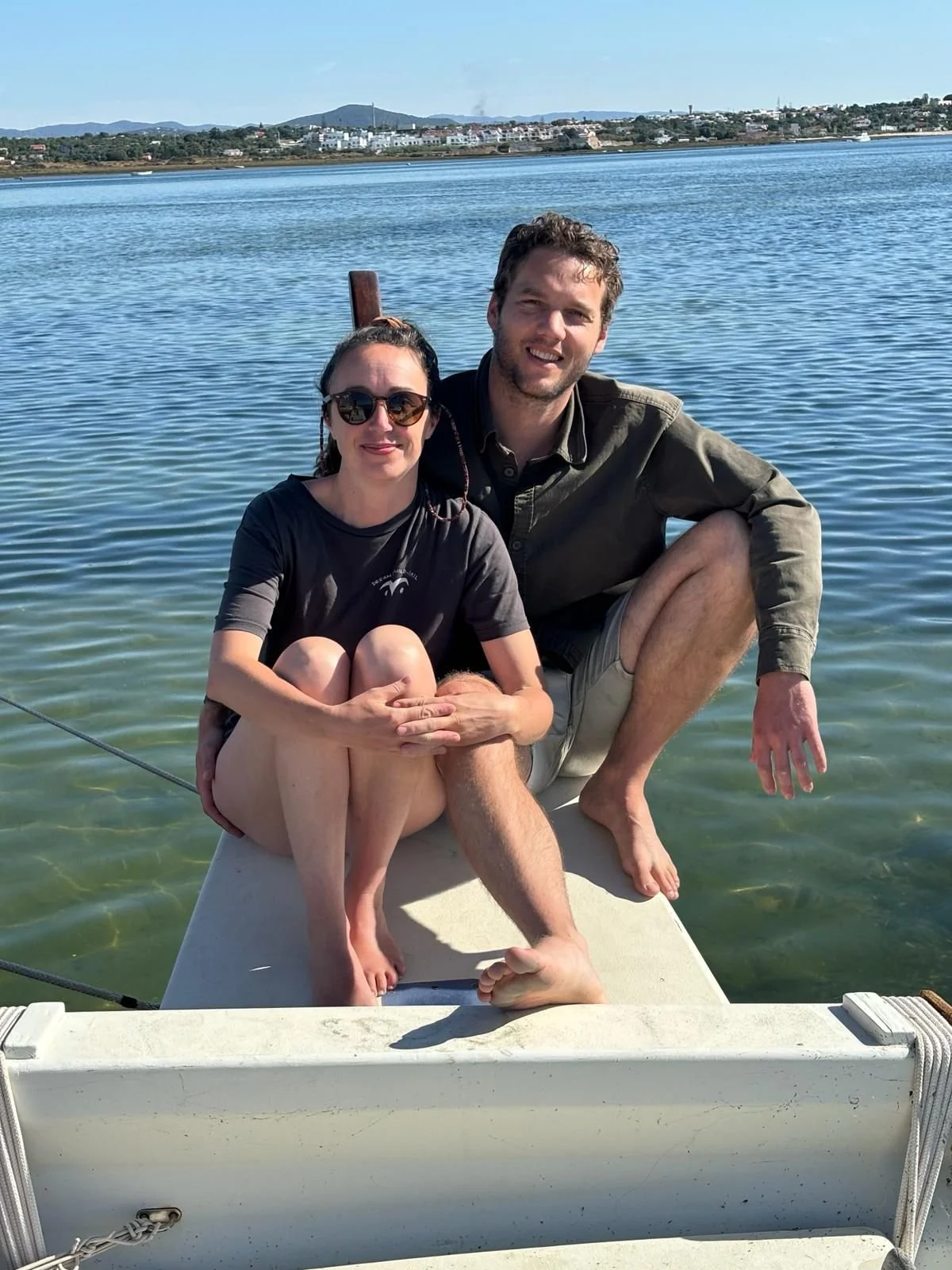
On our final evening, the neighbors brought fresh fish from the local market, and we fired up the charcoal BBQ on Gaia’s famed deck. This was the life we had been dreaming of, and thanks to Hanneke, we got a taste of it. We have a huge task ahead of us, relocating to Brittany to begin building our boat, but the memories of these few days on Gaia (they felt like weeks!) are strong motivation to continue forward. Some question our ability to build our own boat with minimal sailing knowledge and zero boat building experience, but James Wharram designed these boats for everyday dreamers like us. And like anything in life, with time, energy, and commitment (and rallying friends from all over the world, as we intend to do—so do get in touch if you’re interested in helping!), even a small family like ours can build a wooden double canoe to carry us around the world.
Our time on Gaia reminded us of the months we lived in tents on the East Coast of Australia, when Remy and I first met. Those were some of the best memories of our lives, and we can’t wait to create more—this time, at sea.
Want to support our project? Here’s how:
Power the Journey: Contribute to our project and help keep the sails unfurled by making a one-time financial contribution with PayPal.
Join the Inner Circle: Dive deeper by becoming a Patreon for exclusive updates and member benefits, or subscribing to our Substack newsletter community.
Crew Up for Change: Explore partnership and sponsorship opportunities. Join us in creating a more sustainable and hopeful future.
Philanthropic Contribution: Match or raise our personal investment with a philanthropic contribution. Please email us to learn more.
Your involvement propels our journey and helps to create ripples of impact. Thank you.