
A short flight from the capital Port Moresby to the mainland’s north coast, Madang is often dubbed the jewel of PNG, and rightly so. Its flourishing and abundant landscape is like an artist’s palette of earthy greens and browns, and its sea more blue than a summer sky. Most of Madang’s 29,000 inhabitants are unemployed, opting to live off the land and the sea, trading with farmers from the Highlands and relying on tourism to get by. As our morning flight skims over swaying coconut trees that fringe the sapphire lagoons, I can’t help but feel humbled at the uninterrupted beauty below.
War Relics
Our guide ‘Busy Bee Kudjip’ is the best in the area, and with more than 20 years of guiding under his belt, our group passes no stone without Busy Bee sharing its story. As we bounce along the rough roads in Busy Bee’s battered 4WD Land Cruiser, the piercing sun envelopes the locals as they gather in the shade, under trees and makeshift shopfronts, trading handicrafts and other locally made goods.
We stop only for Busy Bee to buy a pack of cigarettes from a street vendor before turning suddenly off the main road and thrusting the car into a barely used track. We come to a halt, and a shirtless man grasping a worn machete greets our entourage. Richard, who lives here in the jungle, runs ahead cutting back the chest-high wild grass to pave our way forward, allowing us deeper into the unknown.
Craters of muddy water flank the path both left and right, half hidden by the tall grass. “These are bomb craters,” shouts Busy Bee over the struggling air conditioner, “We are driving on the old runway of the Japanese war plane airport.” As we plunge deeper into the jungle, the burning sun is replaced by a refreshing tree canopy, and Busy Bee comes to a stop at the end of the old runway. Richard guides us through to a circular clearance; it’s his job to keep the area clean, tidy and ready for Busy Bee’s guests. The mud underfoot is thick and I now kick myself for having only packed thongs – the promise of surf and snorkelling adventures instigated my uncharacteristically amateur packing fail.
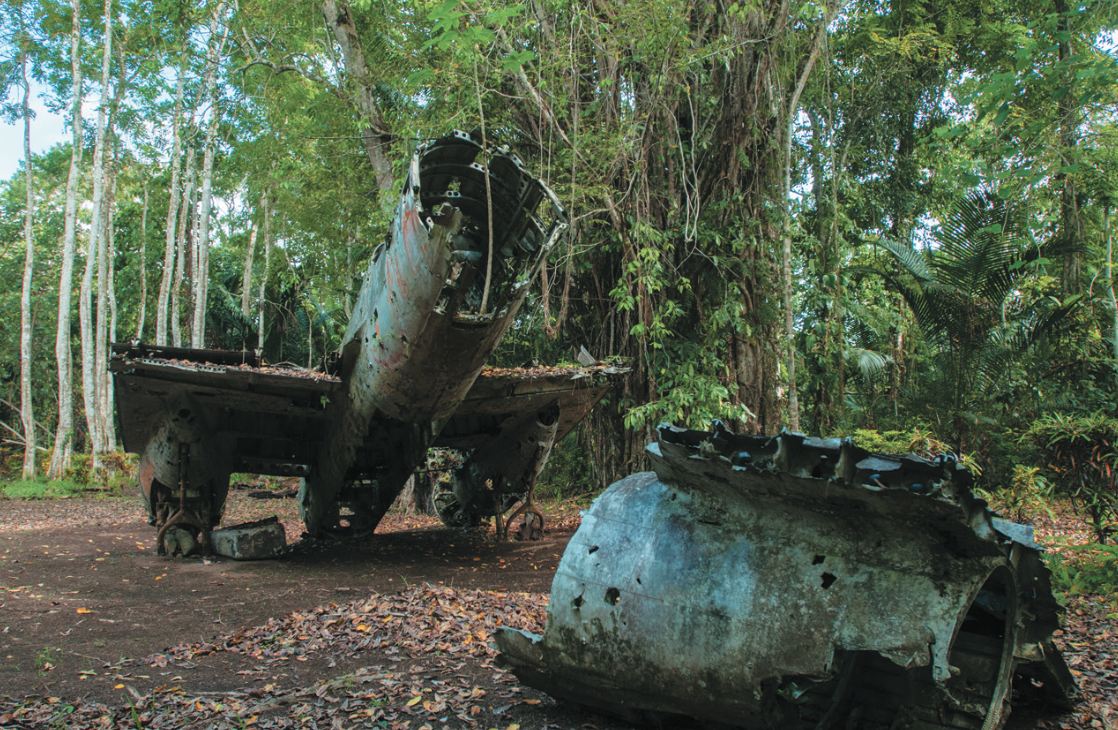
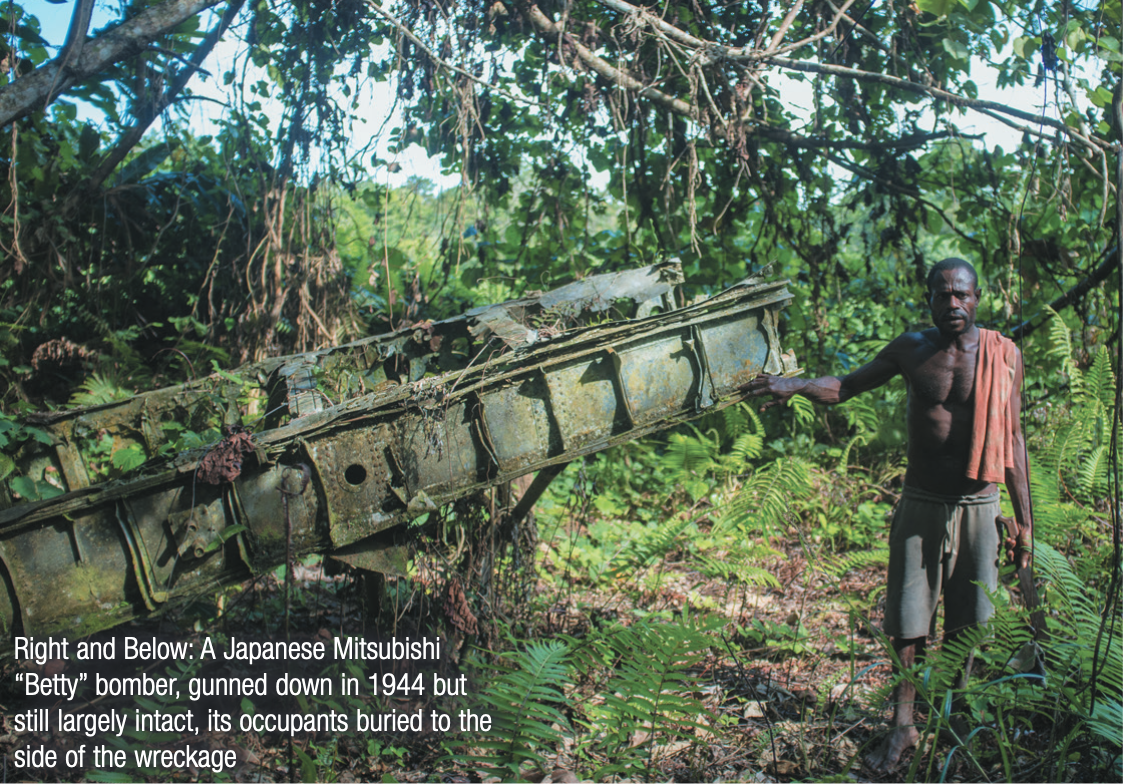
But my princess moment is short-lived as we step gently into the clearing, my eyes immediately drawn to a Japanese Mitsubishi “Betty” bomber, brought down in 1944, killing all four crew on board.
Richard moves around the bomber and encourages us to come closer. I reach my fingers onto the aged plane carcass, stopping for a moment to close my eyes and imagine a period in time I can barely comprehend. The intense energy of the wreckage transports me momentarily to a scene from a Hayao Miyazaki movie; the sun’s rays creep through the canopy, spotlighting the plane wreck with poignant reality. To the left of the plane’s nose I discover four shallow graves. We stand in a minute of silence to pay our tributes to the deceased.
Richard moves us along to other areas of the jungle, where we discover the bomber’s engine, a wing, and other ruins scattered over a large perimeter. “Not many people realise how many Japanese are buried in Papua New Guinea,” says Busy Bee, “There are a lot of bodies here.” Richard lights a small grassfire next to the Land Cruiser, and we are forced to jump over the rising flames – me in thongs – to get back in the car and take off for our next stop, Hobe Village.
Hobe Village
If there was ever an inspiring tale of a man who left his village to make money in the city, then quit it all to return to life off the grid, it would be the story of Joel from Hobe, Madang. The once professional carpenter (Joel’s handiwork can be seen throughout the Madang Resort in town) and self- taught botanist is the chief in this local community of about 100 people, a clan existing without simple basics like running water or electricity. Here the kids travel on foot some one-and-a-half hours each way to school. Those who don’t go to school hang around the compound, but Joel encourages them to get an education.
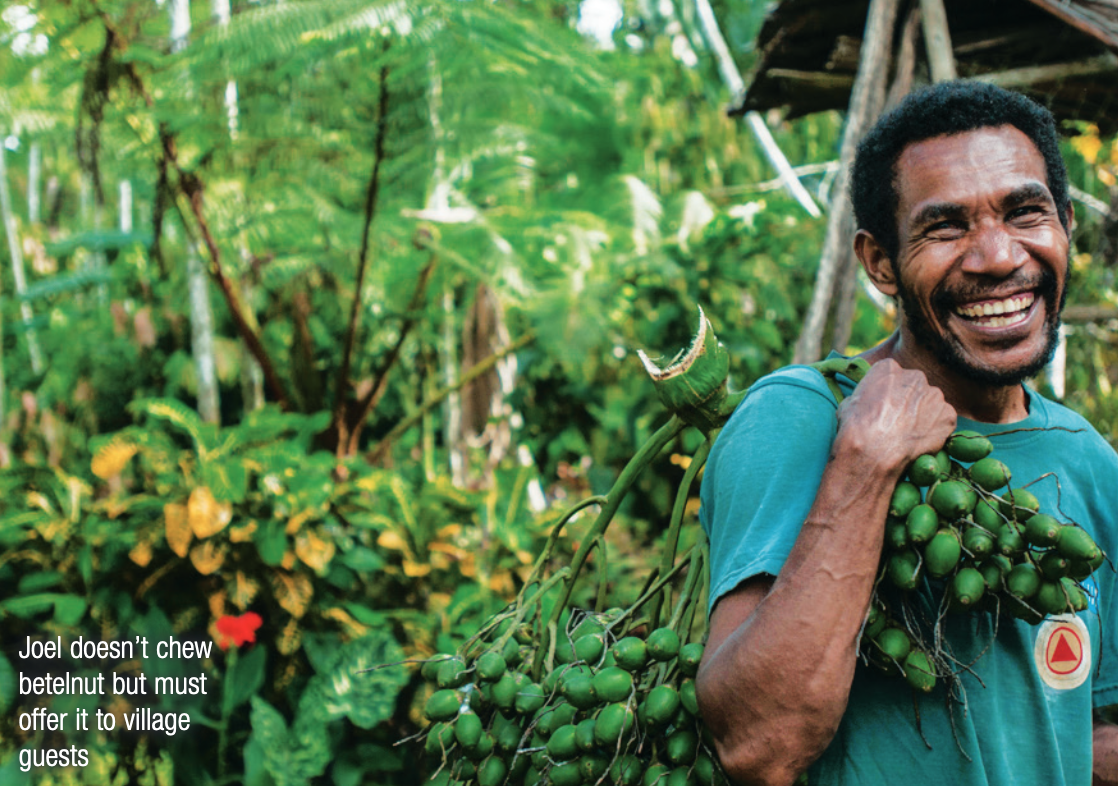
Busy Bee leaves us in Joel’s care for an hour, but I could easily spend a day wandering through his luscious gardens, admiring his impeccable attention to detail. We stroll gently through his Utopia, past flourishing orchids of multiple varieties, tree ferns, aloe vera, vanilla plants, and plants Joel hasn’t found a name for yet. “I started with 40 species, now I’m not sure how many... probably over 100. I quit my job and came back home – I want to live inside the garden, not outside,” explains Joel. He is very quietly spoken and slow moving, but incredibly uplifting.

Joel relies on nature almost entirely, with limited resources to encourage his plants to grow, but has taught himself a few tricks along the way to train his garden into a stylised oasis. He proudly shows us his ‘broken thong technique’, where he has forced plants to grow with a thong buried under their roots, encouraging multiple blooms. “This is what I do... in my garden,” he says with a coy grin.
Leading us up a gradual incline, Joel weaves gracefully past medicinal plants, birds of paradise, and orchids of brown, yellow, vanilla, pink and purple, up a narrow path to two adjacent wooden huts surrounded by ground clovers. A young girl sits shyly beside an outdoor kitchen fire, stoking the flames and giggling behind a warm, betelnut-red smile. “This is my daughter,” announces Joel, “and my home.” Behind the main hut, Joel fumbles with a thick bush growing freely on his back fence, then pulls his hands out holding a huge caterpillar. Black, yellow, white and brown, I keep my distance from the gentle giant as Joel talks passionately about how he has to keep spiders and cats away from his garden – he needs the butterflies to pollinate his blooms.
Beside his hut, two branches of betelnut sit upon the clovers, but Joel later jokes it is the “talking drug: it’s no good for me, just makes you talk too much.”
Tupira
The two-hour-something drive from town up to Ulingan Bay is riddled with potholes. I’m glad we’re not in Busy Bee’s Land Cruiser any more. When we finally reach Tupira Surf Club, we pile out of their comfortable minivan and our senses are engulfed with that familiar sultry smell of ocean. Before us is a newly milled two-bedroom hut standing tall above the sand. We partake in polite Papua New Guinean greetings and then are ushered to the shore, and our eyes become glued to a set of liquid lumps rolling through the tree line. We see waves, plentiful waves, and only one lonely surfer sucking up the empty pleasures. We meet our host Nikki Wynn in the covered communal deck area – complete with bar, hammocks and a ping-pong table – out back of the main hut’s living quarters. Glassless windows give way to a dominating view of the surf; it’s not 10m to the water’s edge. Nikki is dripping wet and the temptation is too much. “Can we surf?” I ask him bluntly, politer greetings aside. “Sure, that’s what you’re here for,” Nikki replies with a tender smile, “it’s pretty good!”
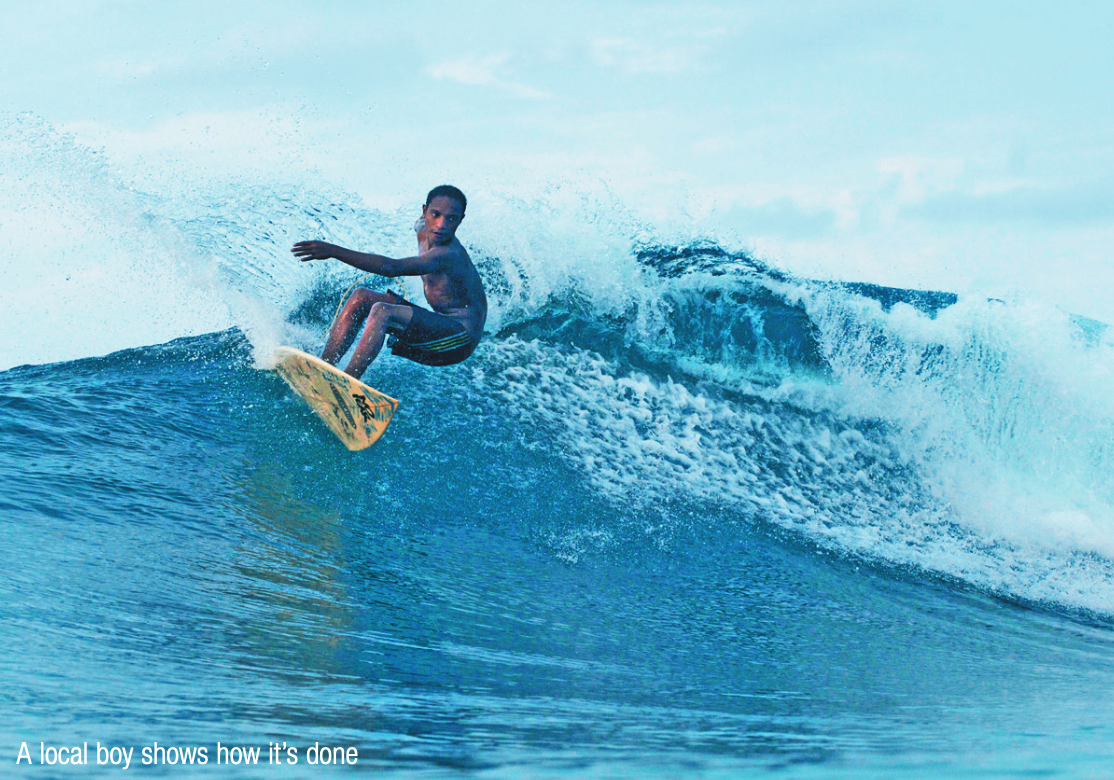
Bags are dumped on the timber floorboards, surfboards pulled from their travel cases. I lather my face with sunscreen but fail to protect my arms and legs thinking I’ll just get a few waves then come back in to meet the staff officially. Amateur fail number two. Our team of five, paddles out into the 1m-high, peeling break. There is not a breath of wind and my surfboard slips smoothly across the glassy water out to the peak.
The sole local eating up all the waves introduces himself as Jeberdi; his bright green boardshorts shoot images of Jiminy Cricket into my mind. Excellent. “So, where is everyone?” I ask Nikki as we wait for a set, puzzled as to why we have this all to ourselves. PNG’s surf camps are often dubbed the last frontier, but surfers worldwide have been catching on to the water wonderland that exists here. “Well, you guys are the only guests we’ve allowed this week, and we have a surfer management plan created by Andy Abel, so we only allow 10 surfers in the water here at any one time.” Nikki’s response is like sing-sing to my ears: foreign, enticing, and seemingly fiction.
Andy Abel, president of the country’s surfing association, kickstarted the plan some 27 years ago and has tirelessly worked to create welcoming surf clubs all over PNG. Tupira, the newest, is the only community-run surf camp of its type in PNG, and possibly the world. Surfers pay a nominal fee to surf uncrowded waves, and together with the kina you spend to stay – and throw down on the bar – Tupira is able to employ locals from the village, and give back to the community through health care, education sponsorship and tourism.
The land is owned by Justice Nicholas Kirriwon, a Supreme Court judge who we met briefly upon our arrival, known to the staff as ‘Uncle Nick’. Justice Kirriwon is the reason Ulingan Bay and surrounds are celebrating the growth of surfing culture and the rewards that come with it. “We support the schools, pay decent wages... it is my duty to look after my lands,” Uncle Nick tells me later. The humble judge, who holds a great deal of sway in this intriguing country, says that while he doesn’t surf, he and his family used to body surf in these pristine waters growing up.
The quality of surf here at Tupira is something of surfers’ folklore: outgoing tide overnight succumbing to an incoming tide all day (during our trip at least), ridiculously consistent metre- high (sometimes plus) sets with forgiving shoulders begging to be caressed, the occasional sucky coverup at just the right time of day, and, of course, the capped crowd limits. My ‘quick surf ’ somehow turns into a few hours of non-stop ocean play, stopping only to share waves with our amazing group. I am so sunburnt it hurts, but the waves are too good to pry myself away from. Below me, Nemo and fishy friends play visibly around my feet; the myriad of colours dotting the reef beneath complements the verdant hills and coconut palms that hug the surf break and bay area.
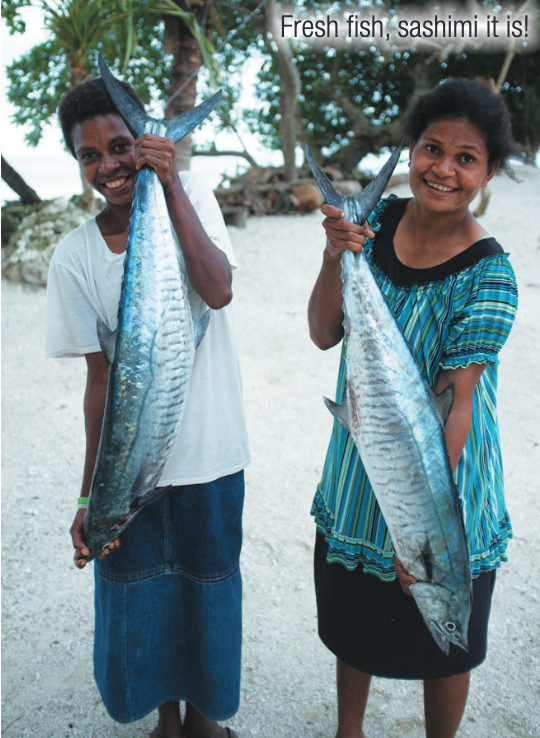
Meals are all-inclusive at Tupira: menus made fresh from local ingredients with fish – particularly sashimi – a daily feature. Our two fabulous female cooks have never stepped foot into a café or restaurant yet dish up flawless food three times a day. Their smiles are as warm as their hand-baked bread each morning. Tupira becomes our second home, and the staff our family.
*Originally published in Airlines PNG Magazine ‘Our Way’, 2014.
