
Originally published in Practical Sailor Magazine (November 2, 2026) republished in FSL Substack with permission.
Two years after Practical Sailor asked “What do you do with old fiberglass boats?”, the boats are still piling up. The U.K. still has no national scheme, France’s industry-funded scheme misses its own targets, U.S. removal budgets are running dry, and in the Pacific old vessels are still being sunk at sea. A field report on what has changed, what hasn’t, and what you can do about the boat in your own slip.
By Angie Richard
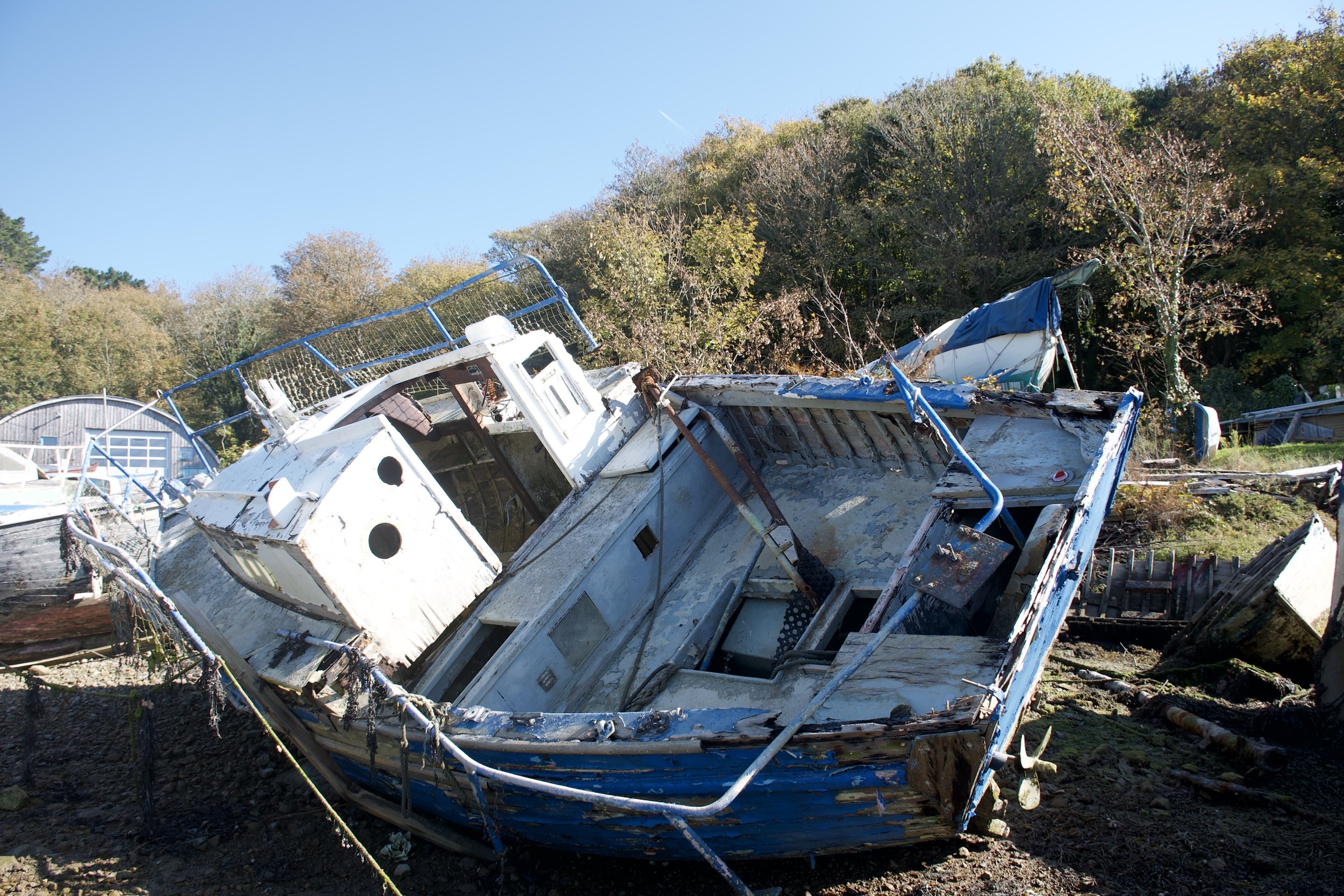
At low tide on the Goyen, a small estuary on the western tip of Brittany, a big old hull lies on its side in the mud. The name on the stern has faded. The paint has cracked and is flaking into the sediment, and large panels of fiberglass, probably once interior liners, are so degraded I can see exposed, javelin-like strands. Under the hand-held Bluetooth microscope I carry on mapping field trips, those strands are clearly glass fibers, loose and ready to go wherever the wind or next high tide transports them.
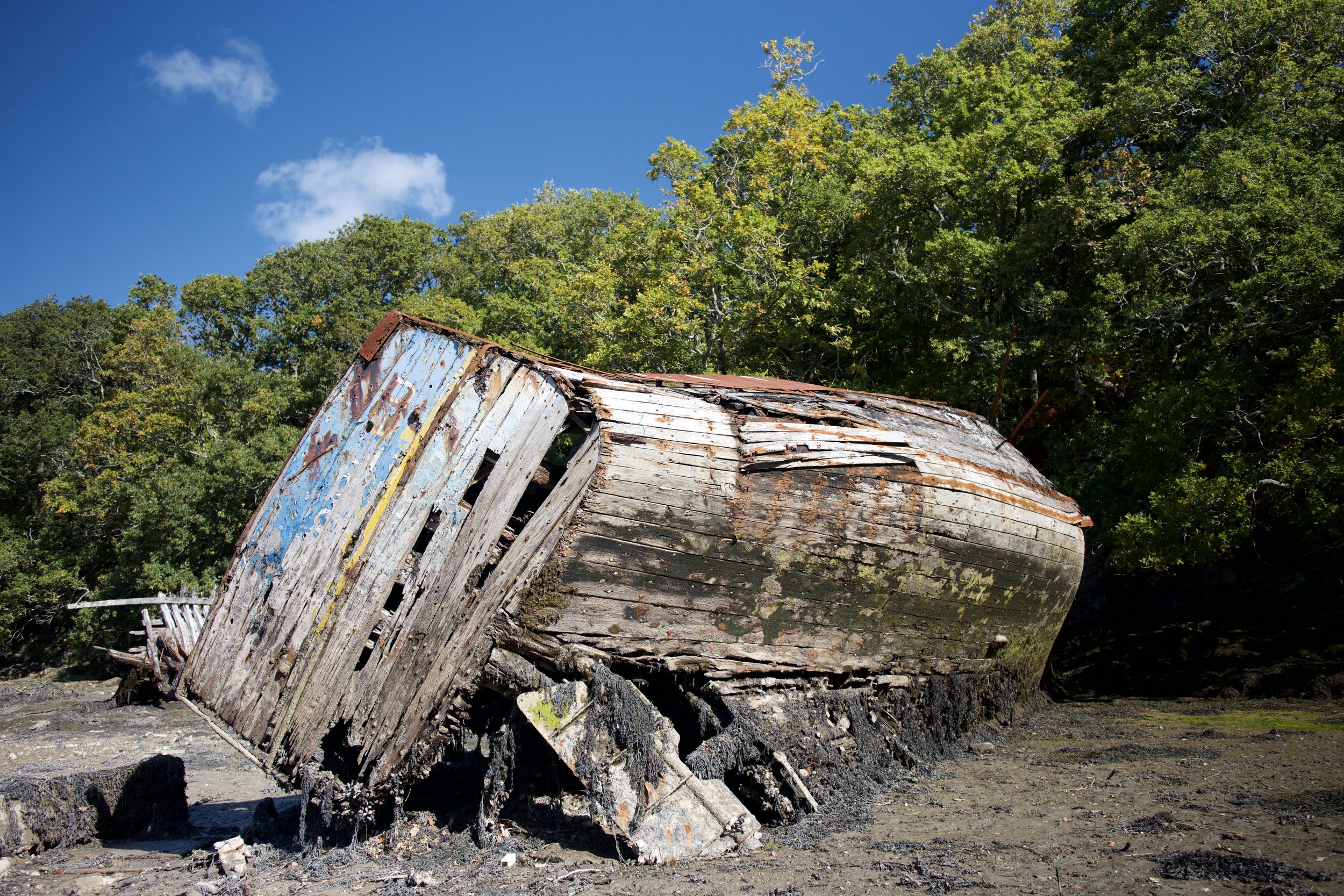
A wreck exposed at low tide on the banks of the Goyen River Estuary, Audierne/Plouhinec, France. Photo: Floating Stories Lab.
Twice a day the water floods over wrecks like this and drains away again. The surrounding banks are peppered with wild oyster and mussel reefs. A large grey heron watches over me as I work; a juvenile seal sunbathes on a sand bank behind the heron; next to the seal, a fisherman casts his line; and 50 meters from where I am taking photographs of exposed fiberglass and shedding paint, another local gathers shellfish in his hands to take home and eat.
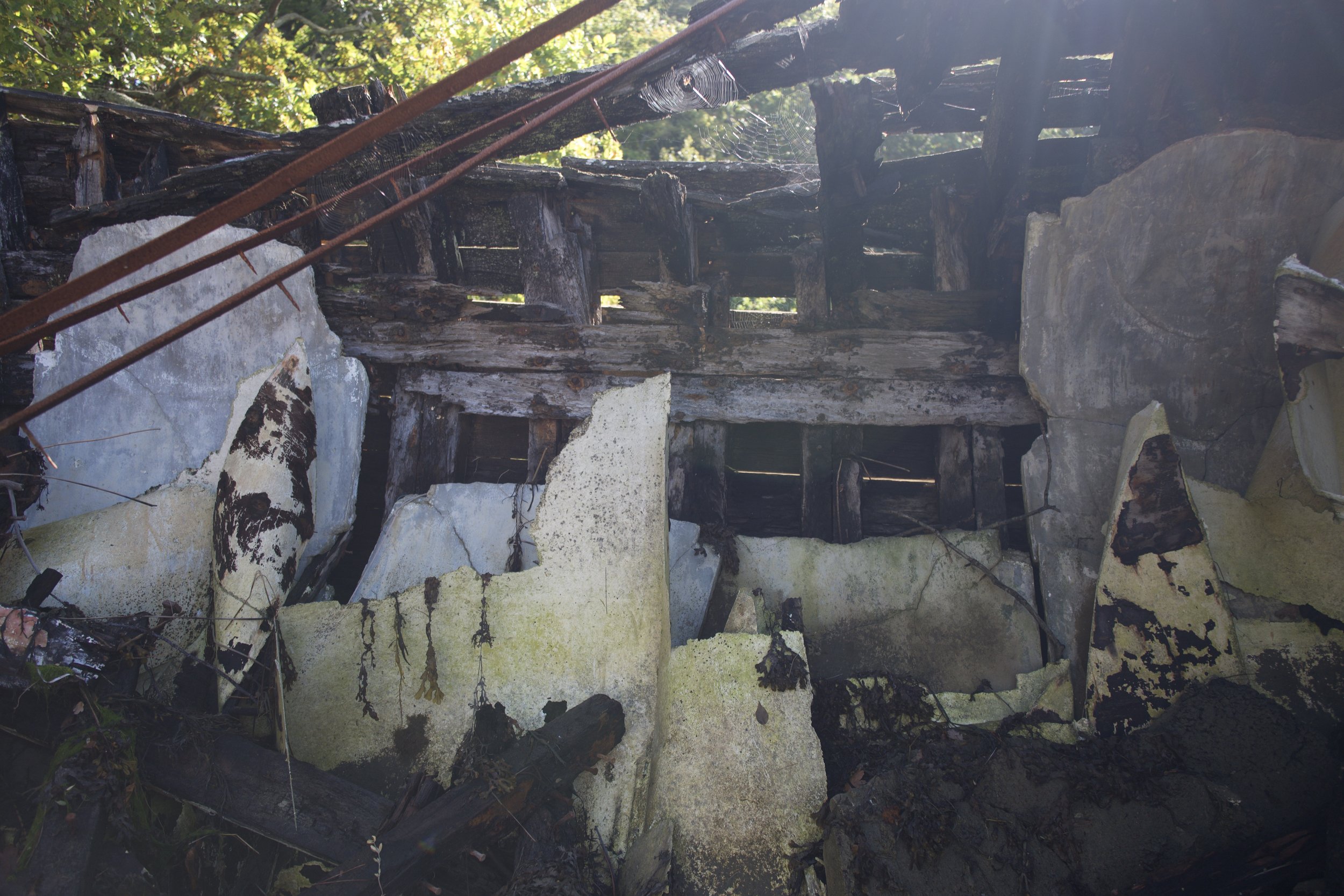
Fiberglass panels inside the open guts of the above wooden-hulled wreck. Photo: Floating Stories Lab.
Two years ago, here at Practical Sailor, I asked what we do with old fiberglass boats (Practical Sailor, September 2024). I described the recycling routes, the policy gaps and a small citizen-science project we had just started to map abandoned boats. Since then, I’ve trudged through a few more estuaries at low tide, sat in a lot more meetings with harbor masters, scientists and boatbuilders on both sides of the Atlantic, and observed the debate heat up.

A cracked hull from an abandoned boat under our hand-held microscope, in-situ. Photo: Floating Stories Lab.
Recently, the British magazine Yachting Monthly published a thoughtful five-point plan to solve what its headline calls the end-of-life boat crisis (Barry Pickthall, Yachting Monthly, August 2026).
1. Count the boats, through harbor authorities.
2. Make all leisure boats register, with the last registered owner held accountable.
3. Add a scrappage fee to new boats, paid into a government-held pot.
4. Have scrappers register and work as a network.
5. And keep researching the least harmful ways to dispose of what’s left.
As Pickthall puts it: “So the technology is here. What is required is the will, not just in the U.K. but across Europe to develop methods to fund a scrappage process spread over the life of the boats.”
I agree with some of it, and I’m glad the conversation is getting louder. But after two more years in the field, I don’t think will and technology are enough. France has the most complete system in the world, and it is missing its own goals. The reasons why tell us a lot about what needs to change, and about the part that sailors like us can play.
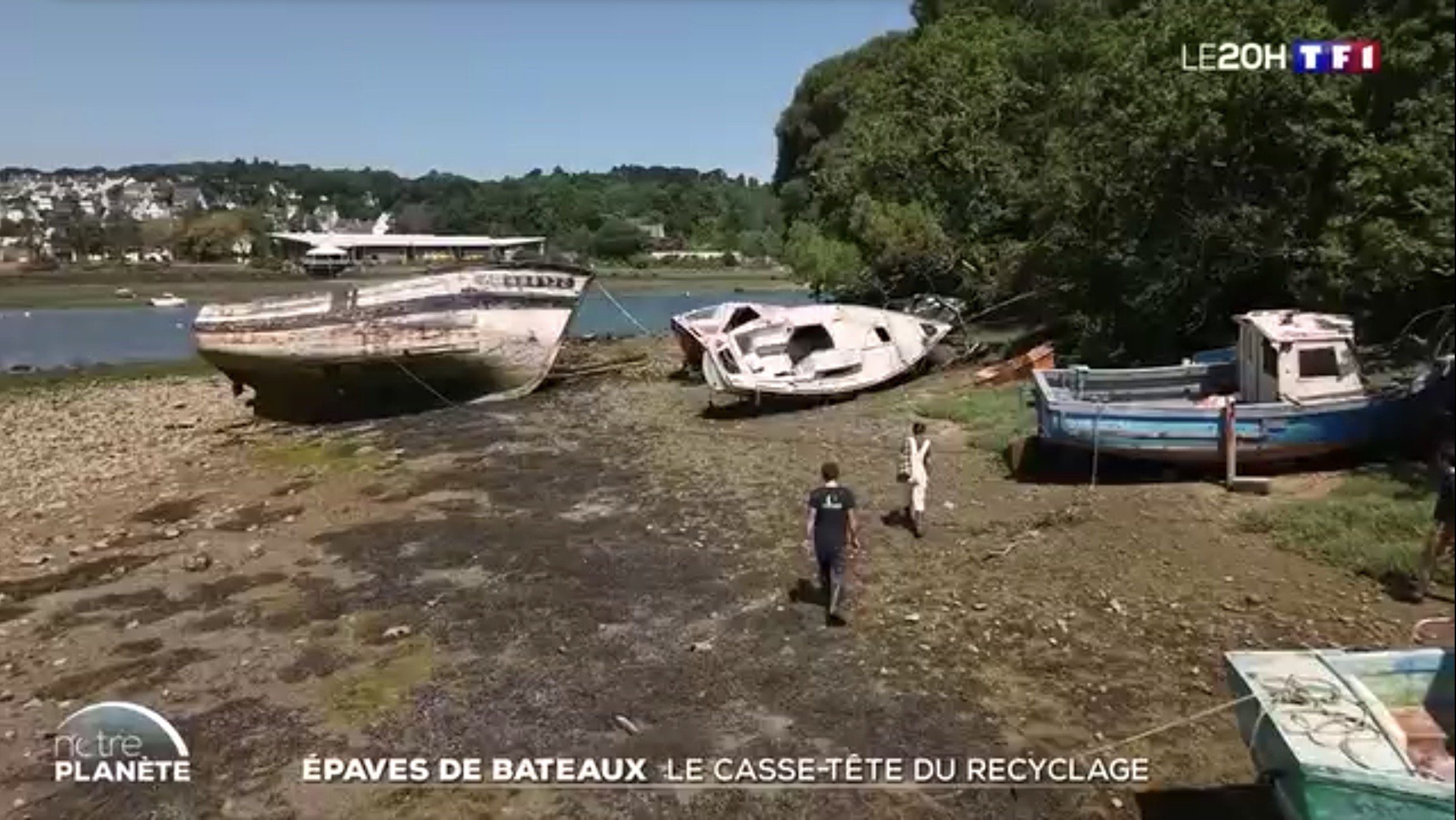
(WATCH: FSL on TF1 News)
Why this is your problem
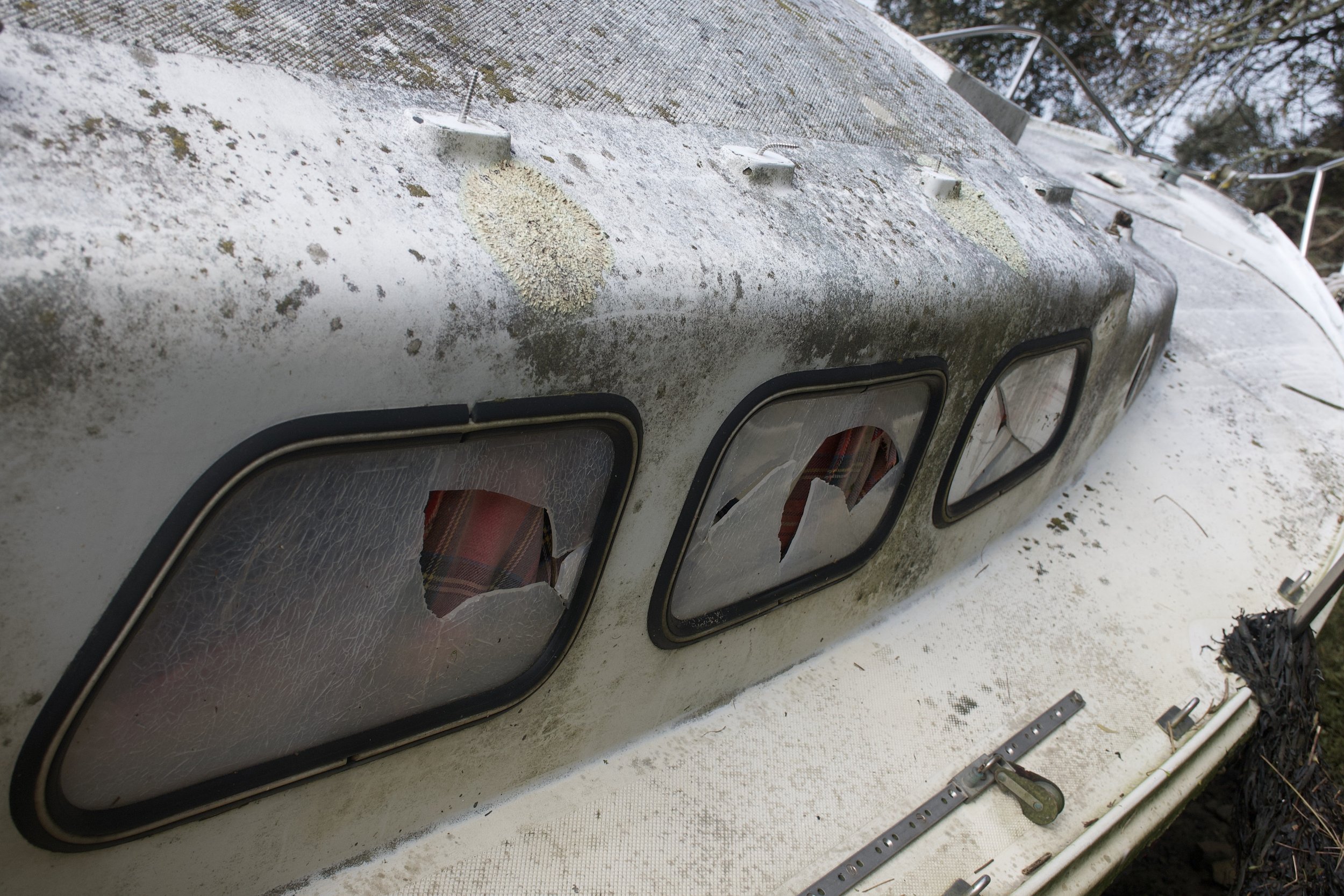
A fiberglass monohull wrecked and abandoned in the Goyen River Estuary, France. Photo: Floating Stories Lab.
Fiberglass replaced plywood as the standard material for small boats in the 1950s and ‘60s, and it was a revolution: cheap to mold, strong, and low on maintenance. The Carbon Trust’s rough design lives are about 20 years for a powerboat and 30-plus for a sailboat (Geraghty et al., 2025). Do the math on the boom years of the 1970s to ‘90s and you can see the wave that is now breaking.
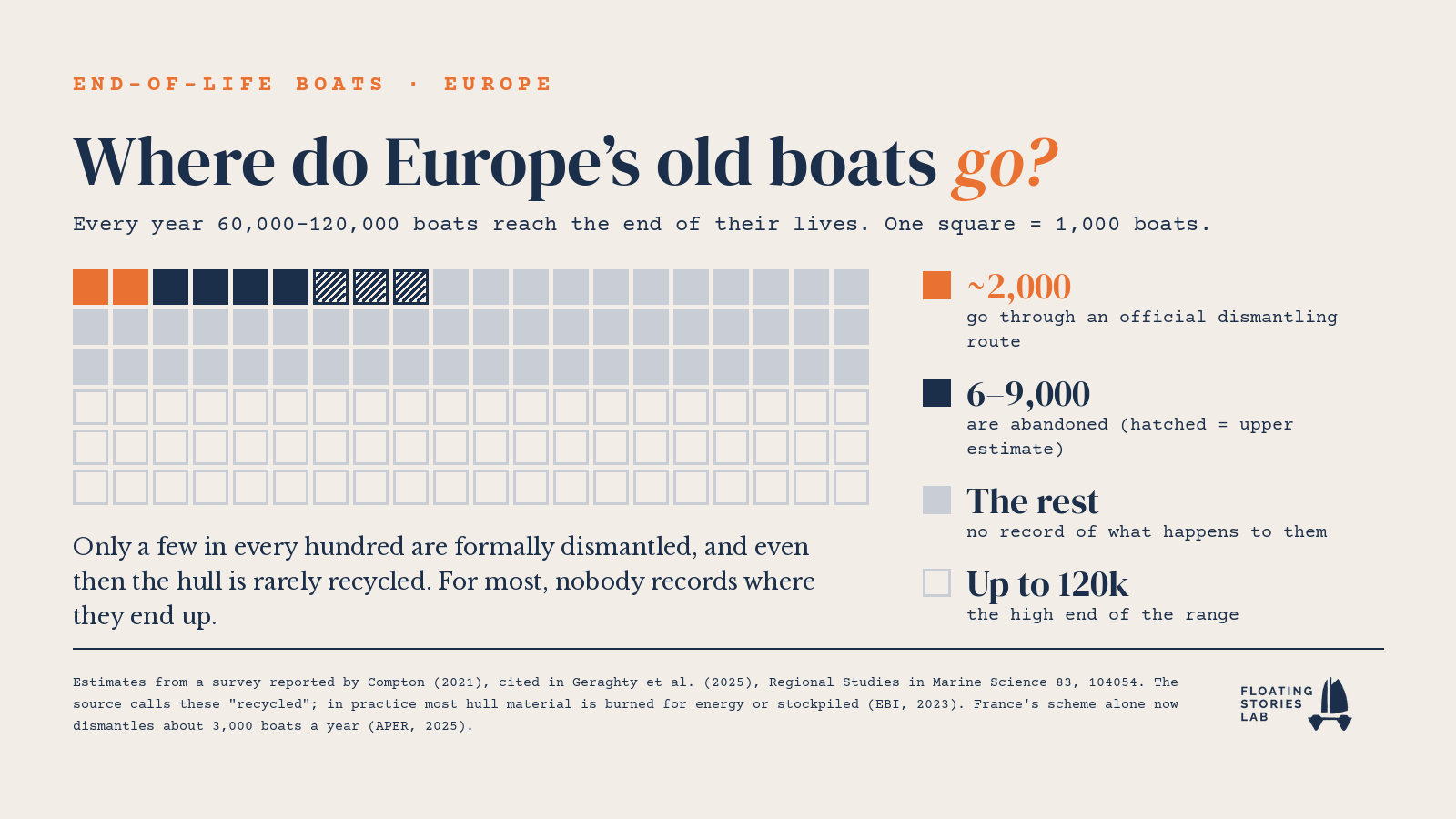
The United States had 11.67 million registered recreational vessels in 2024 (USCG). The European Union has about six million, 95 percent of them fiberglass. Each year, an estimated 60,000 to 120,000 European boats reach the end of their useful lives, about 2,000 are counted as recycled, and somewhere between 6,000 and 9,000 are simply abandoned (from a survey reported in 2021, cited in Geraghty et al.).
Those figures are a few years old; France’s scheme alone now dismantles about 3,000 boats a year, but even generously counted, only a few boats in every hundred go through an official route. “Recycled” is generous: in practice it largely means boats taken apart through an official scheme, and as we’ll see, a dismantled hull is rarely recycled.
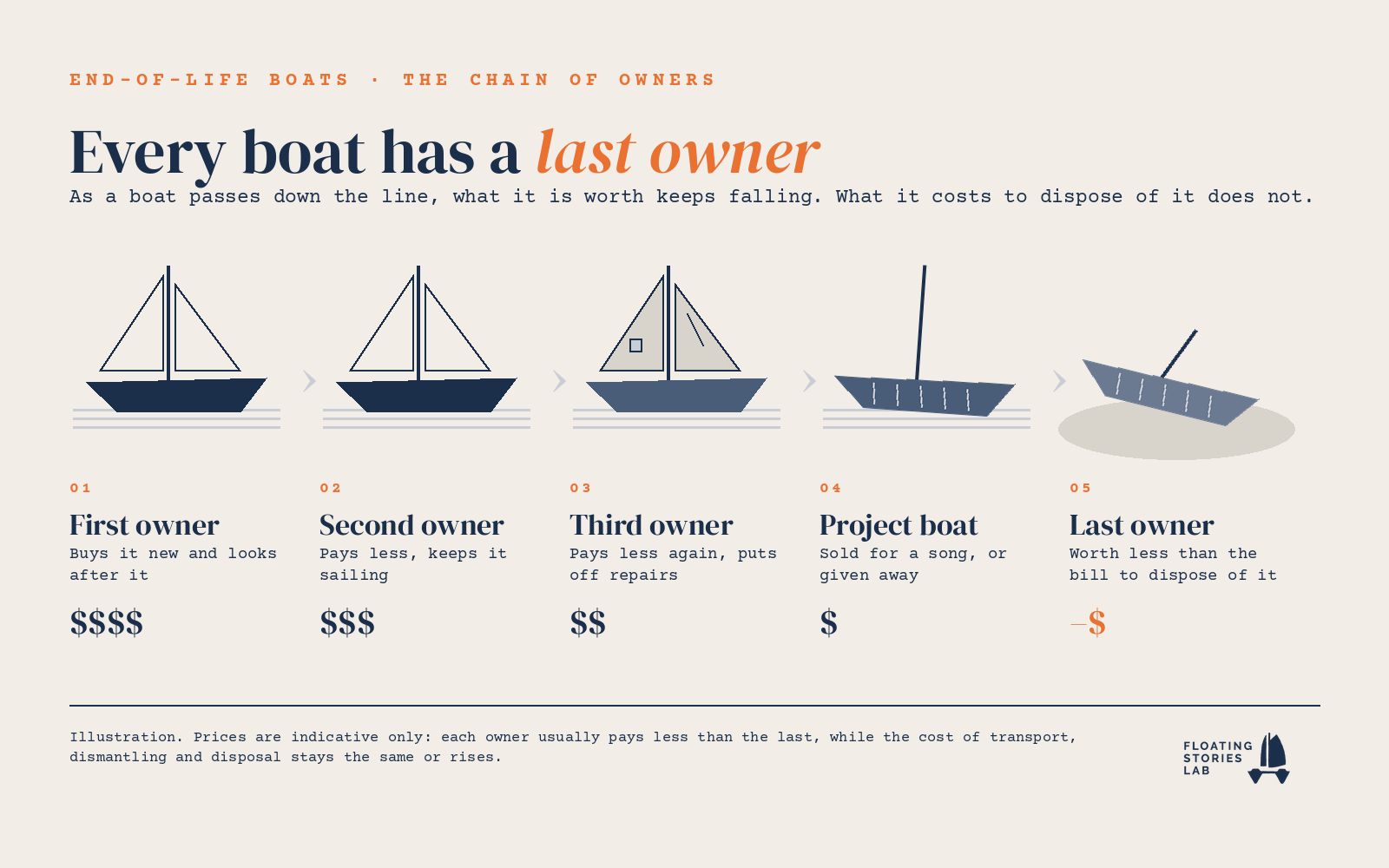
What might be most uncomfortable for most sailors is that a boat almost never goes straight from a loving first owner to the scrapyard. It passes down a chain of owners, each paying less, until it reaches someone who can’t afford to keep it, fix it or dispose of it. And the whole cost of disposal lands on that final owner, usually the one least able to pay it.
When that chain breaks, the public pays. In the U.S., according to the BoatUS Foundation, removing a single abandoned boat often averages more than $24,000 (Island Free Press, 2024). In Cornwall, in England’s southwest, the council-run harbors salvaged and scrapped 74 abandoned boats between 2015 and early 2025 (Business Cornwall, 2025), and in March 2026 the council’s harbors board agreed to spend about £165,000 over three years clearing wrecked and unserviceable boats from Truro and Penryn waters (BBC News, 2026).
In Chichester Harbour on England’s south coast, researchers led by Dr Corina Ciocan at the University of Brighton found up to 11,220 glass-fiber particles per kilogram, confirmed by Raman spectroscopy, in wild oysters and 2,740 in mussels, with the highest counts in winter, the season of boat maintenance (Ciocan et al., 2024). On the Goyen here at home in France, students working with our citizen-science program examined gill samples from wild oysters and mussels growing beside the estuary’s boat cemetery. Under a school microscope, every one held what looked like glass fibers, microplastic threads or paint flakes.
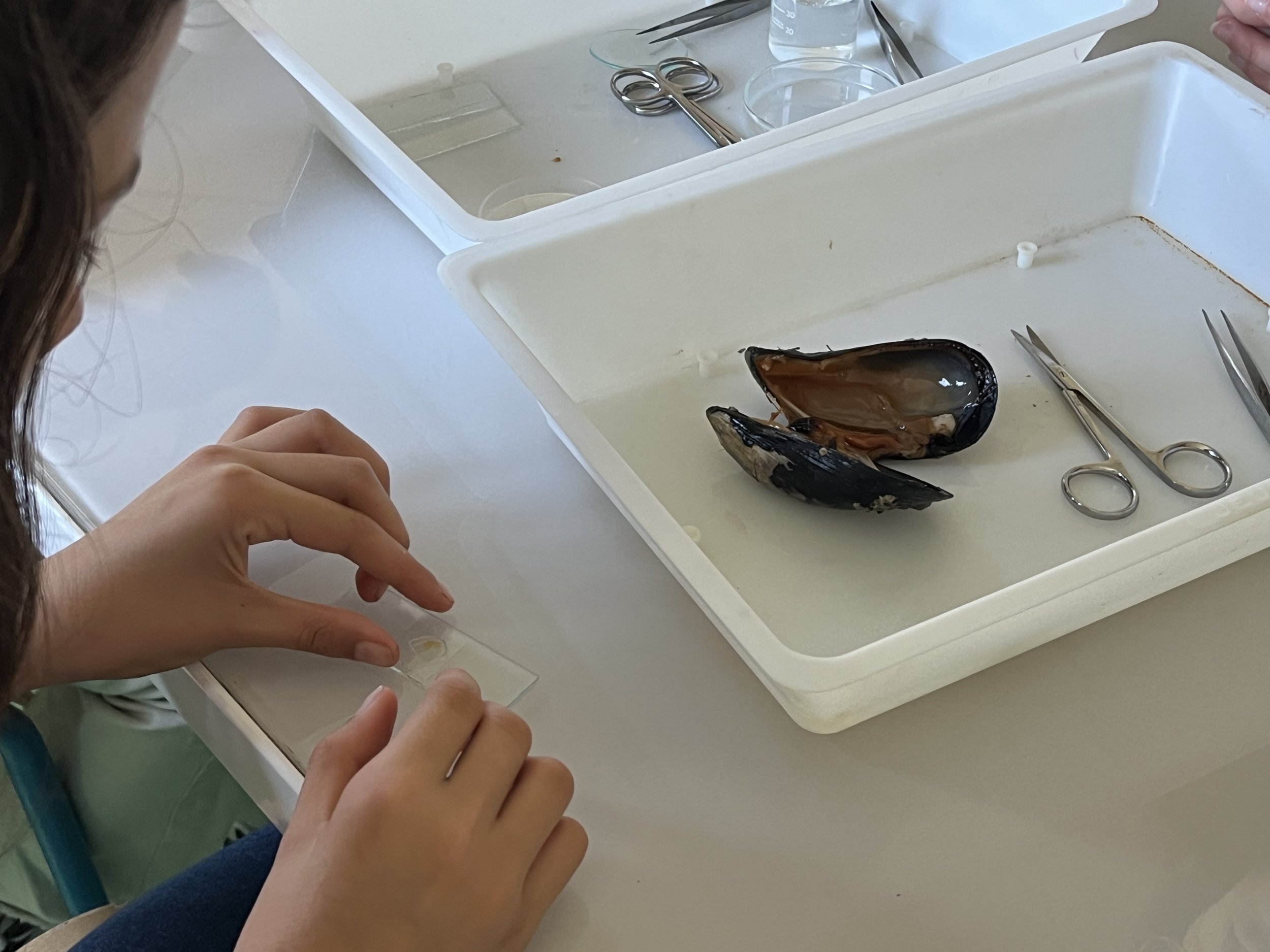
Students examining wild oyster and mussel populations. Read about our collaborative project here: https://www.floatingstorieslab.org/all-posts/microplastic-and-fiberglass-pollution-research-in-gill-samples-of-oysters-and-mussels-in-the-goyen-river-estuary-brittany-france

The five-point plan, revisited
Let me start with what Pickthall gets right. His piece is as much about awareness as about technology, and awareness is half the battle: many sailors I meet still haven’t given much thought to where their boat will end up.
The plan also gets the basics right: you can’t fix a problem you haven’t measured, so count the boats (I have been beating this drum for a few years now, and it is the reason we began our citizen science project mapping bad boats). You can’t hold anyone responsible if you can’t find them, so register the owners. And someone has to pay, so spread the cost across a boat’s life with a fee on new boats, as France does. On those three points, the science also agrees.
The best overview I know of that science is a 2025 review by composites researchers at the University of Plymouth and the National Composites Centre, Sustainability considerations for end-of-life fibre-reinforced plastic boats (Geraghty et al., Regional Studies in Marine Science). It’s open access, and I cite it often. Its authors call for registration to be “expedited” and support producer-funded disposal. They also start from the point that there is a “mismatch between the number of boats expected to reach end-of-life and knowledge of the location of those vessels.”
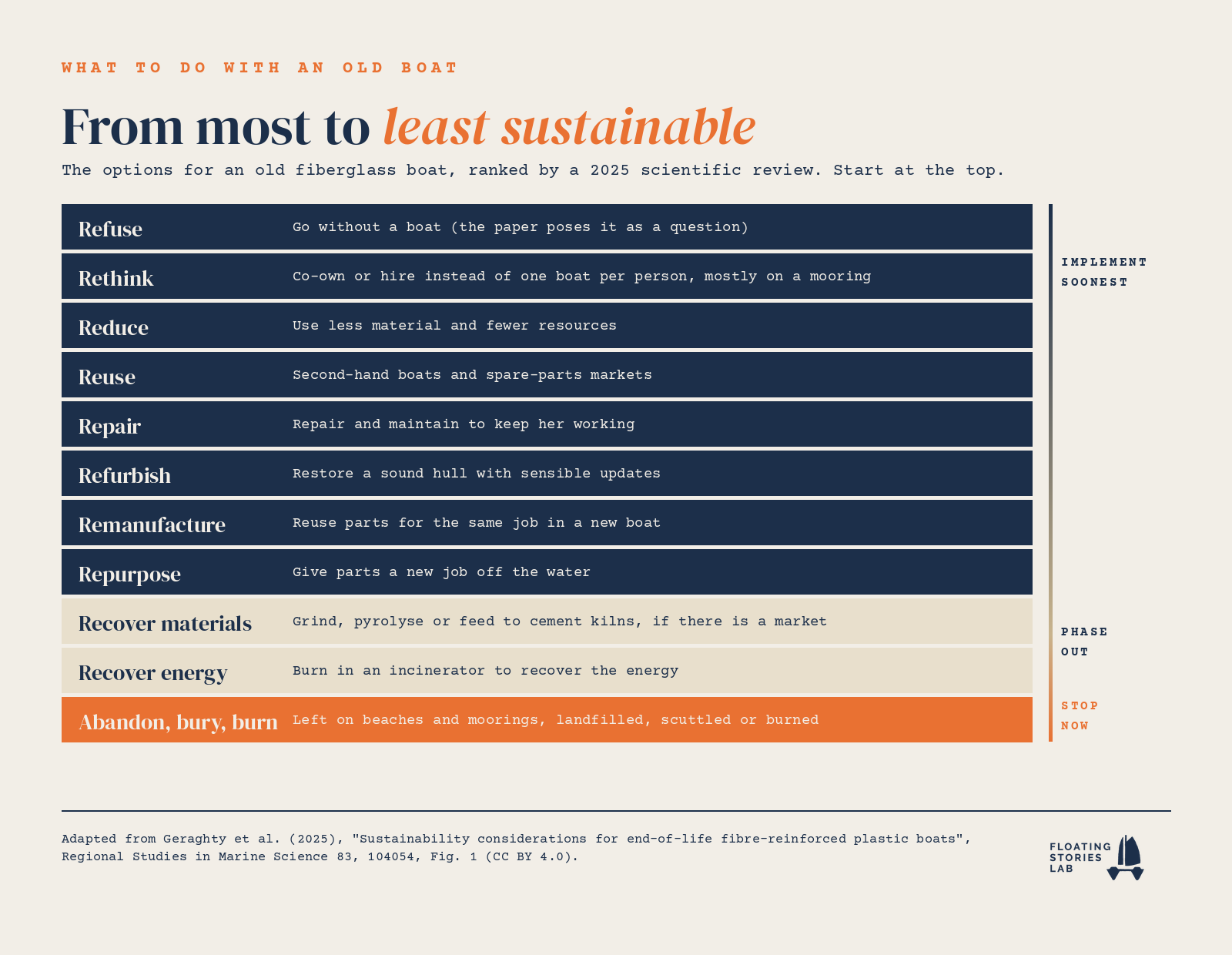
Where the science parts company with Pickthall is on technology. The Geraghty review ranks every way of dealing with an old boat using the “10 R-strategies”, a circular-economy framework also known as theThe ladder shades from “sustainable” at the top to “undesirable” at the bottom. Beside the top rungs, the authors write “implement soonest”: refuse, rethink (including co-owning or hiring rather than one boat per person sitting on a mooring) and reduce.
Next come the options that keep boats and their parts in use: reuse, repair, refurbish, remanufacture and repurpose. Lower down, marked “phase out”, are recovering materials, which is where grinding, pyrolysis, pressolysis and cement kilns sit, and burning for energy. At the very bottom, marked “stop now”: abandon, bury, burn.
Geraghty and colleagues have practical and environmental reasons, not ideological ones, for putting recycling technology so low:
● The materials come out worse. Recovered glass fiber is weaker than new and “not economically competitive with cheap virgin reinforcement”, so it mostly ends up as low-value filler. In tests on wind-turbine blades, pyrolysis cut fiber strength by 6–16%.
● Much of it isn’t ready. On NASA’s nine-step technology readiness scale, the authors rate pyrolysis at 8, pressolysis at 7, solvolysis at 4 and some lab methods at 3. None is yet treating old boats at scale. Pressolysis, which Pickthall highlights, is still moving from pilot to commercial plant; in a 2024 South Hams council pilot in Devon, a 29-foot yacht was taken apart by hand and about 1,500 kilograms of fiberglass recovered, but only a 2-kilogram sample went through the process (Blue Parameters, 2024). Cement kilns and incineration are at 9 because they’re simple: they burn the resin for energy, and in a kiln the glass ends up in the cement.
● Recycling has its own footprint. Cutting up a wreck to move it releases antifouling, fuel, bilge water and grinding dust, materials that “can compromise organisms in the local environment and may eventually enter the food chain.” Grinding and heating take energy, and the solvents used in chemical recycling “may cause negative impacts on the environment and human physiology.” The authors also warn against grinding glass fibers down to nano-sized particles, which could resemble asbestos fibers. They want every route justified by a life-cycle assessment, and point out that today’s assessment tools largely ignore harm to the marine environment.
● The capacity isn’t there. Europe was expected to produce 683,000 tons of composite waste in 2025, against global capacity to recycle fiber-reinforced plastics of under 100,000 tons a year.
● The verdict: recycling makes sense only where a boat is beyond repair and there’s a clear market for the material. Otherwise, the authors write, it is “inappropriate to incur financial and environmental burdens to create recycled material that cannot compete with virgin materials.”
Even the word “recycling” is contested. In November 2025, European trade bodies for boatbuilding, composites, resins and cement asked the EU to count burning composite waste in cement kilns as recycling under its coming Circular Economy Act. An industry-commissioned assessment found kilns beat incinerators on carbon, but that compares two “phase out” options, not a kiln with keeping a boat sailing. If kilns count as recycling, Europe’s recycling rates will rise without a single extra boat being kept in use.
Racing World
Racing is where the boatbuilding industry tries out its ideas, so it’s worth looking at what happens at the top of the sport. When 11th Hour Racing Team built its IMOCA 60, a carbon-fiber ocean racer, in 2021 with sustainability written into the brief, it measured and published what few builders ever do.
It took 34.5 tonnes of material to make an 8.6-tonne boat; plugs, molds, offcuts and waste outweighed the boat three to one. The team kept four-fifths of that waste out of landfill, and its hull and deck molds went straight to another IMOCA team to build again: exactly the kind of reuse the ladder ranks well above recycling.
Its end-of-life plan is just as candid. Winches, batteries and the engine are marked for recycling, but for the hull, rudders and foils the final destination reads “recycle or waste to energy.” That isn’t a failing of the team; it’s the honest limit of what exists today (11th Hour Racing Team, 2021). If a well-funded team can’t yet find a better end for its hull, the 40-year-old cruiser on the next mooring has fewer options still. What can be saved, on their boat and ours, is mostly the gear, which is why stripping and passing on hardware matters long before a hull reaches a dismantler.
Production Builders
Production builders are experimenting, too. Groupe Beneteau, the French group behind Beneteau, Jeanneau and Lagoon, has started building some sailboats with a resin designed to be broken back down at the end of a boat’s life: about three dozen boats by the end of 2024, a tiny share of what it builds (Groupe Beneteau, 2024).
This year it launched catamarans built with recycled glass fiber, 45 percent in the new Excess 11 and 80 percent in a Lagoon 82 demonstrator. It’s an effort, but Beneteau says its recycled fiber comes from its own factory waste, not old boats, and recycled resin is still a goal.
Two caveats from the science apply. Glass fiber recovered by burning off the resin comes out weaker; Beneteau’s partners get around that by melting it down and drawing new fiber, which costs energy and still sits on the ladder’s “phase out” rungs, below simply making less waste. And recycled content doesn’t change how a boat ends. A catamaran built with recycled fiber today is still a fiberglass boat that, by Beneteau’s own estimate, will need dealing with in 30 to 40 years; unless its hull is actually taken apart and recycled when that day comes, the problem has only been pushed down the road.
The group’s own sustainability report is candid that “there is no standard methodology for calculating boat reparability or recycling rates.” For the millions of polyester boats already afloat, the options are still the ones on the ladder. (More on bio-based and recyclable resins in a coming article.)
That points to the change that matters most. The Geraghty review argues that new boats should be designed “for end-of-life, or for disassembly and recycling,” and that life-cycle assessments should ideally run “cradle-to-grave, or preferably cradle-to-cradle.” Most boatbuilding assessments still stop at launch day, often for good methodological reasons, but a builder can’t easily design for an ending the numbers don’t capture. On paper, a hull that can be taken apart and a hull bound for the kiln can look the same. There are signs of movement.
From 2027, France’s eco-fee will charge more for composite hulls and reward recycled content; EBI is developing a boat life-cycle assessment method aligned with the EU’s Product Environmental Footprint rules, which follow a product to the end of its life; and World Sailing, whose Sustainability Agenda 2030 set a goal of Olympic boats being 90 percent recyclable by weight, now says that from 2032 any class seeking Olympic selection will need an independently verified life-cycle assessment (World Sailing, 2026). For owners, the practical version is simple: when you buy a boat, new or used, ask how it comes apart and what the builder or seller expects to happen to it at the end.
Behind all this sits a harder question. The industry, like most, depends on selling new boats; even France’s scheme is funded mainly by a fee on each one sold. That makes the top rungs of the ladder, sharing, repair and longer lives, economic choices as much as technical ones.
Geraghty and colleagues still want recovery technology developed, and they see burning with energy recovery as the realistic route for what’s left today. So the point isn’t that technology is useless; it’s that technology is the last resort. Where I’d push further is on everything that happens before a boat reaches a dedicated disposal center R-ladder (Potting et al., 2017), from the most sustainable at the top to the least at the bottom.
France: the best system we have, and why its targets fell
France is the country everyone points to because it has actual policy in place. Since 2019 it has had an extended producer responsibility scheme for recreational boats from 2.5 to 24 meters (about 8 to 79 feet), run by an industry eco-organization called APER. Builders and importers pay an eco-contribution on every new boat they sell, set by boat type and length. It has risen steeply.
In 2021 a 10-meter (33-foot) sailing monohull carried €363 (Compton, 2021, cited in Geraghty et al.); in 2026 the same boat carries €1,392, and a 12-meter catamaran €2,522 (APER barème 2026). From 2027, 10 percent of the fee will also depend on the boat’s weight and hull material, with composite charged at the highest rate, and builders using at least 20 percent recycled material in the hull can claim a small rebate, capped at 2.5 percent of the fee (APER, notice barème 2027).
In return, owners of French-registered boats can hand an old boat to 37 approved dismantling centers, in mainland France and its overseas territories (APER, recyclermonbateau.fr), and have it dismantled for free. More than 16,000 boats had been taken apart this way by the end of 2025 (Boat Industry, 2026); APER puts the total at over 17,000 by mid-2026.
But look at the targets.
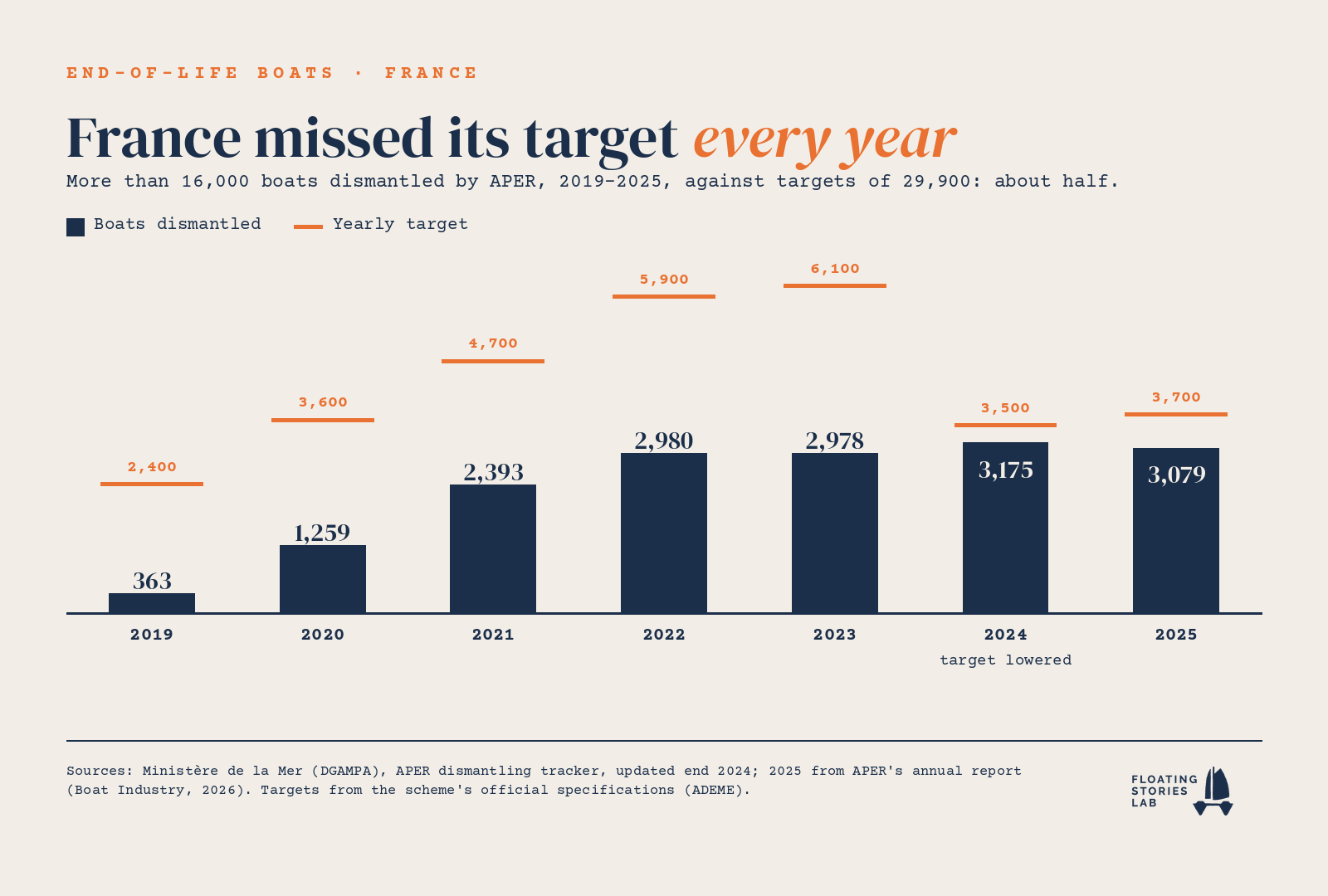
In its first five years the scheme dismantled roughly 10,000 boats against a target of 22,700. Across 2019 to 2025, it managed just over 16,000 against targets totaling 29,900: about half. When APER’s approval came up for renewal in 2024, it didn’t just miss the bar; it asked for a lower one. The minutes of the government committee that reviewed the scheme show APER proposing 3,000 boats a year for 2024–25, below the 3,500 to 3,700 the official specifications called for. Its reasons: the shortfall of the first period, and demand for dismantling that depends on things outside its control; a study of how many boats are actually out there was still under way (CiFREP minutes, 13 June 2024).
In 2025, APER handled 3,093 boats: 3,079 were dismantled and 14 went on to be reused. Only about one in ten (10.1 percent) was an abandoned boat. The whole scheme ran that year on roughly €3 million: €2.1 million from builders’ eco-contributions and €0.95 million from a share of France’s annual boat tax (APER magazine, 2026).
And “dismantled” doesn’t mean recycled. The hull is the hard part. According to APER figures in EBI’s 2023 roadmap, 60 percent of the scheme’s composite waste went to energy recovery, and the other 40 percent was stockpiled, waiting for a better option. APER’s 2025 report still describes recovery as mainly shredding for fuel or filler, with closed-loop reuse “limited” (Boat Industry, 2026).
Three things stand out for anyone designing a scheme elsewhere:
● Free disposal isn’t free if you can’t get there. Dismantling (in France) costs the owner nothing; transport costs whatever a truck, crane or tow costs. APER admits that reaching a center can cost “several hundred, even several thousand euros”, and calls transport one of the main brakes on the scheme. A flat transport subsidy of €50 to €1,000, offered since September 2025, helps but doesn’t close the gap. In Hennebont, on Brittany’s Blavet river, harbor officer Alexandre Giry cleared old boats from his marina on the harbor’s budget. The nearest APER center is a kilometer away, but moving a boat there costs about €100 per meter of length, so his next step is to buy a trailer and move them himself.
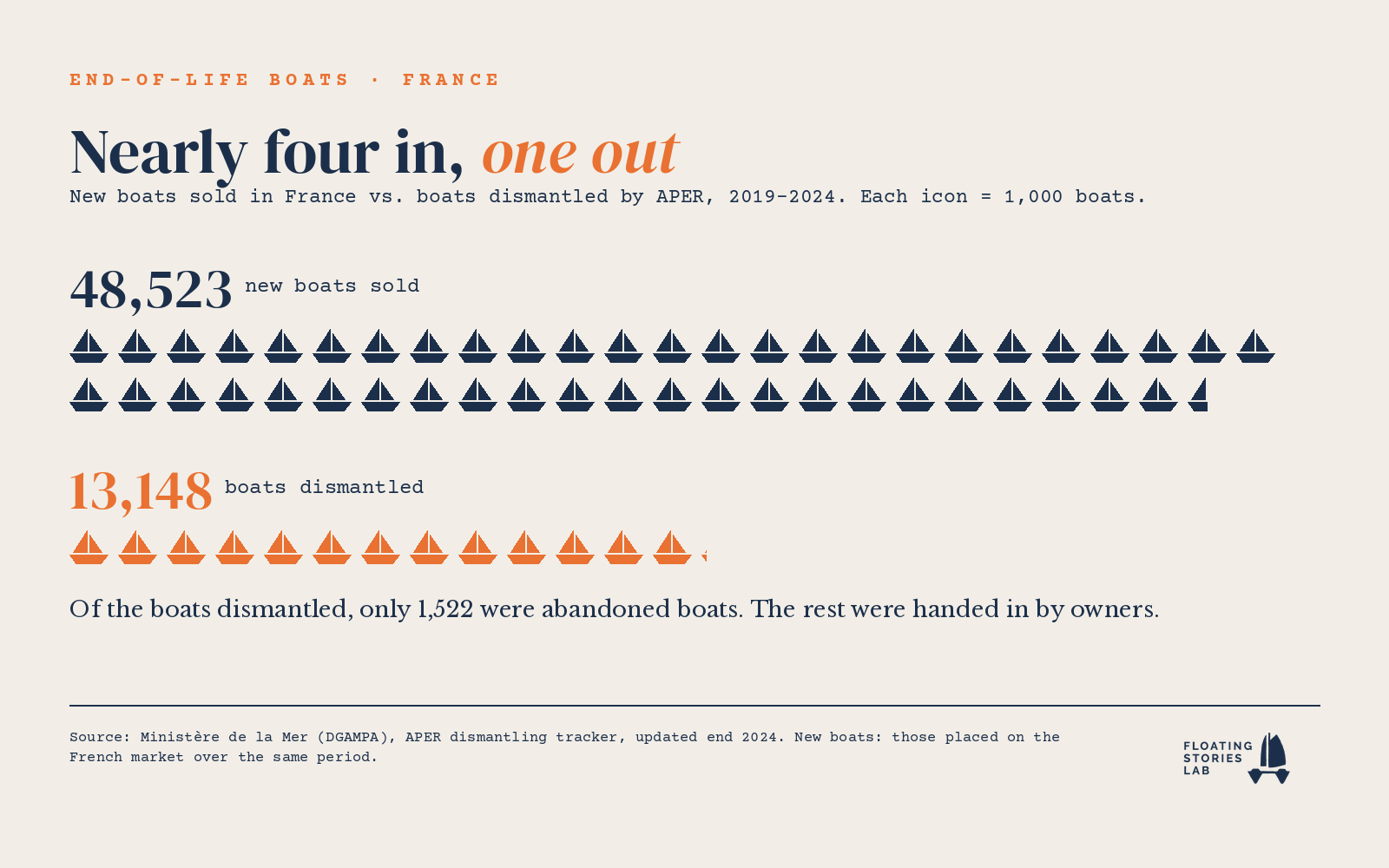
● The scheme mostly serves willing owners. Of the 13,148 boats dismantled to the end of 2024, only 1,522 were abandoned boats. The rest were handed in by owners who had decided their boat was finished.
● It isn’t keeping pace. In the same six years, 48,523 new boats were sold in France, almost four for every one dismantled.
None of this is a criticism of the people running APER. It’s a question of the scheme’s design. A system built around an owner who can afford to get a boat to a disposal center doesn’t reach the boats that matter most: the ones degrading in the mud, partly submerged, or too far gone to move at all.
The North American picture
The United States has no national end-of-life scheme, but it does have decades of state programs that pull abandoned boats out of the water, and a fresh burst of federal attention.
Washington
Washington State has run a Derelict Vessel Removal Program since 2002 and has removed more than 1,200 vessels (Washington DNR). It’s funded by registration fees, the watercraft excise tax, the state capital budget and NOAA grants: $20.6 million for 2025–27. Even so, the department warns that its removal account is “currently low” because removals and costs have risen (DNR, Sept 2026).
Washington also offers two ideas other places could learn from. A Vessel Turn-In Program lets owners who can no longer look after a boat hand it over for responsible disposal before it becomes derelict. And since 2020, when a vessel over 35 feet and more than 40 years old changes hands, the seller must provide a recent marine survey and the buyer must show at least $300,000 of insurance; a seller who skips these steps keeps secondary liability if the boat is later abandoned.
Florida
Florida started 2025 with more than 1,000 abandoned boats in its waters. By mid-December the Fish and Wildlife Conservation Commission had removed 478, and the state had spent more than $9 million that year recovering abandoned boats (Spectrum News 13, Dec 2025). Hurricanes keep refilling the backlog, and officials point to a pattern familiar on both sides of the Atlantic: free or cheap boats picked up online by new owners who underestimate the cost of making them safe.
National Efforts
Nationally, money from the 2021 infrastructure law has flowed through NOAA’s Marine Debris Program, including a $10 million award to the BoatUS Foundation to run a national grant program for removing abandoned and derelict vessels (NOAA). In November 2025, the BoatUS Foundation, in partnership with NOAA, launched the first national database of abandoned and derelict vessels, where anyone can report a boat (Noonsite, 2025). By late August 2026, nearly 1,500 boats had been reported to it (Waterways Journal, 2026).
That’s real progress, and the database answers Pickthall’s first point for U.S. waters. But the money is mostly one-off, and almost all of it goes on removal: pulling out boats that have already sunk, often at more than $24,000 a time. Very little goes on the cheap end of the problem, which is helping owners retire a boat before it becomes a wreck. In California, boats surrendered through a turn-in program cost about a third as much to deal with as abandoned boats pulled from the water (Golbabaei et al., 2024). And once a boat is out of the water, it usually ends up in a landfill.
Canada
Canada went further and made abandoning a boat illegal. Since 2019, its Wrecked, Abandoned or Hazardous Vessels Act has banned abandonment, and leaving a boat in poor condition in the same area for more than 60 consecutive days without the landowner’s permission, with administrative penalties of up to C$50,000 for individuals.
Yet in 2019 a local boat-removal society put the number of abandoned boats on the British Columbia coast alone at around 1,400 (CTV News, 2019), and at an October 2024 hearing of the House of Commons fisheries committee, a Georgia Strait Alliance witness said that, given how few fines had been issued since 2019, they weren’t going to deter many people.
John Roe of the Dead Boats Disposal Society, a volunteer-run non-profit that pulls wrecks out of the Salish Sea with First Nations and local governments, put the problem simply: “we can’t find the owners.” A law that makes the owner pay only works if you can find the owner.

Out of sight, out at sea: the view from the islands
France and North America at least have somewhere to put an old boat. Small island states often don’t. They have little land, less landfill and no recycling industry to speak of, and their harbors collect old vessels from all over the world.
In Fiji, where I’ve worked on ecological documentaries, Suva Harbour held 44 derelict vessels in 2024. By March 2026 that was down to 20, helped since July 2025 by a US$1 million fund from the American Waitt Institute, now paid out through Fiji Ports (Fijivillage, 2026; Waitt Institute, 2025). Six longliners were restored and sailed away. Most of the rest were cleaned of oil, inspected and towed offshore to be scuttled at designated sites.
In October 2026 it was the turn of the Westerland, a steel car ferry built in Germany in 1971. Sold to Fiji in 2006 after 35 years on Danish and German routes, she worked between the islands until she was abandoned (FBC News, Oct 2026). A ship of her age would likely have carried fiberglass lifeboats and fittings, and possibly asbestos. The published reports mention only oil and debris being removed before she went down into the sea.
My first reaction was dismay. But on an island with little landfill and no recycling industry, scuttling can look like the only option, and for a cleaned steel hull in deep water it may be the least bad one. Fiberglass is a different matter.
Issues with sunken boats
Prompted by Pacific island states, the International Maritime Organization commissioned a study of fiberglass boats and alternatives to disposal at sea, published in 2019. It found that fiberglass hulls make poor artificial reefs: reef programs in New Jersey and New York stopped accepting them after waves broke them up and washed the debris onto beaches, and hulls sunk in about 100 feet of water or less are likely to be disturbed by storms.
In the Pacific and the Caribbean, sunken boats have left debris fields and damaged reefs, seagrass and mangroves, and the fiberglass eventually breaks down into microplastics. The international guidelines for sinking vessels at sea say outright that they don’t cover fiberglass (IMO, 2019). And even a clean fiberglass hull, sunk on purpose, erodes over time into micro- and nanoplastics, while boats scuttled privately often go down with their antifouling paint, fuel, batteries and asbestos still aboard (Geraghty et al., 2025). The IMO study floated a disposal fund paid for by boat users, retailers or insurance, but noted that on small islands any recycling means the high cost of shipping fiberglass off them.
Caribbean
The Caribbean faces its own version every hurricane season. Hurricanes Irma and Maria destroyed hundreds of boats in the British Virgin Islands in 2017, the heart of the charter fleet; in 2019 the territory was still tendering for contractors to remove about 200 derelict boats (BVI Recovery and Development Agency, 2019).
In 2024 Hurricane Beryl left boats toppled across the yards at Tyrrel Bay, Carriacou. Many of these boats were built in Europe, but France’s producer-pays scheme only covers boats registered in France (including its overseas territories, such as Martinique and Guadeloupe), not the French-built charter boats registered elsewhere that end their days on a Caribbean shore (Décret 2018-766).
And it isn’t only an island problem. British Marine, the U.K. boating industry’s trade body, told OSPAR’s consultants that in Britain there is “a high risk” that old boats are sent to landfill, sunk at sea or illegally abandoned (OSPAR, 2026). The Westerland is a reminder that boats travel. Many end their lives far from where they were built, and the cost of dealing with them shouldn’t land only on the places with the least room to do it.
The gaps that levies don’t fix
Put France, North America and the Pacific side by side and the same areas of unawareness appear. None of them is solved by a scrappage fee or a new recycling plant.
Nobody knows where the boats are. Harbor authorities usually know the wrecks in their own waters; Pickthall found they had “a very good handle” on them and suggests a freedom-of-information request to each to get a national count. That would be a good start. But wrecks also sit in creeks no authority covers, on foreshores, in boatyards and behind houses, and Britain doesn’t even know how many boats it has: estimates run from about 550,000 in the Defra study to British Marine’s best guess of 850,000 (Resource Futures, 2023; Pickthall, August 2026).
That’s why citizen science matters. Since mid-2025, volunteers in our Bad Boat Mapping project have logged 90 abandoned and end-of-life boats, so far in France, the U.K. and Portugal, simply by walking and looking. It’s a small sample, not a census, but it’s open, site-specific data that didn’t exist before. Half of those boats were already submerged or partly submerged, a third lay beside oyster reefs, and a quarter were commercial vessels, not yachts. And the map is global: anyone, anywhere, can add a boat. Local groups are doing the same. In Cornwall’s Fal and Helford rivers, volunteers with Wreckfree have mapped 160 abandoned boats and reckon that’s “probably only half to two-thirds” of those on the foreshores, before counting boats in yards and gardens.
In the U.S., the new BoatUS database does the same at a national scale. The more boats we get mapped, the harder they are to ignore.
The last mile costs money. The boat that most needs removing is the one stuck on a mudbank with no trailer, no road and an owner who can’t or won’t pay to move it. Some of these owners have died; others inherited a boat they never wanted. A levy on new boats doesn’t reach them unless it pays for transport and the legal steps, too. OSPAR’s new guidance makes the same point from the other side: removing a boat once it’s abandoned generally costs authorities far more than dismantling it would have cost the owner, so schemes should catch boats before they’re abandoned. One way it suggests is to spread the cost through marina add-on fees and harbor dues “fairly amongst all owners, not just the last owner who is usually unable to afford disposal” (OSPAR, 2026).
What does it actually cost?
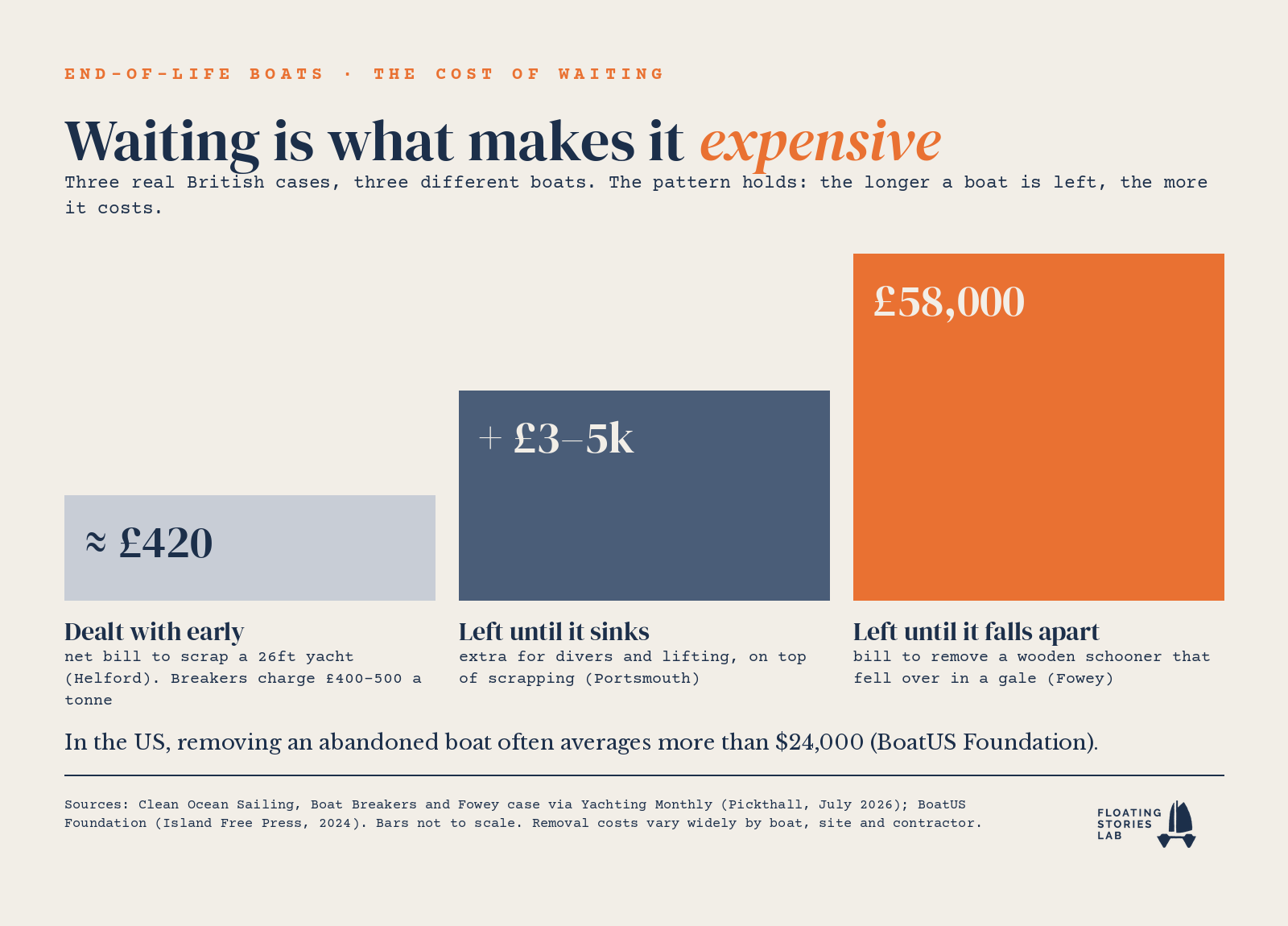
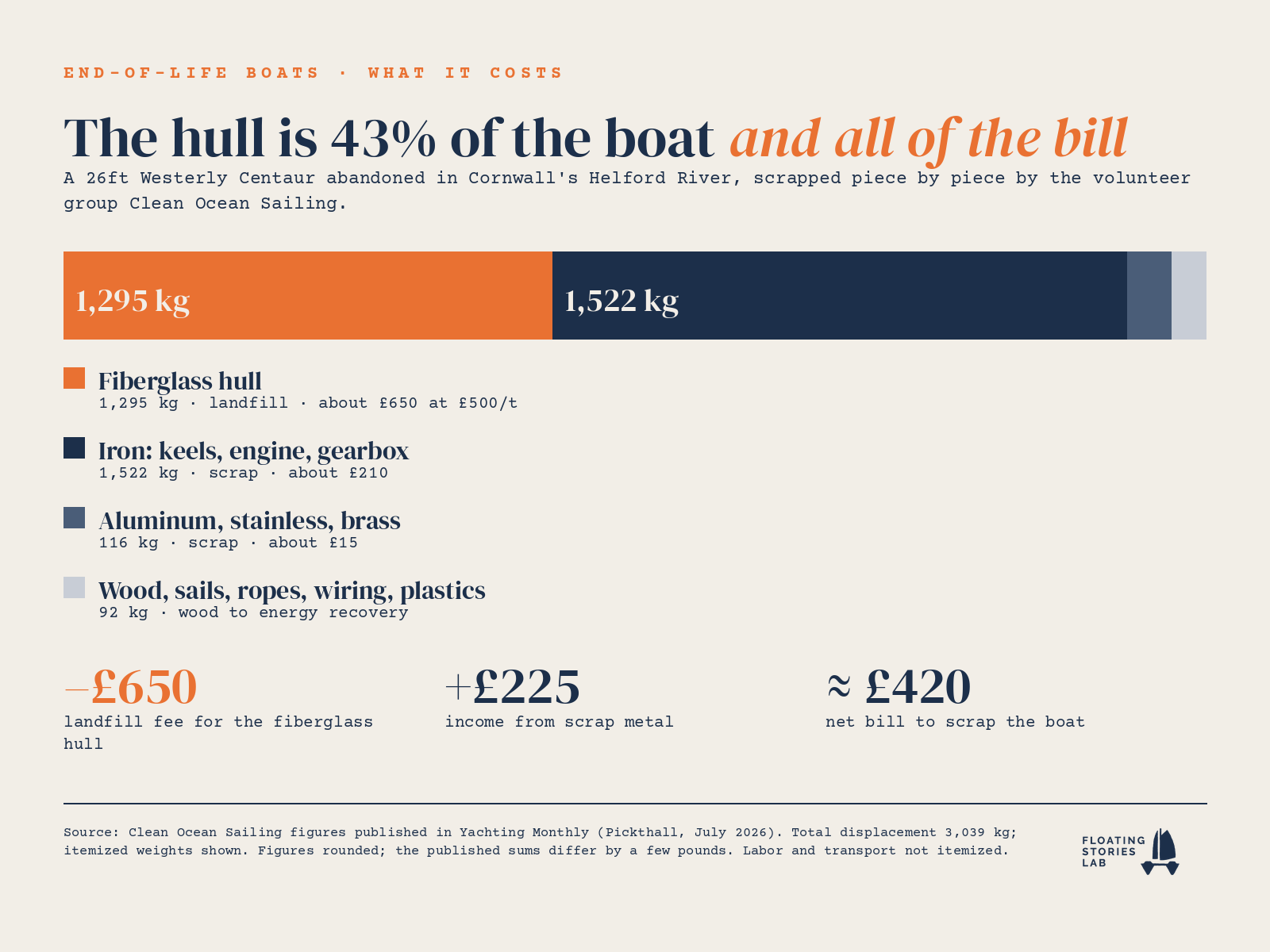
When Clean Ocean Sailing scrapped a 26-foot Westerly Centaur abandoned in the Helford River, it itemized the job. Of her 3,039 kilograms, 1,295 were fiberglass hull, which went to landfill at £500 a tonne, about £650. Scrap from the iron keels, engine, aluminum mast and other metal fittings brought back about £225, for a net disposal bill of roughly £420 (Pickthall, July 2026). One U.K. boat-breaking firm charges £400 a tonne plus transport.
That’s manageable for a boat that’s still afloat and reachable. Waiting is what makes it expensive. Boat Breakers, a boat-breaking firm in Gosport, describes two yachts that sank in Portsmouth Harbour a year after it flagged them, now needing an extra £3,000 to £5,000 of diving and lifting. In Fowey, a wooden schooner that fell over in a gale left its owner facing a £58,000 removal bill that neither the owner nor the local authority can pay, so the hulk lies where it fell.
Wreckfree’s Jake Burnyeat puts it kindly: “you can’t really blame end-of-life boat owners for walking away from their boats when there is no realistic alternative… Somehow that cost needs to be spread over the life of the boat and not just fall on the last owner.”
The industry is now asking for something similar from the other end. EBI wants marinas and boatyards to be allowed to dismantle boats on site, and has floated mobile dismantling units that go to the boats rather than the other way round (EBI, 2023; EBI position paper on the Circular Economy Act, 2025).
It would cut transport costs, but this is where we need to be careful. The Geraghty review warns that cutting up a boat where it lies lets antifouling, fuel, bilge water and grinding dust escape, and that fiberglass fragments tend to concentrate close to shore, which is exactly where marinas and boatyards are.
EBI’s 2023 roadmap asked for licenses “based on suitable protocols”; by 2025 the ask had become “simplified licensing rules.” OSPAR’s guidance does include on-site dismantling permits, but it’s more cautious: each site should have a detailed safety case and a site-specific plan, because the pollution risk “could be high” without controls.
Dismantling closer to home can only be part of the answer if it happens on a sealed pad, with dust extraction and the wash water collected, never on the foreshore. The cleaner local fix may be Giry’s: move the boat whole, a short distance, to a center equipped to take it apart.
Ownership gets in the way. An abandoned boat still belongs to someone. Before anyone can touch it, the owner has to be found or a formal abandonment process completed. Registration helps with the first; only money and simpler procedures help with the second.
The water isn’t counted. Schemes measure boats processed and percentages recovered. They don’t measure what a decaying hull has already shed into the mud and the shellfish, what a scuttled one sheds on the seabed, or what comes off every boat at every haul-out. Even the life-cycle assessments used to rank recycling routes rarely count it.
The people closest to the problem have no role. The systems connect manufacturers, agencies, scrappers and owners. The oyster farmers, fishers, walkers, sailing clubs and schools who live beside the wrecks, and often know their history, have no formal say in which ones are dealt with first. On both sides of the Atlantic, I’ve found these people are among the most motivated and the least asked.
When they do push, things move. On the Dee Estuary, on the border between Wales and England, local cockle fishers were among the first to raise the alarm, Dr Corina Ciocan tells me. Natural Resources Wales identified 55 derelict and potentially abandoned vessels, most of them small and medium fiberglass boats, and since 2024 has been removing them in batches, with funding that includes the Welsh Government’s Nature Networks programme: RIBs and half a fiberglass hull, then a large catamaran, then a sunken yacht at Connah’s Quay that had to be partly lifted, pumped out and floated away (NRW, 2024–25).
The project’s own lessons are sobering. Costs are hard to pin down and “can be very high,” competent contractors are few, and work in a protected estuary is limited to certain times of year (Soanes, 2024).
A seat at the table
There are many closed-door meetings taking place about the end-of-life boat crisis. Around these tables there seem to be ministries, agencies, builders’ federations, recyclers and, sometimes, eco-organizations. The people almost never in the room are you: boat owners, and the neighbors who live beside the wrecks.
Take the best-practice guidance OSPAR adopted this year, for example. It’s useful, practical work, but it was built on interviews with seven organizations, held mainly over one week in September 2025: boating associations, the boat industry’s trade bodies, a harbor, a Swedish boat dismantler and Natural Resources Wales (OSPAR, 2026). No shellfish growers, fishers, scientists or local community groups were among them.
That gap got me thinking about two Pacific island communities and their approaches to coastal management. On Gau, an island about 80 kilometers (50 miles) east of Suva, Fiji, community-based resource management started in a handful of villages. Each wrote its own resource management plan, printed as a poster and kept in every house as a reminder of who is responsible for what, and young villagers were trained by government fisheries staff and licensed as honorary fish wardens to enforce the communities’ own rules (Veitayaki et al., 2005).

The idea spread, and today a committee representing all 16 villages coordinates the work across a network of 16 marine managed areas (Remling and Veitayaki, 2016; Veitayaki and Holland, 2018). In Siviri, a village on the north coast of Efate, Vanuatu, a small volunteer committee, with seats set aside for women and young people, runs its own no-fishing zone. They placed it in the lagoon right in front of the village, where the church and most of the houses stand, so that everyone keeps an eye on it (Pascht, 2022).
In both places, outsiders brought training, money and science, but — importantly — the communities led coastal management, which helps explain why their projects have lasted.
An estuary in Brittany or a creek off the Chesapeake isn’t a Pacific lagoon. Our water is public, the wrecks have owners, and nobody should take an angle grinder to a hull on the beach. But a few ideas could be adapted almost anywhere:
● Keep it in sight. A printed map of local wrecks, updated each month and pinned up at the slipway or harbor office, with a QR code to report a new one.
● Let the people who live there set the order. Which wrecks sit closest to the shellfish beds or residential housing? Which are breaking up fastest?
● Give volunteers a recognized role. Trained locals who can report a boat officially and follow it up, with the harbor master and the law behind them.
● Make it a day out. A yearly “last voyage” day when owners hand in old boats, transport is pooled, and the whole waterfront comes down to watch.
Of course, none of this replaces producer fees, registration or removal budgets. But it would help those schemes reach the forgotten boats in the mud.
Most of us aren’t policymakers. But we are owners, club members, marina tenants and voters, and we’re the ones on the dock.
What you can do
Your boat
1. Make it last. Stay ahead of the jobs that finish old boats: deck core, hull maintenance, chainplates, standing rigging. A well-kept older boat is a great contribution.
2. Plan its last voyage now. Find out what turn-in, dismantling or recycling options exist near you and roughly what transport costs. Budget for it the way you would for a haul-out.
3. Sell or give it away responsibly. Don’t pass a dying boat on for a dollar to someone who can’t keep it. Transfer the title properly, and check your state’s rules on seller liability. And if you’re offered a free or cheap project boat, get a survey and price the work before you say yes.
4. Think about who comes after you. If your heirs will inherit the boat, leave instructions and, if you can, a fund to deal with it.
5. Keep what comes off it out of the water. Use a vacuum sander, work over a tarp on the yard’s pad, and never grind fiberglass on the shoreline or directly into the water.
Your harbor and club
6. Report what you see. Log abandoned boats on the Bad Boat Mapping map, anywhere in the world, or in the U.S. on the BoatUS database. It takes about twenty minutes and a smartphone.
7. Ask your club or marina to run an amnesty or turn-in day, to apply for BoatUS and NOAA removal grants, and to keep an eye on yard boats at risk.
8. Re-home before you abandon. Sea Scouts, sailing schools, community sailing programs and boatbuilding schools can often use a sound older boat. In the U.K., Boat Breakers’ Lonely Boats platform lists unwanted boats for a flat £100 and has found new homes for more than 100 so far (OSPAR, 2026).
9. Share a boat. The average European boat is used only 35 to 50 hours a year (EBI, 2025). Co-ownership spreads the cost, keeps boats sailing and means fewer new ones need building. Ask your harbor or club to reward it, with lower dues or a place higher on the mooring list. (More on that in a coming article.)
Your voice
10. Back funding for the boats already out there, not just a fee on new ones, and ask your state representatives to fund the last mile: transport, and simpler legal steps for abandoned boats. Ask that wrecks beside shellfish beds, seagrass and saltmarsh are dealt with first. And when your harbor, town or state holds a meeting about abandoned boats, go, and take a neighbor.
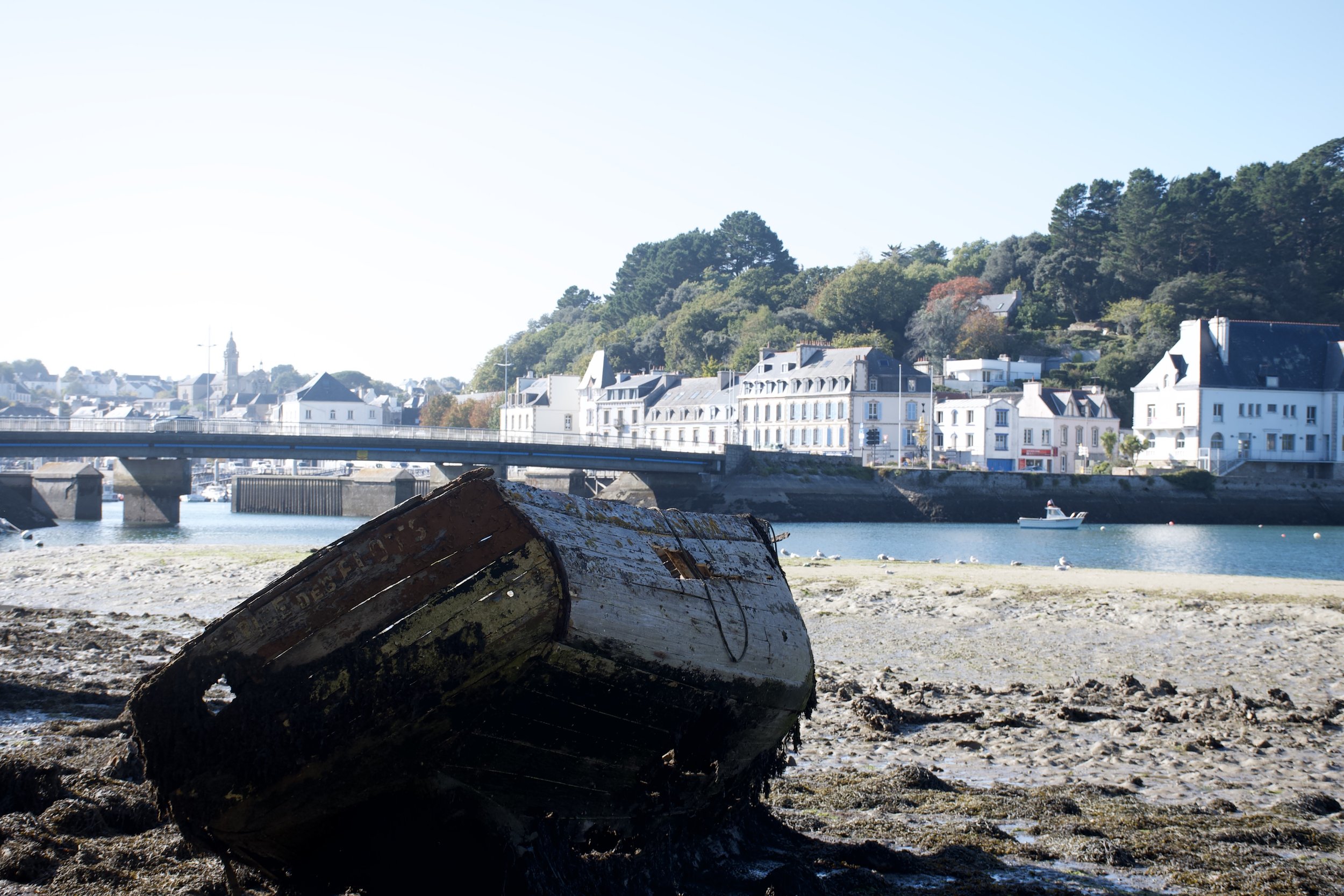
View of Audierne from the Goyen River Estuary Boat Cemetery. Photo: Floating Stories Lab.
The boats lying along the Goyen won’t be the last ones I photograph this year. But the more time I spend in these ‘boat cemeteries’, the less I think of them as a waste problem waiting for the right machine. Each was somebody’s pride once. Each one’s fate was decided long before it reached the mud, or the seabed, by a sale, an inheritance, a yard bill or a lack of options.
That’s the hopeful part. The options the science ranks well above recycling and disposal, keeping boats sailing, passing them on well, sharing them and planning their end, are ones we can take ourselves, starting this season. Technology might be able to deal with what’s left.
So I’d love to hear from you. If you keep a boat on a mooring, in a yard or on a trailer, what would make it easier to hand in one you no longer use? Who lives and works along the edges of your harbor, and should they have a say? Do you know of places where owners and neighbors already look after their waterways together? Write to Practical Sailor, or add a boat to the map. This conversation is better with sailors in it.
Angie Richard is president and co-founder of the Floating Stories Lab, a non-profit building a 41ft wooden catamaran in Brittany as a base for ocean research and storytelling. Its citizen-science program, Regenerative Tides (ReTISS), is a UN Ocean Decade Action.
Sources: Practical Sailor (Sept 2024); Pickthall, Yachting Monthly (July and August 2026); Geraghty et al. 2025, “Sustainability considerations for end-of-life fibre-reinforced plastic boats,” Regional Studies in Marine Science 83, 104054; Compton 2021 and Potting et al. 2017 (cited in Geraghty et al.); Ciocan et al. 2024, Journal of Hazardous Materials; Resource Futures for Defra, End of Life Recreational Vessels, Work Package 1 (Feb 2023); Blue Parameters for South Hams District Council, Disassembly, Recycling and Upcycling of End of Life Vessels (July 2024); Boat Industry, APER 2025 report (2026); Groupe Beneteau, Sustainability Report 2024 and Circular boating partnership page (2026); Excess Catamarans, Excess 11 (2026); BVI Recovery and Development Agency (2019); Yacht.de (July 2024); 11th Hour Racing Team, Sustainable Design & Build Report (2021); World Sailing, Olympic class LCA project (Jan 2026); World Sailing, Sustainability Agenda 2030; USCG Recreational Boating Statistics 2024; OSPAR Commission, Background Document on End-of-Life Recreational Vessels (2024) and Best Environmental Practice Guidance on End-of-Life Recreational Vessels, OSPAR Agreement 2026-06; Island Free Press (July 2024); European Boating Industry, end-of-life boats roadmap (2023), Circular Economy Act position paper (2025); SGS INTRON for EuCIA (Oct 2024); joint industry position paper on the Circular Economy Act (Nov 2025); APER barème 2026 and notice 2027; APER magazine 2026; Boat Industry (2026); Décret 2018-766; Ministère de la Mer APER tracker (end 2024); CiFREP minutes, 13 June 2024; Washington DNR (Sept 2026); Spectrum News 13 (Dec 2025); NOAA Marine Debris Program; Noonsite (Nov 2025); Waterways Journal (Aug 2026); Golbabaei et al. 2024, systematic review of abandoned and derelict vessel policy; A. Giry, Port de Hennebont, personal communication (2026); Canada, Wrecked, Abandoned or Hazardous Vessels Act (2019); House of Commons Standing Committee on Fisheries and Oceans, meeting 119 (2 Oct 2024); CTV News (Aug 2019); Dead Boats Disposal Society; BBC News, “Wrecked boats to be removed from Cornwall waterways” (18 March 2026); Business Cornwall (March 2025); Fijivillage (March 2026); Waitt Institute (July 2025); FBC News (Oct 2026); IMO, End-of-Life Management of Fibre Reinforced Plastic Vessels: Alternatives to At Sea Disposal (2019); Pascht 2022, Ambio; Veitayaki et al. 2005, “Partnerships and the quest for effective community-based resource management”; Remling and Veitayaki 2016, International Journal of Climate Change Strategies and Management; Veitayaki and Holland 2018, Pacific Climate Cultures; Natural Resources Wales news releases (July 2024, Oct 2024, March 2025); Soanes, J., NRW Marine Litter and Derelict Vessel Prevention Project, GRP Boat Symposium, Brighton (July 2024).
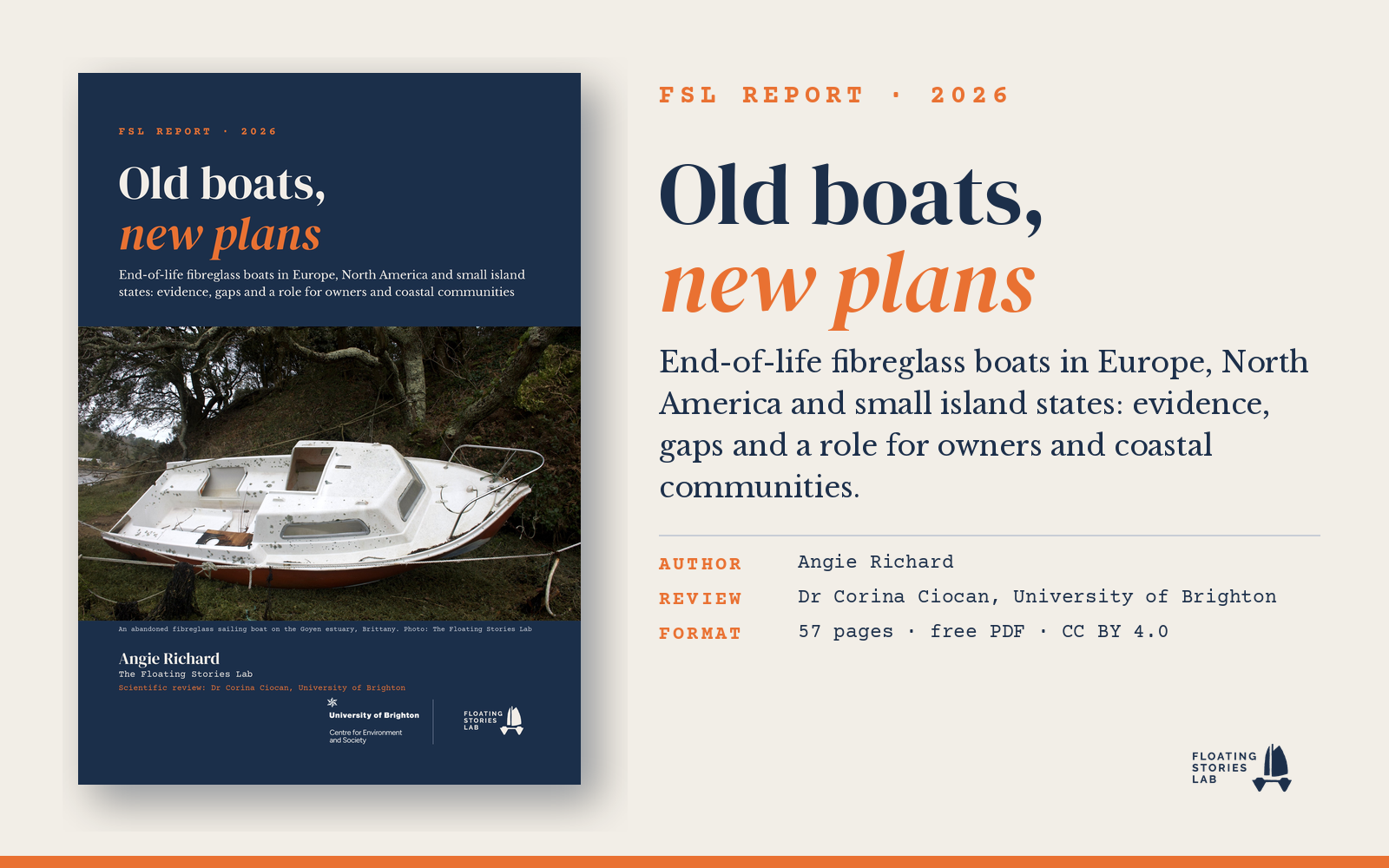
Click on the image to download the full report.