
Reporterre — reporting by Chloé Richard
Originally published in reporterre.net, translated and re-published for the Floating Stories Lab association with permission from the author.
Pour lire l'article original en français, cliquez ici.
Seen as heritage worth valuing for tourism, boat graveyards carry a heavy environmental cost. Over time, debris breaks away from the hulls, polluting the water and the animals that live in it.
Audierne and Plouhinec (Finistère), report
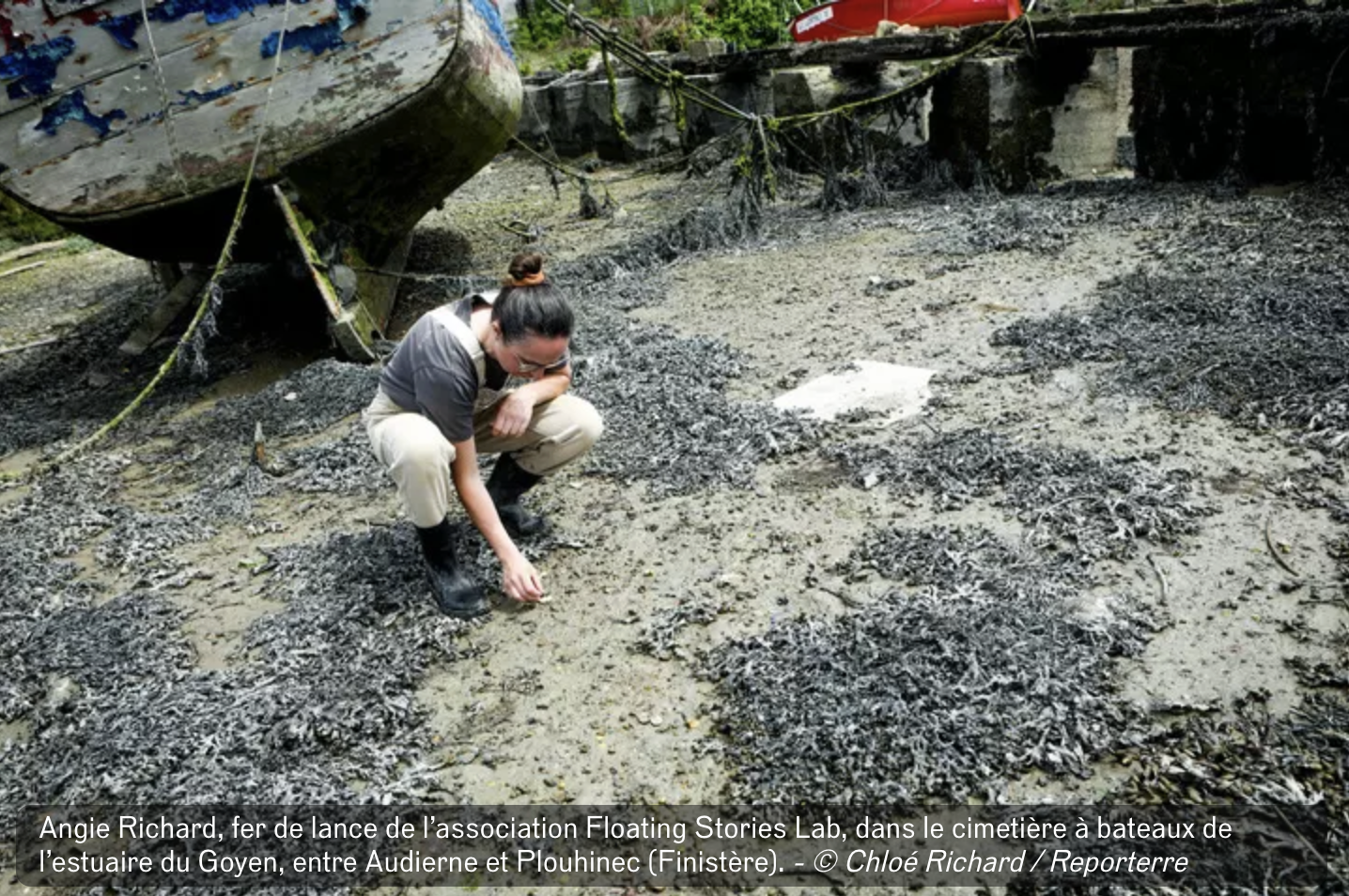
The wreck looks like a carcass where only the spine and a few ribs remain. The kelp covering it shows that at high tide, the skeleton is completely submerged. All around, on a bed of mud that behaves like quicksand, dozens of other boats in various states of decomposition lie just as still, seemingly inert. But let your eye linger a little longer on this boat graveyard, located in the Goyen estuary between the towns of Audierne and Plouhinec (Finistère), and another picture emerges: the site is polluted.
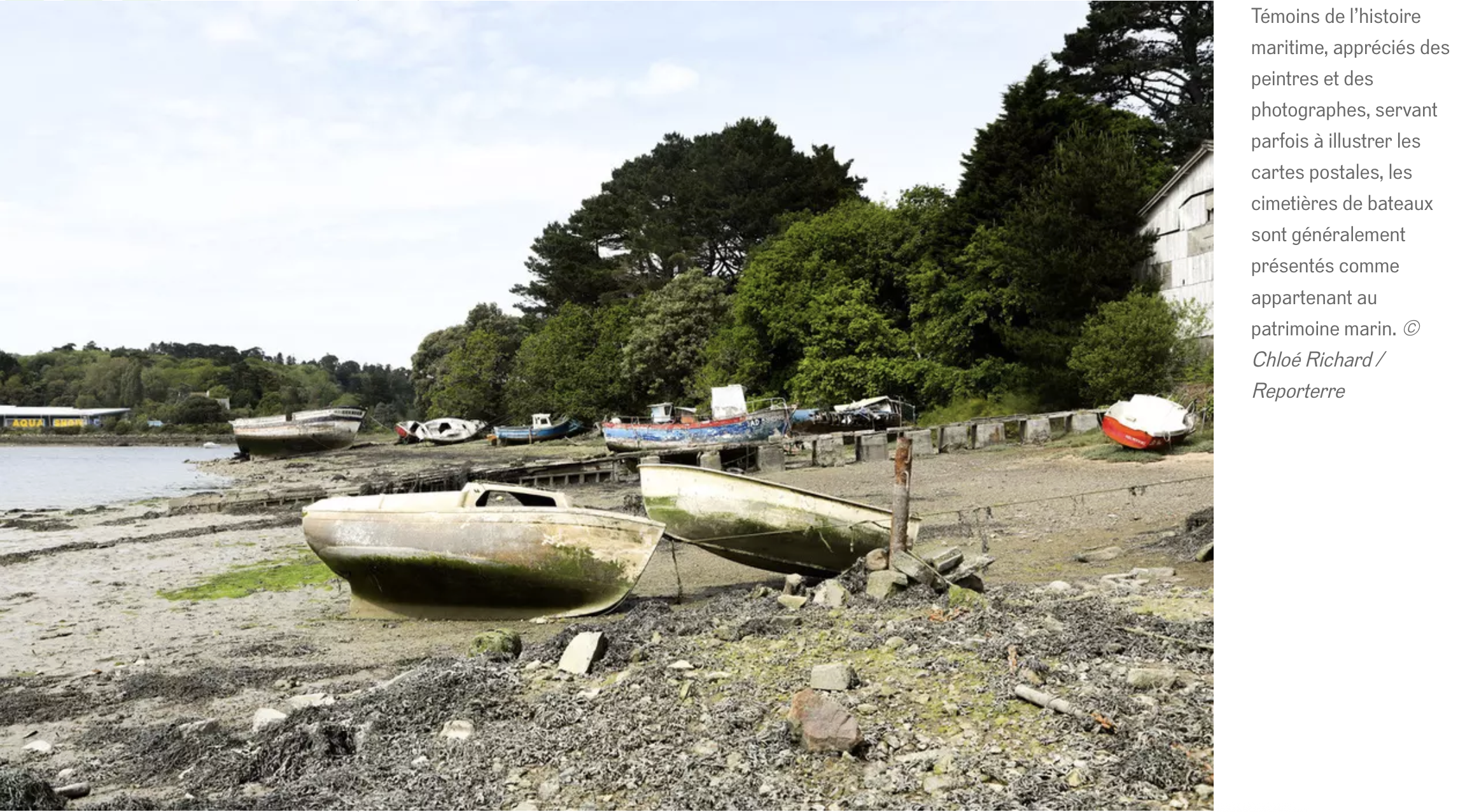
Witnesses to maritime history, prized by painters and photographers, sometimes featured on postcards, boat graveyards are generally presented as belonging to maritime heritage. © Chloé Richard / Reporterre
Across dozens of meters, among seaweed and shells waiting for the next tide, hundreds of small pieces of debris carpet the foreshore. Often these are flakes of peeling paint that come off the boats over time, carried by wind and tide. Or fragments of fiberglass hulls. Or other kinds of waste too, like this plastic window pane stuck in the mud.
Through her association Floating Stories Lab, based in Plouhinec, Angie Richard wants to raise the alarm about the environmental cost of boat graveyards: “All of this isn’t heritage. It’s waste, and it’s pollution,” laments the Australian-born filmmaker, who also makes environmental documentaries, as she wades through the mud of the Goyen in her boots. It was after moving to Brittany two years ago, and “discovering all these abandoned boats everywhere in the region,” that Angie became interested in the subject.
Microparticles of resin and fiberglass
Witnesses to maritime history, prized by painters and photographers, sometimes featured on postcards, boat graveyards are generally presented as belonging to maritime heritage. Many local authorities list these as tourist attractions on their websites. According to Lorient Bretagne Tourisme, the Kerhervy boat graveyard (Morbihan), for instance, is a place “where tuna boats, sardine boats, and simple dinghies peacefully end their lives of good and loyal service. One might fear it looks like a dump, but not at all: this is poetry.”
The town of Landévennec (Finistère) describes its boat graveyard as a place “that never fails to surprise visitors who “enjoy gazing with a certain nostalgia at these old rusted hulls, whether prestigious vessels or modest barges.” The Brittany regional authority promotes existing 3D tours for the boats that are hardest to reach.
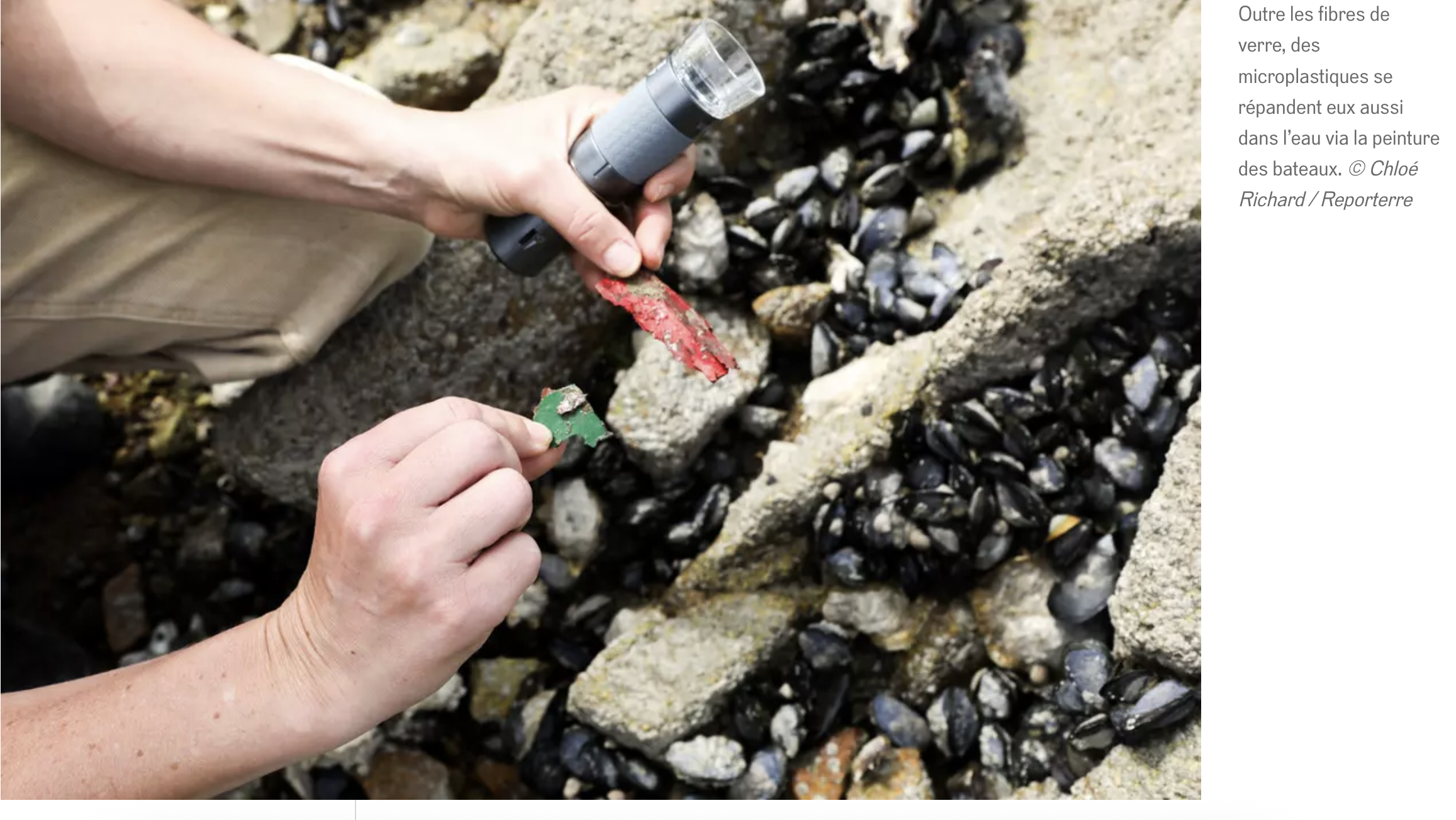
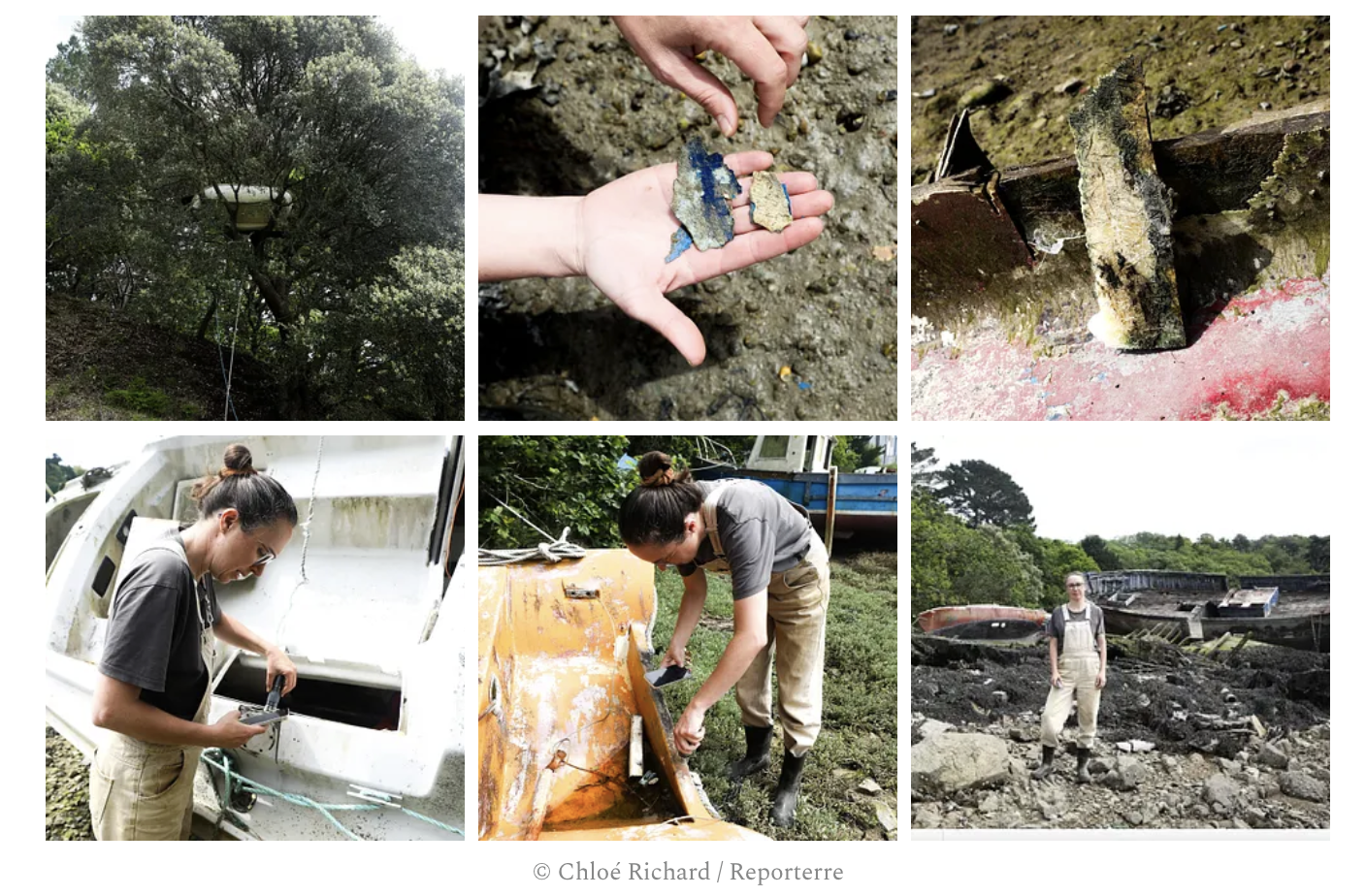
Besides fiberglass, microplastics also spread into the water via the boats’ paint. © Chloé Richard / Reporterre
These flattering, almost romantic descriptions mask a very different story. In her hand, Angie Richard holds a small portable microscope connected to her smartphone. “You can really see how tiny these particles are. There are also a lot of shards. All of this ends up in the water afterward,” she says, as she presses the scientific instrument’s lens against the damaged hull of a fiberglass boat.
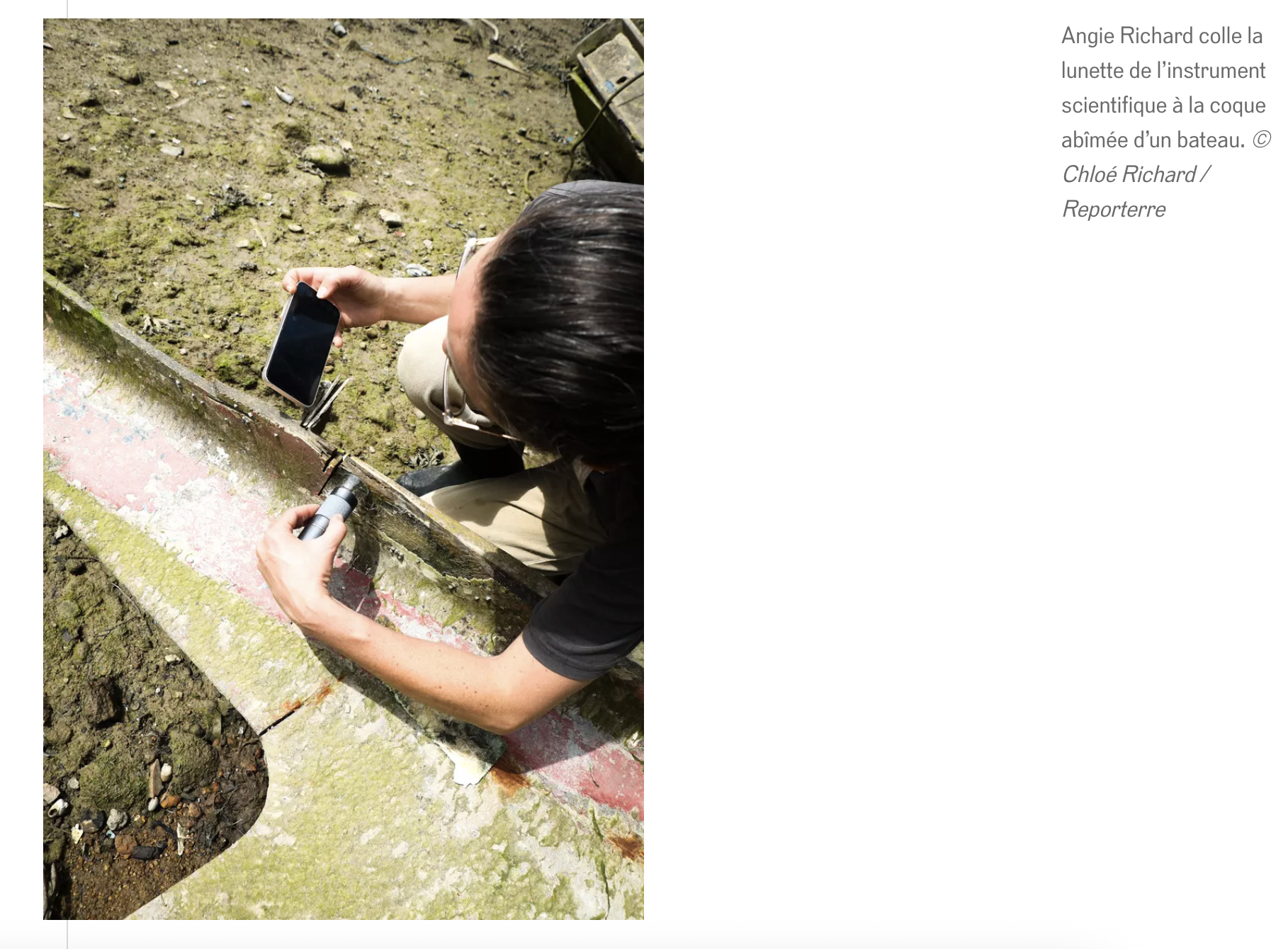
Angie Richard presses the scientific instrument’s lens against the damaged hull of a boat. © Chloé Richard / Reporterre
“These boats release microparticles of resin and fiberglass into the environment,” explains Corina Ciocan, an ecotoxicologist at the University of Brighton. The scientist has conducted research using oysters and mussels collected from Chichester harbour in England. “We found large quantities of fiberglass. For one kilogram of oysters, we could find 1,000 particles of this composite material. And even in cases with a low concentration of fiberglass, the animals are affected.”
“The animals are affected”
The bivalves were collected in front of a boatyard, which releases a lot of dust into the water. “In an experiment, we found that zooplankton, or sea fleas, died in under an hour when exposed to fiberglass,” the researcher notes.
For her, fiberglass closely resembles asbestos. Corina Ciocan would like to see this composite material also recognized as hazardous. “When inhaled, it carries the same risks as asbestos: studies have shown that workers in fiberglass manufacturing plants are more prone to developing emphysema or lung cancer.”
Oysters and mussels from the Goyen also contaminated
In late April, as part of workshops organized by Floating Stories Lab with Breton middle-school students, the ecotoxicologist visited Finistère. In the Goyen estuary, mussels and oysters were collected. “Using the microscope, we were able to see that these animals’ gills all contained plastic and fiberglass residue,” says Corina Ciocan.
The researcher’s visit was made possible by the citizen science project ReTiss (Regenerative Tides: Sailing for Solutions), led by Floating Stories Lab and funded by the European Union. It is by building bridges between citizens and scientists, notably through citizen science, that Angie and her association hope to shift the conversation around the pollution caused by boat graveyards.
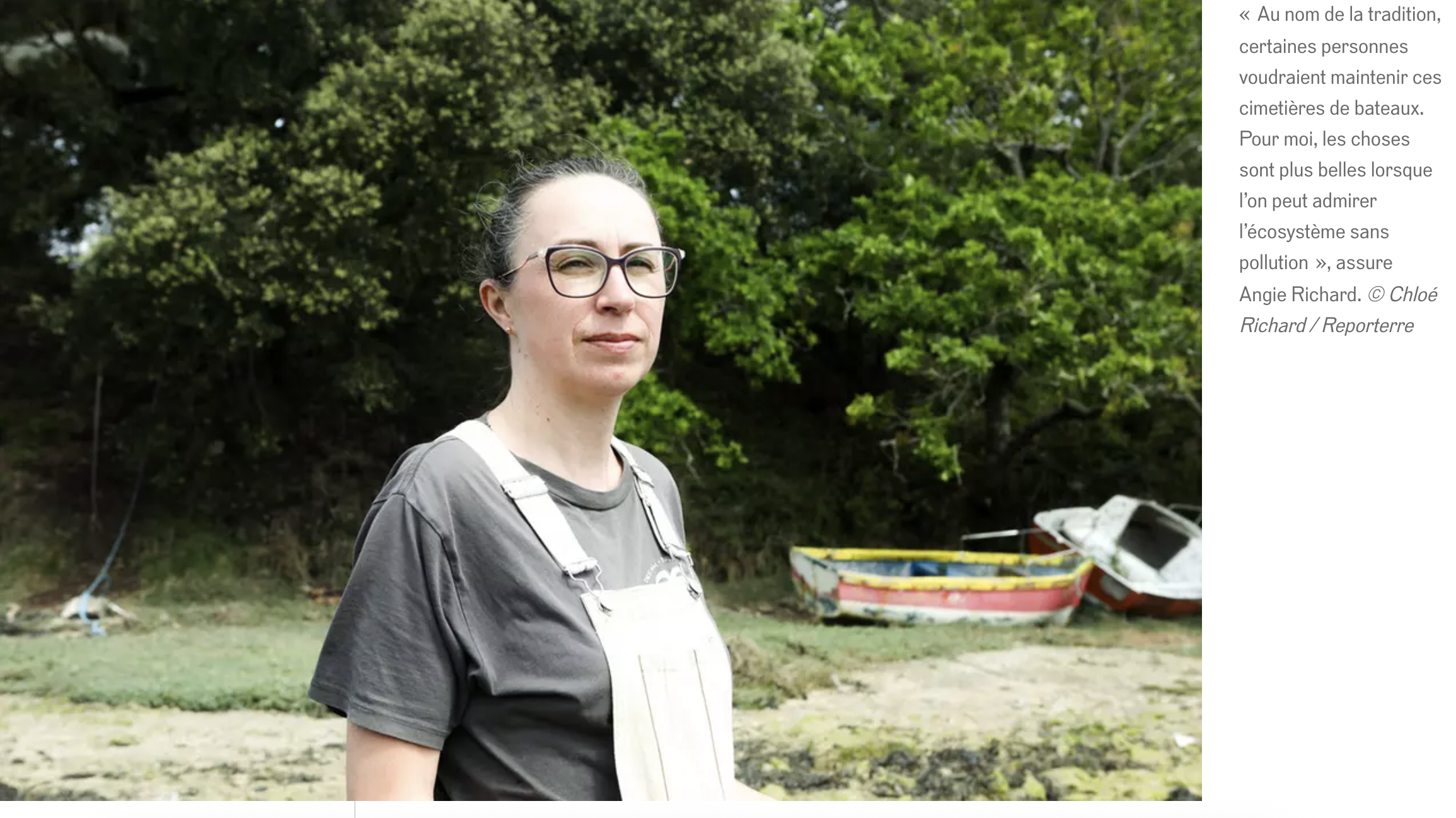
“In the name of tradition, some people want to keep these boat graveyards. To me, things are more beautiful when you can admire the ecosystem without pollution,” says Angie Richard. © Chloé Richard / Reporterre
In her lab in Brighton, Corina Ciocan also carried out another, complementary study: “After exposing bivalves to this powder [fiberglass] for a week, we found that their digestive systems were saturated with resin. The animals could no longer feed.”
Angie and her association are mapping boat graveyards on a tool called Bad Boat Mapping. “Collecting data as citizens or as an association isn’t mandatory in itself. But it’s a way for us to contribute to research using our own means,” explains Angie, as she photographs fragments of debris scattered across the mud.
A possible path to recycling
In the Goyen estuary, as elsewhere, abandoned boats come from all backgrounds: some were fishing boats, others commercial vessels, others belonged to private individuals, or to the State. Some are very old, others less so. “When the registration number is still legible, we can sometimes track down the owners. Or we discover that they’ve died and their children don’t know what to do with these wrecks,” says Angie, spotting, for the first time, a small boat... perched at the top of a tree. “Every time I come back here, I discover new ones. It’s a bit depressing,” she adds.
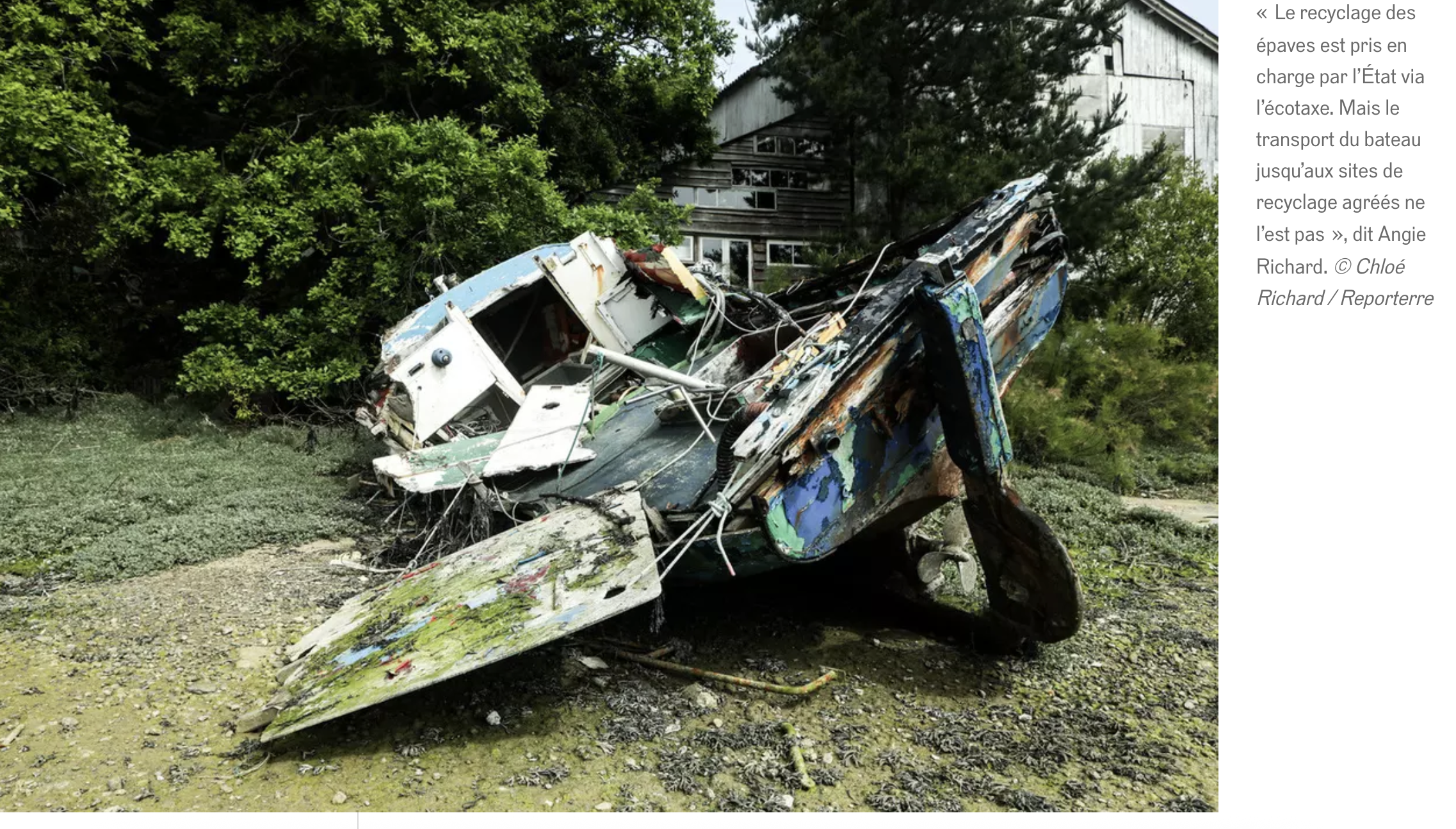
“Recycling of wrecks is covered by the State through the eco-tax. But transporting the boat to approved recycling sites is not,” says Angie Richard. © Chloé Richard / Reporterre
Solutions do exist, however, for recycling boats at the end of their life. In France, the Association pour une plaisance écoresponsable (Aper) is the organization approved by the Ministry of Ecological Transition to manage the deconstruction and recycling of recreational boats, as well as those belonging to professionals, local authorities, or associations. “This recycling is covered by the State through the eco-tax. But transporting the boat to approved recycling sites is not,” says Angie Richard. In her view, this cost should also be covered by the tax, which applies to products or services that harm the environment.

By building bridges between citizens and scientists, Angie Richard and her association hope to shift the conversation around the pollution caused by boat graveyards.
With her association, Angie is co-building a wooden (double) canoe, “as eco-responsible as possible, because we’re already trying to think about its end of life and the ecological footprint it will or won’t have. That’s something manufacturers should be doing too.” Once in the water, the boat will be used for research and shared, to make the sea as accessible as possible. While the boat takes shape, one thing is certain for Angie: “In the name of tradition, some people want to keep these boat graveyards. To me, things are more beautiful when you can admire the ecosystem without pollution.”
