
What should happen when the Floating Stories Lab’s sea days are done?
“I loved my Justine. When I first saw her I was smitten; she was everything that I’d always wanted. For years she served her purpose well and we had many enjoyable outings together. But then I fancied something bigger, faster, sleeker—so she had to go. Sold her to a friend who subsequently passed her on to someone else. Last year, she turned up on Saltash ‘beach’, abandoned and broken, a tragic sight. Scavengers had already hacked off her useful bits. And she’s not alone; there are so many neglected and/or abandoned boats in the area.”

Derek Pilgrim wrote of finding his beloved Justine wrecked on the beach back in 2021. We have since learned that the EU is grappling with the issue of abandoned boats. We also know that they leach a cocktail of substances—fiberglass, resin, paints—that have a negative impact on marine life like oysters and mussels, filter feeders absolutely critical to maintaining the health of our aquatic places and providing protein for human communities around the world.
During our first Wooden Boatopia Council meeting, Kiana Weltzien expressed her concerns about the idea of selling her boat, Mara Noka, now 50-years-old, stating that end-of-life is something she’s thinking about because the idea of a boat with so much ‘story’ ending up dumped on a beach would be a devastating end.
When thinking about what materials to use on the Floating Stories Lab’s Narai Mk IV Polynesian-inspired wooden catamaran, it would be irresponsible, I think, to not be thinking about its end of life. Fiberglass is often touted as a wonder material, but nothing is forever, despite what the salesman will tell you.
With the conundrum of all this whizzing around our heads, I then learned of Jack Manning Bancroft and the ‘intentional death date’ set for the organisation he founded, AIME Mentoring. A light bulb went off: we need a ‘death plan’ for the Floating Stories Lab.
I’m not someone who feels super at ease with death. I’ve lost people I love, and as a mum, I’m deeply preoccupied with keeping my kids alive. But death is a part of life. The idea of ignoring it just doesn’t sit right when we’re building something that’s meant to be regenerative and honest.
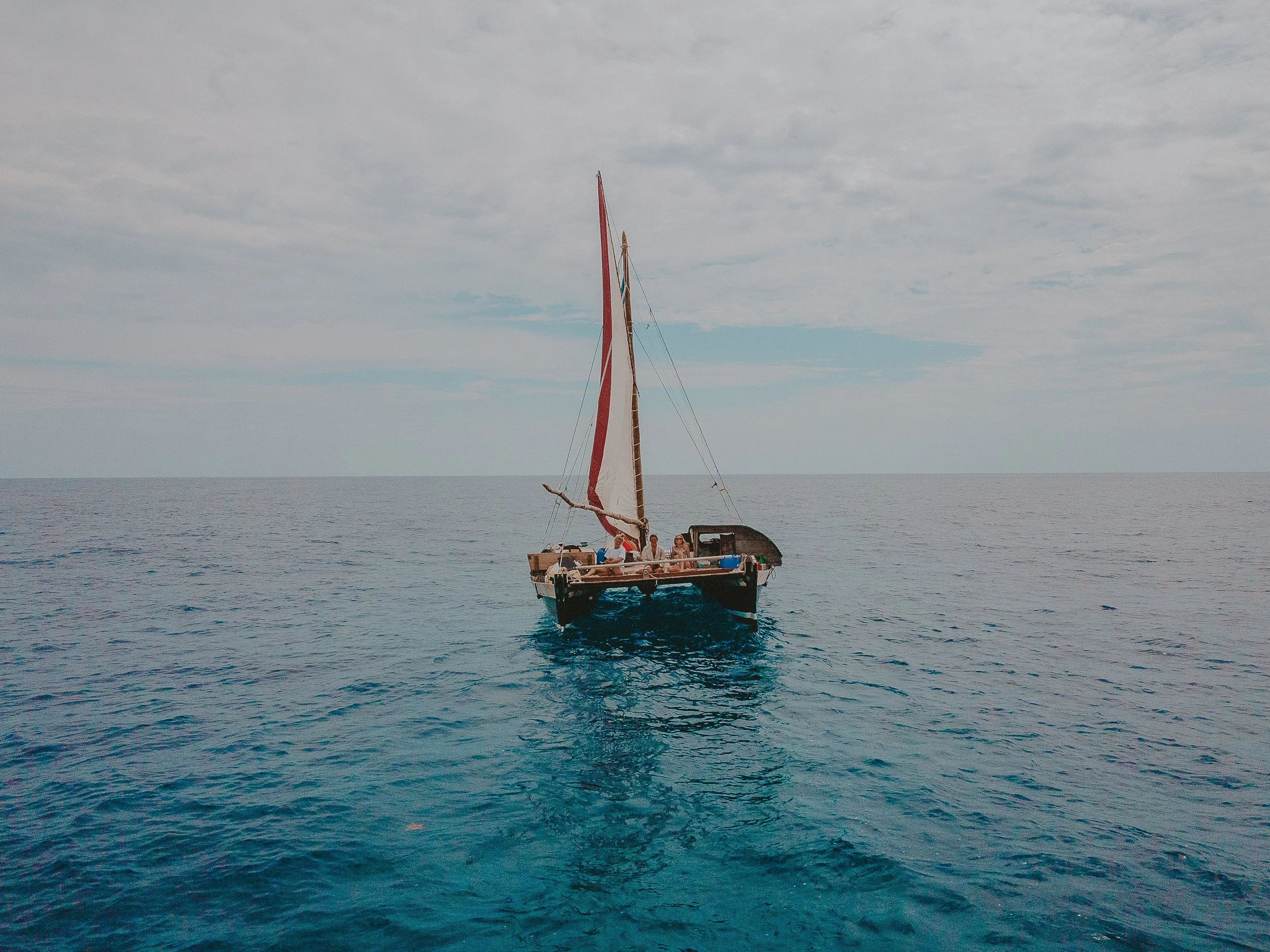
Kiana’s Mara Noka is over 50 years old. Rebuilt ahead of the Women & the Wind voyage and documentary filming, this is a boat filled with story, countless nautical miles, and community care. Photo: Women & the Wind/Alizé Jireh.
One that’s not just about what happens to a boat when her sea legs are done, but what happens to the community around her, the stories she holds, and the non-profit association that stewards her.
We’ve now officially registered the Floating Stories Lab as a non-profit. That gives us a shared container to imagine not only the boat’s life and death but the longer arc of this living project. And that’s where you come in; this is an open invitation. A work in progress.
We’re designing with death in mind, not as an endpoint, but as a part of the story. A natural phase. The anticipated lifespan for the boat is around 50 years, based on what’s typical for well-maintained Wharram designs using ply/epoxy and some form of external sheathing. Is 50 years too long? Maybe. That’s something we want to discuss together. Maybe it’s more helpful to think in decades—what might be needed in 10, 20, 30 years? How do we evolve with that?
The death plan as it stands is also about more than the boat. It’s about the whole project ecosystem: the floating studio/lab, the non-profit, and everyone involved over time. So while we start with the vessel, we acknowledge that the association itself will need its own version of a death plan that can hold space for transformation, pause, reinvention, or closure.

Hanneke Boon and James Wharram’s Pahi 63 Spirit of Gaia is a test case to see the durability of wood epoxy and of various design elements used in her. Twenty years since her launching (1992), she had sailed hard during the first 6 years, including a round the world voyage, spent the next 9 years sailing during the summer in the Ionian Sea and Adriatic and the last 5 years quietly resting in Trizonia. In these 20 years she had overhauls in 1996 in New Zealand, a major one in 1997 in Australia, in 1999 in Corfu after completing her circumnavigation, another major one in 2002. Follow the blogs of her next major overhaul HERE. Spirit of Gaia is now 32 years old and still sailing. Photo: Wharram Designs.
Creating an Intentional Legacy
The aim isn’t to last forever, it’s to matter while we’re here. That means nurturing what the boat enables—adventures, knowledge exchange, community, relational networks, creativity, imagination, and care. Knowing we’ve only got so much time helps us focus.
Designing for Regeneration
The boat should not become waste. When she’s no longer seaworthy, we want her to become something else. An on-land community sanctuary. A shared creative studio. A forest playground.
Building with Purposeful Materials
We’re choosing materials that best align with this vision, whilst acknowledging realistic financial parameters. Locally produced, durable, and ultimately decomposable or repurposable. We will be using French-grown and harvested plywood, epoxy, and timber with minimal external sheathing—so we can honor both endurance and the boat’s eventual decay.
Committing to Continuous Care
Long life isn’t passive—it needs attention. We’re committing to care for the boat as a living being, with maintenance, upgrades, and love across her decades of service.
Embracing Natural Cycles: Life, death, and renewal are part of everything. We want to embody that. When the boat’s done sailing, can her transformation be part of a larger cycle? Maybe she becomes part of a Living Land Lab. Maybe she composts into something new. Maybe the people she brought together carry on the next story.
Legacy over longevity. Regeneration over accumulation. Sharing over hoarding. Cycles over straight lines. And above all, co-creation.
This is not just our boat, our project, or our association. It’s something being built in community, with shared hopes and hands. The more we dream this together, the more meaningful—and grounded—it becomes.
What should happen when the Floating Stories Lab’s sea days are done? What role should the non-profit play in holding or letting go? Do you think every project like this should have a death plan? How would you want to participate in its final phase?
Drop us a comment. We want to imagine the life of this boat together, along with her afterlife, too.
-Angie
